Some comedy scenes are funny because of an outrageous situation. Others are funny because a character says something completely unexpected. And then there are Abbott and Costello routines, where a single innocent phrase can somehow turn into a ten-minute linguistic disaster.
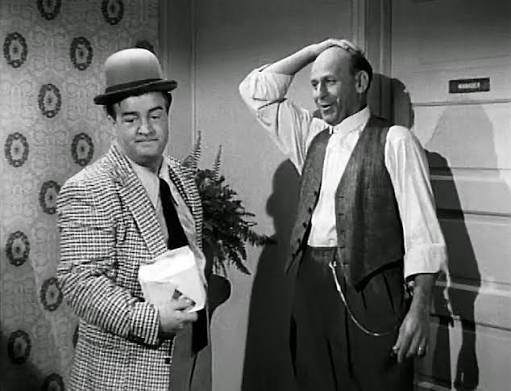
That is exactly what happens when Bud Abbott and Lou Costello receive astonishing news: Lou’s Uncle Tom has apparently struck gold in Alaska. Suddenly, their ordinary lives are transformed by the possibility of fortune. Alaska is calling, gold is waiting, and the two men need money to make the journey north.
Naturally, there is only one person they can turn to for financial help: their notoriously irritable landlord, Sid Fields.

Fields agrees to finance their adventure—but there is a catch. He wants Lou to bring back some “gold ore.”
Simple enough, right?
Not when Lou Costello is involved.
The moment Fields says “gold ore,” Lou becomes suspicious. He doesn’t understand the word “ore” as a mining term. Instead, he hears it as the word “or.”
And suddenly, a perfectly normal request becomes a philosophical crisis.
Lou essentially interprets “gold ore” as “gold or something,” because why would anyone need a strange word like “ore” when perfectly good words already exist?
His confusion leads to the wonderfully absurd logic: “It’s got to be gold or something! It can’t be gold or nothing!”
This is classic Costello comedy. The joke isn’t simply that Lou doesn’t know what “ore” means. It is that he is completely convinced that he does understand it.
That distinction is what makes the scene so hilarious.
Abbott tries to explain the mining process, but instead of bringing clarity, every explanation gives Lou another opportunity to misunderstand the English language.
Fields explains that miners “smelt” gold ore.
Unfortunately, Lou hears “smelt” and immediately connects it to “smelled.”
Now the gold isn’t merely difficult to find—it apparently has an unpleasant odor.
Lou’s reaction is priceless. If the process involves something that has been “smelled,” then surely the gold must stink. And if it stinks, why would anybody want to dig it up?
Once again, Abbott and Fields are trying to discuss mining while Costello is operating in an entirely different universe.

The routine keeps escalating because every technical term becomes an invitation for another misunderstanding.
Eventually, Abbott tries a different approach. He explains that gold can be found in deep underground “veins” and that these deposits can lead to the famous “mother lode.”
For most people, these are perfectly ordinary geological terms.
For Lou Costello?
Absolutely horrifying.
Lou doesn’t process the terminology scientifically. He processes it literally.
“Veins.”
“Mother lode.”
“Strike.”
Put those words together in Costello’s imagination, and suddenly gold mining sounds less like geology and more like a disturbing family incident.
His confusion reaches its ridiculous peak when he imagines having to go underground and “strike my mother in the vein while she’s carrying a load.”
At this point, the original conversation about finding gold has completely disappeared.
Nobody is talking about Alaska anymore.
Nobody is talking about financial investment.
Nobody is even really talking about mining.
Instead, three grown men are trapped inside a linguistic minefield created entirely by Lou’s inability—or unwillingness—to understand ordinary expressions in their intended context.
And that is precisely why Abbott and Costello were so effective.
Their comedy often depended on the tension between Abbott’s attempt to maintain order and Costello’s relentless destruction of logic. Abbott represents the straight man desperately trying to explain reality. Costello represents someone who hears the explanation, takes every word in the most ridiculous possible way, and then builds an entirely new reality around it.
The brilliance is that Lou isn’t simply “stupid.” He is aggressively literal.
Every clarification creates another problem.
Tell him about “ore,” and he hears “or.”
Explain “smelt,” and he thinks about smells.
Mention “veins,” and he imagines something completely different.
Then introduce “mother lode,” and suddenly the conversation becomes a family nightmare.
The scene demonstrates one of the great strengths of verbal comedy: language itself becomes the punchline.
There is no elaborate special effect required. No expensive set. No complicated stunt. The entire routine is powered by pronunciation, vocabulary, timing, repetition, and Costello’s extraordinary ability to look genuinely offended by his own misunderstandings.
What makes the exchange even more enjoyable today is that the basic misunderstanding remains easy to follow. You don’t need to know anything about gold mining to appreciate the joke. In fact, knowing less about mining might make Lou’s interpretation even funnier.
The audience understands what “gold ore” means.
Abbott understands what “gold ore” means.
Fields understands what “gold ore” means.
Everyone understands it—except Lou.

And Lou is absolutely determined to make sure everyone else understands it incorrectly too.
That is the magic of Abbott and Costello’s comedy. They could take an ordinary phrase, twist its meaning, stretch the misunderstanding, and keep escalating until the original subject was almost forgotten.
What began as a plan to travel to Alaska in search of a fortune ends up becoming a ridiculous lesson in English vocabulary.
Gold may be buried underground, but in this scene, the real treasure is the comedy hidden inside a few simple words.
And somehow, Lou Costello manages to turn “gold ore” into “gold or,” “smelt” into “smelled,” and “mother lode” into a completely outrageous family misunderstanding.
Only Abbott and Costello could turn a gold rush into a linguistic disaster this spectacular.