Some comedy scenes need pages of dialogue.
Others need elaborate setups, complicated characters and carefully constructed punchlines.
John Belushi needed a guitar.
And one word.
“Sorry.”
The famous guitar-smashing moment from National Lampoon’s Animal House remains a perfect example of why Belushi became such an unforgettable screen presence.
The scene lasts only a few moments.
Yet more than four decades after the film’s 1978 release, it’s still instantly recognizable.
Everything Starts Peacefully
The setup couldn’t be more innocent.
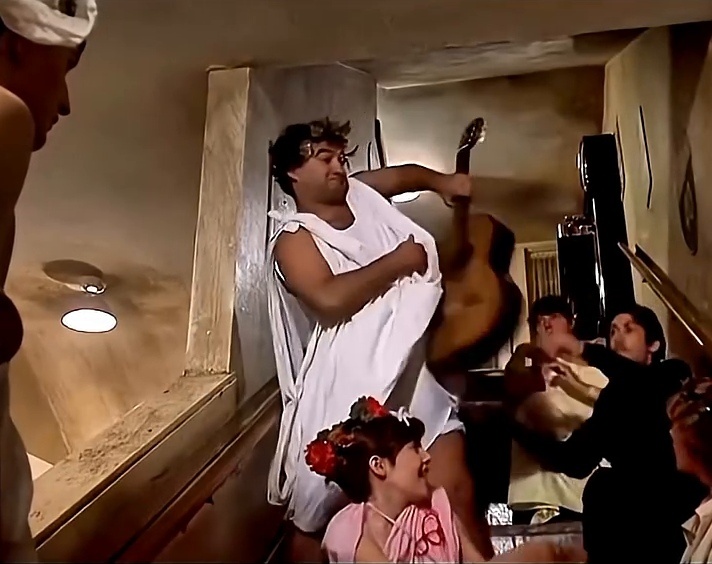
A young man sits on the stairs playing an acoustic guitar.
He’s surrounded by women.
The mood is quiet and romantic.
Then Bluto appears.
John Belushi’s character doesn’t immediately do anything.
That’s important.
He stops.
He listens.
For a moment, it almost looks as though Bluto is genuinely moved by the music.
And because the audience already understands what kind of person Bluto is, that pause creates anticipation.
Something doesn’t feel right.
Then it happens.
Goodbye, Guitar
Without warning, Bluto takes the instrument.
He lifts it.
And smashes it against the wall.
The romantic atmosphere disappears instantly.
But Belushi isn’t finished.
He looks back at the stunned guitarist.
Then comes the perfect finishing touch:
“Sorry.”
IMDb’s record of the film’s dialogue preserves the gag exactly this way: the guitarist is singing, Bluto grabs and destroys the instrument, then apologizes.
It’s almost impossible to improve the joke by adding anything else.
Why Is It So Funny?
The comedy comes from contrast.
The guitarist is gentle.
Bluto is destructive.
The song is sentimental.
Bluto’s response is absurdly violent.
And after doing something completely unreasonable, he behaves as though he accidentally bumped into someone in a hallway.
Sorry.
That’s the punchline.
Had Bluto shouted afterward, the scene wouldn’t have been nearly as funny.
Had he explained why he hated the song, it would have slowed everything down.
Belushi does the opposite.
He destroys the guitar and immediately returns to emotional neutrality.
That contrast makes the moment.
Belushi Didn’t Need Much Dialogue
One of John Belushi’s great comedic strengths was physicality.
His face could communicate an entire joke before he said anything.
His body language could turn a basic movement into comedy.
Animal House understood this.
Some of Bluto’s most memorable scenes depend less on clever dialogue than on simply letting Belushi behave like Bluto.
The cafeteria sequence is another famous example.
IMDb’s production trivia says Belushi’s behavior while piling food onto his tray was improvised, including the notorious “zit” gag, with director John Landis instructing the camera operator to keep following him.
That tells us something important about Belushi’s screen presence.
Sometimes the smartest filmmaking decision was simply:
Keep the camera on John.
Bluto Became an Icon
Belushi plays John “Bluto” Blutarsky, one of the members of the chaotic Delta Tau Chi fraternity.
Bluto isn’t exactly a model student.
He’s impulsive.
Destructive.
Unpredictable.
And completely committed to whatever ridiculous idea enters his mind.
That unpredictability is essential.
When Bluto enters a scene, audiences understand that normal social rules may stop functioning.
A romantic guitar performance?
Not anymore.
A cafeteria lunch?
Potential food fight.
A motivational speech?
It might include a wildly inaccurate reference to Pearl Harbor.
Bluto exists to destabilize whatever situation he’s placed inside.
Animal House Changed Belushi’s Career
Belushi was already famous from television.
He had been part of the original Saturday Night Live cast and had established himself as one of the show’s most explosive performers.
But Animal House pushed him into movies.
Mental Floss describes the film as Belushi’s big-screen debut and notes the exhausting schedule he maintained between shooting the movie and returning to New York for SNL.
The film itself became an enormous success.
Mental Floss reports that the relatively inexpensive comedy eventually earned about $141 million domestically, a remarkable result for the era.
And Bluto became one of the defining characters associated with Belushi.
The Power of the Pause
Watch the guitar scene again and pay attention to what happens before Belushi destroys anything.
He listens.
That’s where much of the joke is created.
If Bluto immediately entered and smashed the guitar, it would merely be random destruction.
Instead, the pause gives us time to wonder:
Does he like the song?
Is he going to join in?
Is he actually having a tender moment?
Nope.
The guitar is doomed.
Great comedy often depends on withholding the punchline for exactly the right amount of time.
Belushi’s pause does that perfectly.
The Guitarist’s Reaction Matters Too
Comedy needs a straight man.
The guitarist provides one.
He isn’t behaving absurdly.
From his perspective, he’s having a pleasant moment when a stranger suddenly destroys his instrument.
His stunned reaction makes Bluto look even more ridiculous.
And Bluto’s tiny apology afterward becomes funnier because no reasonable person could believe “Sorry” is an adequate response.
That’s the entire comedic relationship compressed into seconds.
One person behaves normally.
Bluto does not.
Animal House Was Built for Chaos
This scene also captures the larger personality of Animal House.
The movie is about disorder crashing into institutions and social expectations.
Delta House represents chaos.
The authorities want control.
Bluto might be the purest embodiment of the Delta philosophy.
He doesn’t merely break rules.
Sometimes he seems unaware that rules exist.
That’s why John Belushi was such effective casting.
His physical comedy could make Bluto feel almost like a force of nature.
A Joke That Works Without Context
One reason this clip remains excellent short-form content today is that you don’t need to know anything about the rest of the movie.
You don’t need to understand Delta House.
You don’t need to know Dean Wormer.
You don’t even need to know Bluto’s name.
You see:
A guy playing guitar.
Another guy listening.
The second guy destroys the guitar.
“Sorry.”
Setup.
Surprise.
Punchline.
Done.
That’s exceptionally efficient comedy.
From 1978 to Social Media
The interesting thing about scenes like this is how naturally they fit modern short-video platforms.
The original filmmakers weren’t thinking about Facebook Reels or viral clips.
But the construction is almost perfect for them.
The viewer understands what’s happening immediately.
There’s anticipation within seconds.
Then comes a visual payoff.
And the clip ends with a memorable reaction.
It demonstrates something worth remembering about classic comedy:
Good timing doesn’t expire.
Technology changes.
Editing styles change.
Audiences change.
But a perfectly constructed joke can survive all of it.
One Word Was Enough
John Belushi didn’t need to explain Bluto.
The character’s behavior told us everything.
That’s why the guitar scene has survived as one of the movie’s memorable little moments.
The setup is simple.
The destruction is sudden.
And the apology is absurd.
A lesser performer might have tried to add another joke.
Belushi knew when the joke was already finished.
He destroys the guitar.
Hands back what’s left.
And says:
“Sorry.”
Sometimes one word really is enough. 😂🎸💥