Before Laurel and Hardy became one of the most recognizable comedy teams in film history, their greatest weapon was largely visual. A raised eyebrow, a confused expression, a perfectly timed pause, or a disastrous attempt at solving an ordinary problem could generate enormous laughs without the need for dialogue. That changed dramatically in 1929 with Unaccustomed As We Are, a landmark short that introduced audiences to the voices of Stan Laurel and Oliver Hardy.
Released on May 4, 1929, Unaccustomed As We Are was produced by Hal Roach and directed by Lewis R. Foster. It was a two-reel comedy and is widely recognized as Laurel and Hardy’s first all-talking film. The cast also includes Mae Busch as Mrs. Hardy, Thelma Todd as Mrs. Kennedy, and Edgar Kennedy as Officer Kennedy.
The title itself contains a clever joke. It plays on the familiar phrase “unaccustomed as I am to public speaking,” reflecting the fact that Laurel and Hardy were entering the new world of talking pictures. Although several earlier Laurel and Hardy shorts had already used synchronized music and sound effects, Unaccustomed As We Are was the first in which audiences could actually hear the comedy partners speak.
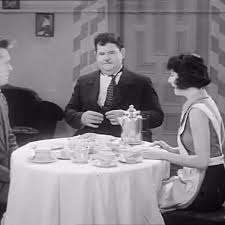
The story begins with Oliver Hardy bringing his friend Stan Laurel home for dinner. Ollie expects a pleasant evening and imagines that his wife will prepare a wonderful meal. Unfortunately, Mrs. Hardy is far less enthusiastic about the surprise guest. Her frustration quickly turns the supposedly peaceful dinner into a familiar Laurel and Hardy disaster.
When Mrs. Hardy storms away, Stan and Ollie are left to prepare the meal themselves. This simple situation becomes the perfect playground for their comedy. Neither man is particularly capable in the kitchen, and their attempts to solve one problem only create another. Their physical comedy remains central, but now their voices, dialogue, and sound effects add an entirely new dimension.
The arrival of Mrs. Kennedy, played by Thelma Todd, makes the situation even more complicated. She offers to help the two men with their dinner, but their clumsy behavior results in her dress catching fire. The boys then find themselves desperately trying to hide the increasingly embarrassing situation before her husband, Officer Kennedy, discovers what has happened.
What follows is classic Laurel and Hardy escalation. A relatively ordinary domestic problem becomes a completely chaotic situation involving misunderstandings, frantic hiding, an angry husband, and plenty of physical punishment. The comedy works because Stan and Ollie never seem fully aware of how much trouble they are creating.
One of the most fascinating aspects of Unaccustomed As We Are is hearing their voices in this early stage of their careers. Oliver Hardy’s confident but increasingly exasperated delivery perfectly complements Stan Laurel’s nervous, high-pitched reactions. Their voices would eventually become as recognizable as their physical appearances.
The film also demonstrates how the arrival of sound changed filmmaking. Early talking pictures presented technical challenges, and Unaccustomed As We Are was produced during a period when studios were still learning how to work with synchronized dialogue. Four cameramen reportedly alternated during production, reflecting the technical difficulties of early sound recording.
Interestingly, the film was also released in a silent version with intertitles, allowing theaters that had not yet converted to sound to continue showing it. This illustrates how quickly the movie industry was changing in 1929, when silent and talking pictures existed side by side.
For fans watching the full-length version today, Unaccustomed As We Are offers much more than an old comedy short. It represents an important turning point in Laurel and Hardy’s career. The duo had already demonstrated that they could create memorable comedy through movement and facial expressions, but this film proved that their personalities translated beautifully to sound.
The short also contains elements that would become familiar throughout their later work. Stan’s distinctive whimpering reactions, Ollie’s exasperation, their inability to complete simple tasks, and their tendency to make every situation dramatically worse all contribute to the unique Laurel and Hardy formula. One recurring Ollie line and Stan’s characteristic vocal reactions also make their early appearance here particularly significant.
Decades later, Unaccustomed As We Are remains an entertaining snapshot of two comedians standing at the beginning of a major new chapter. It captures Laurel and Hardy during a fascinating moment when silent-film comedy was giving way to the talkies.
For modern viewers, the film is a chance to experience not only the humor but also the history behind it. The technology may feel primitive compared with today’s productions, but the fundamental comedy remains remarkably clear: two friends attempt to solve a simple problem, make everything worse, and somehow keep going.
That timeless formula is precisely why Laurel and Hardy continue to attract audiences generations later. Unaccustomed As We Are is not simply their first talking comedy—it is a glimpse of the moment when two already gifted screen comedians discovered that their voices could be just as funny as their faces and physical performances.