Hollywood’s Golden Era of Bullfighting and Bedlam
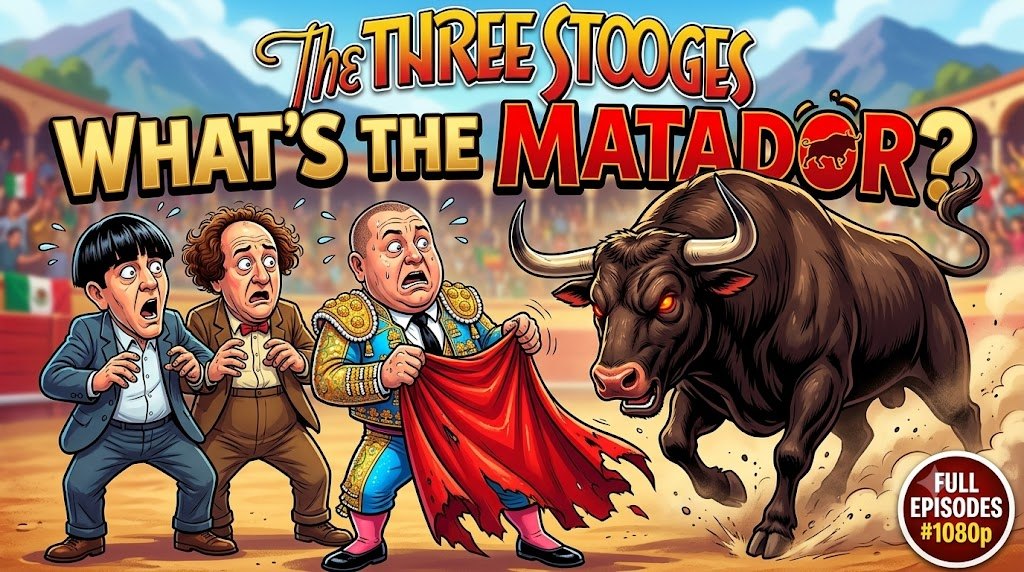
When Columbia Pictures released What’s the Matador? on April 23, 1942, the world was steeped in global turmoil. Audiences packing movie theaters were desperately searching for unrestrained escapism, and no trio delivered physical euphoria quite like Moe Howard, Larry Fine, and Curly Howard. Directed by slapstick veteran Jules White, this 17-minute whirlwind stands out as the 62nd short subject in the Stooges’ iconic catalog. Beyond its rapid-fire gags and vibrant south-of-the-border setting, What’s the Matador? serves as a quintessential masterclass in high-energy comic pacing, mistaken identities, and Curly Howard’s unmatched kinetic genius.
Anatomy of an Accidental Rivalry
The premise wastes no time thrusting our trio of out-of-work vaudevillians into genuine peril. Arriving in Mexico hoping to secure theatrical bookings with their comedic novelty acts, Moe, Larry, and Curly instantly run afoul of traditional theatrical etiquette—and romantic jealousy.
- The Fateful Encounter: At the border train station, the boys encounter Dolores (played with glamorous sharpness by Suzanne Kaaren), an American tourist who inadvertently enlists their bumbling chivalry to help with her excessive luggage.
- The Green-Eyed Monster: Enter Sanchez (portrayed with booming theatrical fury by Harry Semels), Dolores’s wildly jealous husband and a celebrated, hot-tempered matador. Misinterpreting their antics as shameless flirtation, Sanchez vows swift and bloody vengeance against the hapless Americans.
- The Extortion: Rather than resorting to a back-alley duel, Sanchez uses his political clout and intimidation tactics to sabotage their stage gig. He orchestrates a setup where the Stooges are booked not into a quiet playhouse, but directly into the city’s bullfighting arena.
The Kinetic Genius of Curly Howard
The emotional and comedic centerpiece of the film belongs entirely to Curly Howard. Dressed in an oversized, ridiculously embroidered suit of lights (traje de luces), Curly embodies the very antithesis of masculine bravado. Where legendary bullfighters exhibit stoic grace, Curly offers trembling knees, high-pitched squeals, and rubber-limbed evasion tactics.
- Slapstick Geometry: Jules White’s direction emphasizes sharp, rhythmic physical violence. When Curly enters the bullring, his interaction with the cape is not a dance of death, but an athletic ballet of errors. He spins wildly, trips over his own ornate tassels, and uses the red cloth like a laundry towel rather than a decoy.
- Sound Design and Foley Brilliance: The short showcases vintage Columbia sound effects at their peak. Every hoof-strike, frantic hoofbeat, and ricocheting horn impact is synchronized with high-pitched whistles, brass horns, and hollow wooden clats.
- The Climactic Bout: Driven by sheer panic rather than courage, Curly turns the confrontation into an absurd spectacle. Through accidental trips, misplaced props, and frantic duck-and-cover maneuvers, he wears down the charging beast. In one unforgettable sequence, Curly manages to subdue the bull through a series of chaotic missteps that leave the animal bewildered and the arena crowd roaring with pandemonium.
Underneath the Laughs: Moe, Larry, and the Machine of Comedy
While Curly takes center stage in the ring, the sequence works only because of Moe and Larry’s impeccable timing on the sidelines. Moe Howard anchors the stakes with his signature scowling authority, acting as both abusive stage manager and frantic cheerleader. His aggressive eye-pokes, chin-pulls, and double-slaps are executed with mathematical precision, maintaining a breakneck rhythm that never lets the audience catch their breath.
Larry Fine, ever the subtle glue of the team, excels in the transitional moments. His bemused expressions, erratic reactions to Moe’s fury, and quirky physical presence provide the necessary breathing room between the major set pieces.
Legacy and Influence in the Stooges Canon
What’s the Matador? holds a distinct place in comedy history for several reasons:
- The Wartime Good Neighbor Policy: The Mexican backdrop reflects Hollywood’s broader cultural pivot during early World War II, celebrating Latin American settings with vibrant musical flair and theatrical melodrama.
- The 1959 Remake: Seventeen years later, Columbia recognized the enduring power of this specific script and remade the short as Sappy Bull Fighters (1959), featuring Joe Besser alongside Moe and Larry. While that later effort marked the end of the original Columbia shorts run, it was the 1942 original featuring Curly in his prime that carved out legendary status.
- Pure Physical Poetry: More than eight decades later, the short remains a brilliant artifact of unpretentious physical cinema. It demands no prior knowledge, delivers continuous belly laughs, and proves that a great comedian, a red cape, and an angry bull are timeless ingredients for comedic perfection.