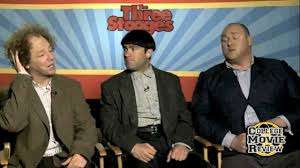
The interview may be short, but it captures nearly everything audiences love about The Three Stooges. There is rapid-fire wordplay, absurd logic, physical comedy and the familiar chemistry between three characters who seem incapable of remaining civilized for more than a few seconds.
It begins with what should be an easy promotional question.
The interviewer asks whether their new family comedy could be enjoyed equally by an eight-year-old and an 80-year-old.
For most actors, this would be an opportunity to talk warmly about making entertainment for multiple generations.
The Stooges have another idea.
They immediately find a ridiculous similarity between the two age groups before Moe tries to restore order.
“Shut up, you lamebrains!”
And just like that, the interview belongs to The Three Stooges.
Moe explains that the movie is for everybody. Parents should bring their children. Children should bring their parents.
So far, reasonable.
Then dogs should bring cats.
Cats should bring mice.
Mice should bring fleas.
And, naturally, someone should remember the cheese.
The joke demonstrates one of the simplest but most effective elements of Stooge comedy: escalation. A statement begins somewhere logical and then keeps expanding until it reaches complete nonsense.
That style of humor defined so many of their classic routines. The audience understands the pattern almost immediately, but the question becomes how far Larry, Moe and Curly will push it.
Usually, the answer is much farther than expected.
The interviewer then moves toward Hollywood life.
Now that the trio are appearing on the big screen, are they living the glamorous Hollywood lifestyle?
Moe turns the question around by asking whether the interviewer knows the Beverly Hills Hotel.
For a moment, it sounds as though the Stooges are about to reveal that they are staying at one of Hollywood’s famous luxury locations.
Instead, they admit they are sleeping in a van out in Burbank.
The glamorous image disappears instantly.
Even better, one of the others complains that Moe has revealed their secret because now people will start following them.
That contrast between celebrity and poverty is classic Stooge humor. They may be movie stars attending publicity events, but their characters remain the same lovable disasters audiences remember.
They are not suddenly sophisticated because somebody put them in Hollywood.
If anything, Hollywood simply gives them a bigger place to cause trouble.
The conversation becomes even funnier when the interviewer asks whether they did anything special to prepare for their roles.
Again, it sounds like a standard celebrity-interview question.
And again, the Stooges refuse to give a standard answer.
One explains that every morning he ate three pieces of burnt toast and a rotten egg.
Why?
Because he has a tapeworm—and apparently that is good enough for it.
The joke is pure Three Stooges: unpleasant, ridiculous and delivered as though the explanation makes perfect sense.
Then Moe reveals his own acting preparation.
Before each scene, he likes to prepare by slapping an “inanimate object.”
The interviewer naturally asks what the inanimate object is.
Moe’s answer is immediate:
“Both of you.”
https://youtu.be/PR1qd2f0Mjw?si=luygroXSYX9c0iC_
Larry and Curly barely have time to process the insult before the physical comedy takes over.
It is a perfect Moe Howard joke because it combines his role as leader with his eternal frustration toward the other two.
Moe sees himself as the responsible one.
Larry and Curly are the obstacles.
Whenever they become too foolish, Moe believes corrective action is required—usually delivered with his hands.
That dynamic is central to the trio’s comedy.
Without Larry and Curly irritating Moe, Moe’s explosive reactions would not be nearly as funny. Without Moe threatening them, Larry and Curly would lose the authority figure they constantly challenge.
Their personalities function together.
The interview then turns toward fame.
The Stooges have supposedly traveled from an orphanage run by nuns to movie premieres, press events and glamorous Hollywood parties. The interviewer wonders whether success has changed them.
This is another perfect setup.
One Stooge proudly admits that he has changed.
His underwear.
On the way to the interview.
Another announces that he has finally spent money on his first $5 haircut.
Instead of celebrating this supposed upgrade, the others immediately accuse him of throwing money away.
Again, the comedy comes from reducing a glamorous Hollywood question to something embarrassingly ordinary.
They are being asked whether fame has transformed their personalities.
Their answers concern underwear and cheap haircuts.
It is impossible to imagine a more appropriate Three Stooges response.
Yet underneath the nonsense comes something almost sentimental.
They insist that they never want to forget where they came from.
For a brief second, it sounds sincere.
Then comes the punchline:
If they forget where they came from, how will they find their way home?
Any possibility of seriousness disappears.
This is another reason the routine works so well. The Stooges constantly allow the audience to believe a normal answer might finally arrive.
Then they destroy it.
A heartfelt statement becomes a directional problem.
A Hollywood hotel becomes a van in Burbank.
Professional acting preparation becomes burnt toast, a rotten egg and slapping Larry and Curly.
A family-friendly movie becomes an invitation for mice and fleas.
Nothing remains serious for long.
Eventually, the interviewer attempts to wrap things up and thanks the trio for their time.
That should be the end.
But endings are dangerous when The Three Stooges are involved.
The familiar physical routine returns, and the interviewer gets a much closer experience of Stooge comedy than he probably expected.
The trio’s slapstick takes over once again.
What makes the sequence especially funny is the way the performers treat physical aggression almost like punctuation.
A sentence ends.
A slap follows.
Another person reacts.
Moe gets annoyed.
Someone else is struck.
The rhythm becomes instantly recognizable.
That rhythm was one of the great secrets behind The Three Stooges’ longevity.
Their physical comedy looked uncontrolled, but successful slapstick requires tremendous control. Timing determines everything. A performer has to move at precisely the correct instant. The reaction must be exaggerated enough to communicate the joke without completely destroying the illusion.
Larry, Moe and Curly made that timing look effortless.
This interview format also reveals how strong their characters were outside the usual story structures of their films.
There is no complicated plot here.
They are not plumbers destroying someone’s mansion.
They are not doctors accidentally terrorizing patients.
They are not construction workers creating catastrophe on a building site.
They are simply answering questions.
And that is enough.
Because the comedy was never entirely dependent on the situation.
The characters themselves generated the chaos.
Ask Curly a straightforward question and the answer can immediately become ridiculous.
Let Larry contribute and the misunderstanding grows.
Give Moe enough time to listen to both of them and eventually somebody is getting slapped.
That is the engine.
The interviewer merely provides fuel.
There is also something wonderfully timeless about seeing the trio confronted with celebrity-interview questions.
Modern actors are routinely asked about preparing for roles, handling fame, attending premieres and adjusting to Hollywood success.
The Three Stooges parody that entire process simply by refusing to behave like polished celebrities.
They have no inspiring preparation routine.
They have burnt toast and rotten eggs.
They are not living at the Beverly Hills Hotel.
They are supposedly sleeping in a van.
They have not transformed into glamorous movie stars.
One has changed his underwear and another bought a $5 haircut.
And their leader prepares for scenes by hitting the other two.
The more seriously the interviewer approaches them, the funnier their answers become.
That is what makes “The Three Stooges — Larry, Moe, Curly Interview” such an entertaining little showcase of their comedy.
In only a few minutes, it delivers verbal jokes, character comedy, absurd answers and the physical mayhem fans expect from the trio.
Most importantly, it demonstrates that Larry, Moe and Curly do not need an elaborate adventure to be funny.
Give them a microphone.
Ask them a few questions.
Then get out of the way.
Because once The Three Stooges start talking, even a simple Hollywood interview can become complete comedy chaos.