Classic television comedy has a special charm that is difficult to recreate. Long before viral videos, social media clips, and carefully edited short-form content, comedians had to hold an audience’s attention through character, timing, dialogue, physical comedy, and pure performance. The Carol Burnett Show became one of the great examples of this style, creating memorable sketches that could turn the simplest everyday situation into something completely ridiculous.
The “Oldest Man” hot dog vendor sketch is a perfect example.
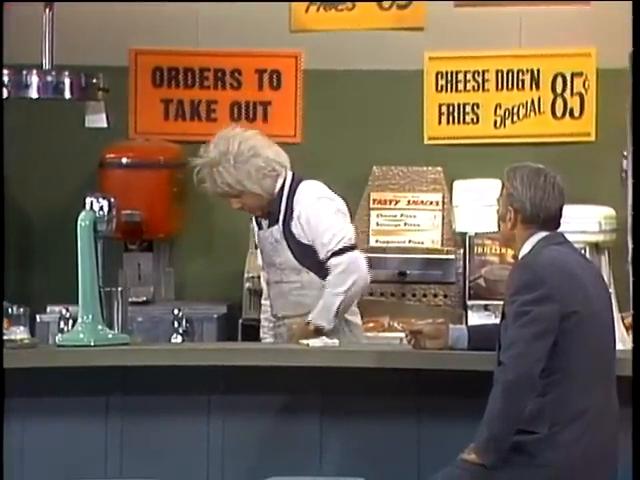
The setup could hardly be more ordinary. A customer approaches a hot dog stand, expecting to place an order and move on with his day. There is nothing unusual about buying a quick meal. But the moment the vendor enters the conversation, the situation begins to change.
Instead of an ordinary transaction, the audience gets a hilarious encounter built around character, awkwardness, and perfectly timed reactions.
At the center of the sketch is Tim Conway’s unforgettable “Oldest Man” character. Conway had an extraordinary talent for creating characters who could transform the smallest interaction into comedy. His performances were often built around distinctive voices, movements, pauses, facial expressions, and an almost painfully slow rhythm.
That rhythm is a huge part of the joke.
The character does not simply sell hot dogs. Every action seems to take far longer than it should. A simple question can become an extended conversation, while an ordinary task can turn into a drawn-out performance.
The comedy comes from watching everyone around him attempt to deal with the situation.
This is one of the classic techniques that made Tim Conway such a memorable performer. He understood that comedy does not always require a complicated punchline. Sometimes, simply taking an ordinary situation and slowing it down to an absurd degree can be enough.
The hot dog stand provides the perfect environment for this kind of humor.
A food vendor is normally expected to work quickly. Customers order, the food is prepared, money changes hands, and the next person is served. Efficiency is part of the experience.
The “Oldest Man” character completely destroys that expectation.
Every interaction seems to move at its own pace.
That contrast immediately creates tension, but it is a comedic tension rather than a dramatic one. The customer wants a simple transaction, while the vendor appears to have all the time in the world.
The longer the interaction continues, the funnier it becomes.
Another important part of the sketch is Conway’s physical performance. His movements are deliberately exaggerated and carefully controlled. He does not need to jump around constantly to get laughs. Instead, tiny gestures become meaningful because the audience is waiting for them.
A slow turn.
A long pause.
A confused expression.
A seemingly endless movement toward the food.
Each moment adds another layer to the character.
This style of physical comedy requires incredible timing. If the performer moves too quickly, the joke disappears. If the pause is too long, the audience may lose interest. Conway knew exactly how to find the space between those two extremes.
That is why his comedy remains so effective.
The customer also plays an important role in the sketch. Without someone reacting to the Oldest Man’s behavior, the joke would not have the same impact. The audience needs a character who represents the normal response.
The customer expects normal service.
Instead, he receives an experience that becomes increasingly strange.
This creates a familiar comedic pattern: one character behaves completely normally while another behaves in an absurd way. The normal character’s frustration allows the audience to appreciate just how ridiculous the other character has become.
It is a formula that has been used in comedy for generations, but great performers can make it feel completely fresh.
The hot dog setting also makes the sketch especially relatable. Almost everyone has experienced a quick food purchase, waited in line, dealt with a slow transaction, or encountered someone who seemed to take forever to complete a simple task.
The sketch takes that everyday frustration and pushes it to an extreme.
Instead of waiting a few extra seconds for lunch, the customer appears to be trapped in an endless hot dog transaction.
That exaggeration is what makes the situation funny.
The sketch also demonstrates why The Carol Burnett Show continues to attract audiences today. The program was built around performers who were willing to completely commit to their characters. They were not afraid to look ridiculous, stretch a joke, exaggerate a reaction, or let a scene become increasingly absurd.
The result was comedy that felt energetic and unpredictable.
Even though the sketch was carefully performed, there is a sense that anything could happen.
This is especially important with Tim Conway. His characters often seemed as though they were operating according to their own strange internal logic. That made his interactions with other performers even more entertaining.
The audience could anticipate that something ridiculous was coming, but they could never be completely sure how the moment would unfold.
That element of surprise remains one of the strongest parts of classic sketch comedy.
Another reason the sketch works is its simplicity.
There are no elaborate special effects.
There is no complicated plot.
There is no need for a huge production.
There is simply a hot dog stand, a customer, and an unusual vendor.
Yet those basic ingredients are enough to create several minutes of memorable comedy.
That simplicity is something modern audiences can still appreciate.
Today’s viewers are surrounded by highly edited entertainment, but sometimes the most satisfying comedy comes from watching talented performers interact in a simple setting. The focus stays on the characters rather than the production.
The “Oldest Man” character is also a reminder of how much personality can contribute to comedy. Conway does not simply tell jokes. He builds a complete personality. The voice, posture, facial expressions, movements, and pace all work together to create someone immediately recognizable.
Once the character appears, the audience already understands what kind of trouble is coming.
And that anticipation makes every subsequent interaction even funnier.
The sketch is also a wonderful example of comedic escalation. What begins as a basic food order gradually becomes more complicated. The audience watches the customer attempt to navigate the situation while the vendor continues behaving exactly as expected.
The comedy grows because the characters refuse to behave normally.
That is classic sketch writing at its best.
Decades after its original television era, this kind of comedy remains surprisingly easy to enjoy. You do not need to know every detail about the period in which the sketch was produced. You do not need to understand a complicated reference.
The basic situation is universal.
Someone wants a hot dog.
Someone needs to serve the hot dog.
And somehow, everything becomes ridiculously difficult.
That is all the setup needed.
The rest depends on performance.
Tim Conway’s “Oldest Man” character became one of those memorable comedy creations because he could turn simple behavior into an event. His slow movements and unusual delivery gave the character an identity that audiences could immediately recognize.
The hot dog vendor sketch captures that talent beautifully.
It is funny because it is simple, exaggerated, and brilliantly performed.
More importantly, it demonstrates why classic comedy continues to survive across generations. Great timing does not become outdated. A perfectly delivered reaction does not lose its power. And a character who can make an ordinary situation completely ridiculous can still make audiences laugh decades later.
The next time you watch this classic sketch, pay attention not only to the jokes but also to the pauses, expressions, movements, and reactions. Those small details are where much of the comedy lives.
The “Oldest Man” may be running a hot dog stand, but he certainly is not running it like everyone else.
And that is exactly what makes the sketch unforgettable. 😂