Some movie scenes are remembered for their comedy. Others become unforgettable because of their music. But every once in a while, a film delivers a sequence so energetic that it feels as though the entire world has suddenly turned into a dance floor.
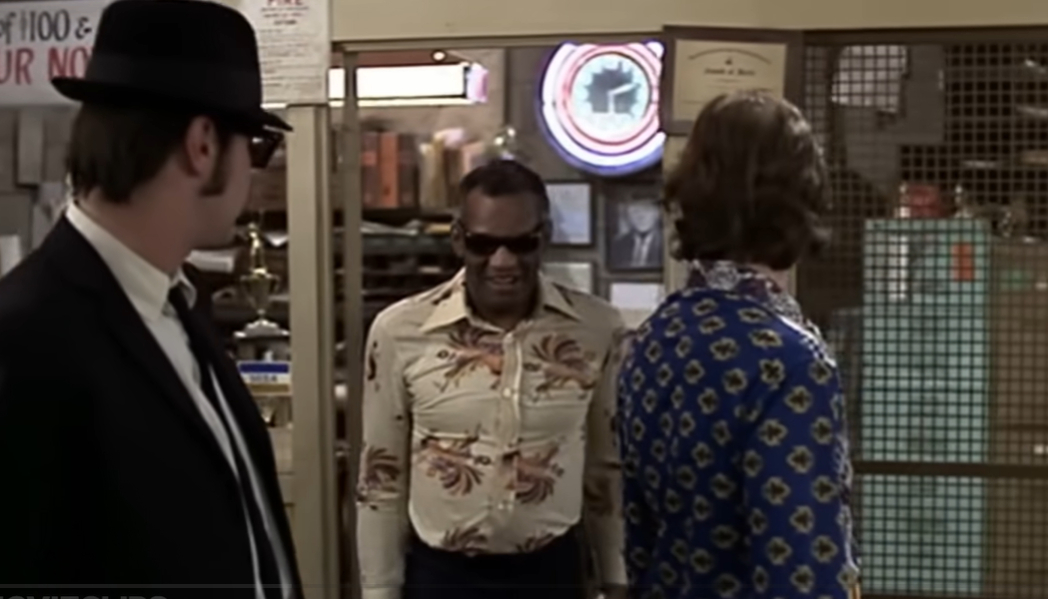
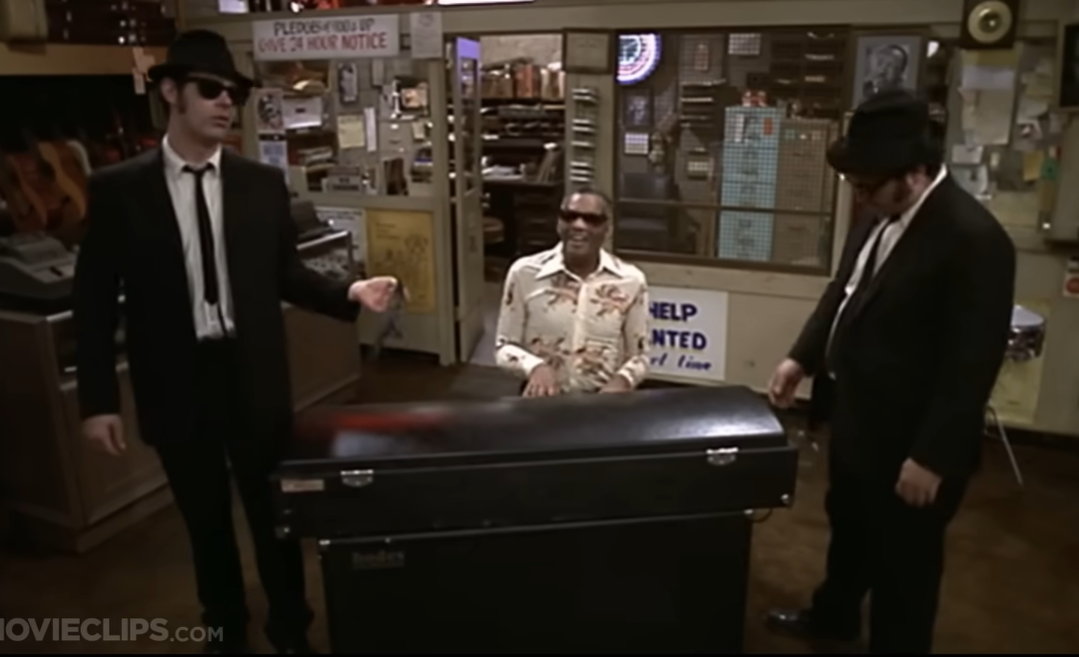
That is exactly what happens in The Blues Brothers (1980), when John Belushi and Dan Aykroyd walk into Ray’s Music Exchange and encounter the legendary Ray Charles.
What begins as an ordinary visit to purchase musical equipment quickly becomes one of the film’s most joyful and recognizable musical sequences. A simple question about an electric piano leads to a demonstration that transforms the music shop into the center of an extraordinary street celebration.
And when the opening notes of “Shake a Tail Feather” arrive, nobody seems capable of standing still.
Two Men in Black Suits With One Important Mission
At the center of The Blues Brothers are Jake and Elwood Blues, played by John Belushi and Dan Aykroyd.
The brothers have a mission that sounds almost impossible. They must reunite their former band and raise enough money to save the Catholic orphanage where they grew up.
Their journey takes them across Chicago, bringing them into contact with musicians, old friends, unexpected enemies, and increasingly ridiculous situations.
Despite the chaos surrounding them, Jake and Elwood remain remarkably focused. Dressed in their familiar black suits, white shirts, narrow ties, and dark sunglasses, they approach nearly every problem with the same deadpan confidence.
When they enter Ray’s Music Exchange, they are looking for equipment that can help bring their musical operation back to life.
They have no idea that their shopping trip is about to become a full-blown musical spectacle.
Ray Charles Does Not Need to Explain Himself
Inside the store, Jake and Elwood begin examining an electric piano.
There is some discussion about the instrument’s condition and whether its action is still working properly. For an ordinary shop owner, this might be an opportunity to offer a sales pitch or explain the technical qualities of the merchandise.
But Ray Charles takes a different approach.
Rather than arguing, he simply sits down at the keyboard.
The moment his fingers touch the keys, the atmosphere changes.
Ray begins playing with the effortless confidence of someone who has spent a lifetime understanding music. His performance is relaxed but powerful, demonstrating that the instrument is perfectly capable of delivering the sound he wants.
There is something wonderfully entertaining about the way he handles the situation.
He does not need to convince anyone through words. His musicianship provides the answer.
And then the music moves beyond the walls of the shop.
“Shake a Tail Feather” Takes Over the Street
As the performance develops, the sequence bursts into “Shake a Tail Feather,” a lively rhythm and blues number that perfectly captures the spirit of the film.
The song, originally associated with the Chicago soul tradition and popularized by James and Bobby Purify, becomes the engine behind an extraordinary dance sequence.
Ray Charles leads the musical energy from behind the piano, while the sound spreads into the street.
Suddenly, people begin gathering outside the shop.
Pedestrians stop walking. Heads turn toward the music. Before long, the sidewalk becomes a dance floor filled with people responding to the rhythm.
The scene introduces a joyful collection of classic dance movements, including the Twist, the Swim, the Monkey, and the Mashed Potato.
What makes the sequence so entertaining is its sense of collective excitement. The dancers do not appear to be competing with one another. They are simply enjoying the music.
The street becomes a spontaneous celebration where strangers move together as though they have all been waiting for the same song.
It is an explosion of movement, personality, and musical enthusiasm.
John Belushi and Dan Aykroyd Make the Perfect Contrast
While Ray Charles commands the musical performance, Belushi and Aykroyd provide the comedy that makes the sequence even more memorable.
Their characters are famous for their serious expressions and almost unnatural ability to remain calm when surrounded by chaos.
That personality becomes especially effective here.
As the people around them begin dancing, Jake and Elwood maintain their familiar composure. Their dark sunglasses and matching suits make them look completely disconnected from the excitement unfolding around them.
The contrast is hilarious.
An entire neighborhood appears to have surrendered to the music, while two men who supposedly live for blues and soul stand watching with remarkable seriousness.
Belushi brings his unmistakable physical comedy to Jake, while Aykroyd provides the quieter, more controlled presence of Elwood.
Their chemistry gives the scene another layer of entertainment. They do not need to dominate the musical number because their characters already provide the perfect visual counterpoint.
This is one of the reasons the Blues Brothers work so well on screen. Their comedy never needs to overpower the music.
Instead, it allows the music to become even more enjoyable.
The Power of Authentic Musicianship
One of the greatest strengths of The Blues Brothers is its commitment to genuine musical performance.
Ray Charles was not simply a celebrity appearing in a movie. He was one of the most influential musicians in American music history, with a career spanning blues, gospel, soul, jazz, and rhythm and blues.
His presence gives the sequence an authenticity that cannot be manufactured.
The piano performance feels natural because Ray understands exactly how to make the instrument communicate emotion and energy.
The supporting musicians also play an essential role. The arrangement creates a strong rhythmic foundation, allowing the song to expand naturally into a larger performance.
Director John Landis understood the importance of giving the music room to breathe. Rather than treating the sequence as a short interruption, the film allows the celebration to grow.
The result feels less like a conventional movie musical number and more like an unexpected live concert happening in the middle of Chicago.
A Musical Celebration That Goes Beyond the Story
The plot of The Blues Brothers revolves around Jake and Elwood’s mission to reunite their band and save the orphanage.
But moments like the Ray Charles sequence demonstrate that the film is about much more than its central storyline.
It is a celebration of American musical traditions and the artists who helped shape them.
Throughout the movie, audiences encounter legendary performers including James Brown, Aretha Franklin, Cab Calloway, and Ray Charles.
Each appearance brings a different musical personality to the screen.
James Brown delivers gospel-inspired energy, Aretha Franklin commands the Soul Food Cafe with “Think,” and Cab Calloway brings classic showmanship to the ballroom.
Ray Charles contributes something particularly joyful with “Shake a Tail Feather.”
His performance connects the world of the film with the larger history of soul and rhythm and blues, reminding viewers that the music itself is the real foundation of the Blues Brothers’ identity.
Why This Scene Still Makes People Dance
More than four decades after its release, the sequence remains one of the most recognizable moments in The Blues Brothers.
Its appeal is remarkably simple.
The song is infectious. Ray Charles is captivating. The dancers bring genuine enthusiasm, and Belushi and Aykroyd provide the comedy that holds everything together.
There is also something timeless about watching ordinary people respond to great music.
No one needs an invitation to join the celebration. The rhythm is enough.
Modern films often rely on elaborate choreography, sophisticated visual effects, and carefully designed production numbers. Yet this sequence demonstrates how powerful a musical scene can become when it focuses on performance, personality, and the natural excitement of a crowd.
The joy feels immediate because the music is allowed to lead.
The Moment That Defines the Spirit of The Blues Brothers
John Belushi and Dan Aykroyd created something special with Jake and Elwood Blues. Their characters brought comedy into the world of blues and soul without ever making the music feel like a joke.
The Ray Charles sequence captures that philosophy perfectly.
Two men arrive looking for a piano, a legendary musician begins playing, and an ordinary Chicago street transforms into a celebration of music and movement.
The black suits remain perfectly recognizable. The sunglasses stay firmly in place. Jake and Elwood continue their mission.
But for a few unforgettable minutes, the entire world belongs to the music.
Ray Charles sits at the keyboard, the dancers fill the street, and “Shake a Tail Feather” keeps the energy moving.
Some movie scenes are remembered because they tell an important part of the story.
This one is remembered because it makes everyone watching want to get up and dance.
And every time those opening notes return, the message remains exactly the same:
Forget standing still.
Get up, move your feet, and shake a tail feather.