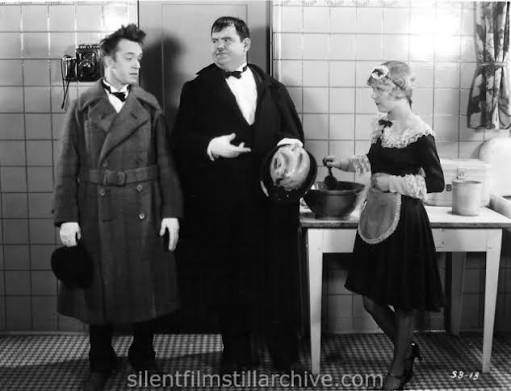
Some of the greatest comedies in cinema history begin with the simplest ideas. A family prepares for an elegant dinner. Distinguished guests are invited. The table is beautifully arranged, the food is carefully prepared, and every detail suggests an evening of refinement and sophistication. Yet in the hands of Stan Laurel and Oliver Hardy, this perfectly ordinary situation becomes an unforgettable adventure filled with confusion, clever visual gags, and nonstop laughter. That is exactly why From Soup to Nuts (1928) remains one of the most enjoyable silent comedies ever made.
https://www.youtube.com/watch?v=d0e7RZyHp9M
Produced during the closing years of the silent film era, From Soup to Nuts captures Laurel and Hardy at an important stage in their careers. Their partnership was still developing, but audiences could already see the chemistry that would eventually make them the world’s most famous comedy duo. Even in these early performances, the balance between Laurel’s innocent clumsiness and Hardy’s confident but increasingly frustrated personality is remarkably polished.
The film tells the story of an elegant dinner hosted by a wealthy family. Everything is expected to proceed without incident, but the household staff are far less prepared than anyone realizes. Laurel and Hardy are responsible for serving the meal, maintaining order, and ensuring that the evening reflects the highest standards of hospitality. Naturally, almost nothing goes according to plan.
What makes the film so entertaining is that the comedy grows naturally from believable situations. There are no impossible stunts or exaggerated fantasy sequences. Instead, viewers watch ordinary tasks become increasingly difficult through small misunderstandings and unfortunate timing. Carrying dishes, arranging plates, serving guests, and responding to unexpected problems all become opportunities for perfectly constructed visual humor.
Stan Laurel’s performance is a wonderful example of why he became one of silent cinema’s greatest comedians. His character approaches every challenge with complete honesty. He never intends to create trouble. Instead, his curiosity and uncertainty lead him into situations that become funnier with every passing moment. Laurel’s expressive face tells the entire story without the need for spoken dialogue. A raised eyebrow, a puzzled smile, or a hesitant glance communicates more emotion than pages of script ever could.
Oliver Hardy serves as the ideal partner. While Laurel appears uncertain, Hardy projects confidence and professionalism. He believes every problem can be solved if everyone simply follows his instructions. Unfortunately, each attempt to restore order only creates another problem. Hardy’s growing irritation becomes increasingly amusing because the audience knows he is fighting a battle he can never truly win.
One of the film’s greatest strengths is its extraordinary use of physical comedy. Every movement is carefully choreographed. Objects appear in exactly the right place. Characters cross paths at precisely the wrong moment. Simple actions unexpectedly trigger larger disasters. Although everything looks spontaneous, every gag reflects careful planning and remarkable precision.
The dinner table itself almost becomes another character in the story. It represents elegance, order, and social expectation. Every polished plate, folded napkin, and carefully prepared dish symbolizes perfection. Laurel and Hardy, meanwhile, represent unpredictability and human imperfection. The collision between these two worlds creates the film’s central comic energy.
Unlike many modern comedies that depend heavily on dialogue, From Soup to Nuts relies almost entirely on visual storytelling. This makes the film surprisingly timeless. Viewers from any country can understand the humor because laughter is generated through expressions, gestures, timing, and universally recognizable situations. There is no language barrier preventing audiences from enjoying the comedy.
Another reason the film has endured is its careful pacing. Rather than overwhelming viewers with constant action, the filmmakers allow each joke to develop naturally. A tiny mistake gradually becomes a larger problem. One misunderstanding affects another. Eventually, the carefully organized dinner begins falling apart in spectacular fashion. This gradual escalation keeps audiences engaged because every scene introduces a fresh complication.
The supporting cast also deserves recognition. The dinner guests attempt to maintain proper etiquette despite witnessing increasingly ridiculous events around them. Their determination to remain polite makes Laurel and Hardy’s mistakes appear even funnier. Instead of reacting dramatically, they often continue behaving as though everything is perfectly normal, adding another layer of subtle humor.
Watching the film today also provides valuable insight into social customs of the late 1920s. Formal dinners were important social occasions, and etiquette played a significant role in upper-class life. Beautiful dining rooms, elegant clothing, and carefully organized service reflect an era when entertaining guests carried considerable importance. While these traditions have evolved, the basic human desire to make a good impression remains familiar.
The partnership between Laurel and Hardy would eventually inspire generations of comedians. Their influence can be seen in performers such as Rowan Atkinson, Jacques Tati, Jerry Lewis, and countless others who recognized the power of visual comedy. Many of the techniques that audiences now associate with physical humor were perfected by Laurel and Hardy during films like From Soup to Nuts.
Director Edgar Kennedy demonstrates remarkable control throughout the production. Every sequence flows smoothly into the next, ensuring that the comedy never feels repetitive. Instead of repeating identical jokes, the story continually introduces new situations that challenge the characters in different ways. This variety helps maintain excitement from beginning to end.
Perhaps the film’s most important achievement is its warmth. Although everything goes wrong, the comedy never feels cruel. Laurel and Hardy are not laughing at others; they are simply trying their best in circumstances that become increasingly impossible. Their kindness and sincerity encourage viewers to forgive every mistake and enjoy the journey rather than focusing on the outcome.
Nearly one hundred years after its premiere, From Soup to Nuts continues to remind audiences why silent comedy remains one of cinema’s greatest artistic achievements. Without relying on dialogue, elaborate effects, or modern technology, Laurel and Hardy created entertainment that still feels fresh, imaginative, and genuinely funny. Their performances celebrate the humor hidden within everyday life, proving that even the most ordinary dinner can become unforgettable when viewed through the eyes of true comic masters.
Whether you are a longtime admirer of Laurel and Hardy or discovering their work for the first time, From Soup to Nuts offers a perfect introduction to their unique style. It captures their remarkable chemistry, showcases their extraordinary physical performances, and demonstrates why their influence continues to shape comedy nearly a century later. Few films illustrate the timeless power of silent storytelling more effectively than this delightful 1928 classic.