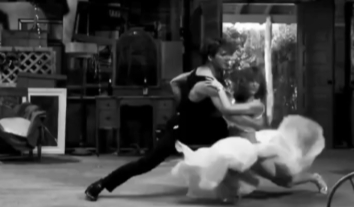
Before anyone leaves the ground, Patrick Swayze and Jennifer Grey give you a reason to keep watching. In a brief dance-room clip from Dirty Dancing, he guides her across the floor while her light skirt swings with each turn. The room is modest, the movement quick, and the attraction easy to recognize. Even stripped of the film’s familiar colors, the sequence carries a warmth that explains why viewers still return to Baby and Johnny nearly four decades later.
For audiences who remember the movie’s arrival in 1987, a few seconds can bring back an entire evening. Perhaps it was a trip to the theater with friends, or a rented videotape that stayed beside the television longer than it should have. Someone knew the songs before knowing the dialogue. Someone else insisted on watching it again. The memories differ, but the pleasure of seeing these two performers find their rhythm remains remarkably immediate.
Directed by Emile Ardolino and written by Eleanor Bergstein, Dirty Dancing follows Frances “Baby” Houseman during a family vacation at a Catskills resort in the summer of 1963. There she meets Johnny Castle, a dance instructor whose working life is far removed from the comfort she knows. Their relationship develops through dance, but the film’s appeal rests equally on Baby learning to look beyond the boundaries of her upbringing.
That background gives even a short dancing sequence emotional weight. Johnny knows how to occupy a room. Baby is discovering how to move through one without constantly asking whether she belongs there. Watching them together, we see a relationship built around an uneven starting point: one partner has the experience, while the other must find the confidence to participate. The interesting part is seeing how that distance begins to close.
In the uploaded excerpt, the choreography keeps their connection visible. Their hands link as they move apart, then draw them together again. Grey’s skirt describes the turns, making the movement readable even in black and white. Swayze’s darker clothing gives his figure a clear outline against the room. The visual contrast helps the eye follow both dancers without distracting from the exchange taking place between them.
Swayze’s screen presence is especially effective because his movement looks purposeful. He places his feet firmly and makes changes of direction seem manageable. There is strength in the way he supports the partnership, but the camera also captures the attention required to maintain it. His appeal in this material comes from watching someone do something well while remaining responsive to the person beside him.
Grey gives the sequence its answering energy. Her movement has buoyancy, and the swinging skirt makes that quality especially apparent. She contributes to the dance rather than simply being carried through it. When the pair separate, the space between them becomes part of the performance; when they reconnect, their timing brings the composition back together. That exchange gives viewers something more engaging than a display of one star’s skill.
It also helps explain what people mean when they talk about movie chemistry. The phrase can sound mysterious, as though attraction appears on screen through luck alone. Here, much of it is visible in practical details. The performers respond to changes in position, keep the movement flowing, and direct their attention toward one another. The audience reads those choices as intimacy because the partnership appears to matter to both people.
None of that requires guessing what the actors felt privately. Baby and Johnny exist within a story, and Swayze and Grey’s achievement lies in making that story persuasive. A brief clip cannot tell us whether a take was spontaneous, how many rehearsals preceded it, or what happened after the camera stopped. It can show how effectively two performers communicate through movement, and this excerpt gives viewers plenty to appreciate on that level.
The setting contributes more than it first appears to. A rehearsal room offers less ceremony than a stage. Its open floor and ordinary surroundings keep the emphasis on the dancers, inviting us to notice the work within the romance. There is something appealing about watching a connection develop where people practice, repeat, and adjust. The room makes the moment feel close enough to observe rather than distant enough only to admire.
For older viewers, that closeness may be part of the nostalgia. Dirty Dancing recalls the excitement of having somewhere to go and someone you hoped would be there. It remembers the awkwardness of learning a step while trying not to reveal how much another person’s opinion matters. Those feelings survive changes in fashion and technology. A younger audience can recognize them without having shared the experience of watching the film in 1987.
Baby’s place in the story gives that recognition another dimension. Her growing confidence concerns more than becoming an attractive partner. She begins to trust her judgment and to recognize that the world contains experiences her family’s position has sheltered her from. The dancing gives that development a visible form. She must commit to a movement, accept the possibility of getting it wrong, and keep going while another person watches.
Johnny’s role becomes more interesting when viewed alongside hers. His competence does not erase the social distance between a resort employee and a guest. Within that divide, a dance offers temporary common ground: both people have to attend to the same rhythm and make the partnership function. The romance gains force from that shared activity. We can see them cooperating before we are asked to believe in what they might become.
The black-and-white presentation of this particular excerpt brings those physical details forward. Without the original palette, the eye settles on posture, turns, and the changing distance between the dancers. It is a useful reminder of how much the performances contribute on their own. The clip does not need a caption announcing that these are memorable characters. Their movement supplies the invitation to watch.
A short excerpt naturally leaves much outside the frame. We do not get the whole conversation, the full musical sequence, or the larger progression of the relationship. That incompleteness can make the moment more inviting, provided it leads viewers back to the fuller scene rather than to an invented story about its making. There is already enough interest in the dance itself.
Nearly forty years after Dirty Dancing reached theaters, Baby and Johnny can still hold attention in a plain room with a few well-timed turns. The famous moments remain part of the movie’s appeal, but this smaller passage offers a reason to revisit what surrounds them. Watch the partners move apart and find one another again, then let the longer scene show you what thirteen seconds can only begin to suggest