Some comedy routines need elaborate sets, complicated stories or spectacular physical gags.
Abbott and Costello needed three words:
Who’s on first?
From those words came one of the most celebrated comedy routines in American entertainment history.
The premise couldn’t be simpler.
Bud Abbott is explaining the lineup of a baseball team to Lou Costello. Lou wants to know the names of the players so he can understand who is playing each position.
There’s just one problem.
The players have some very unusual names.
The first baseman is Who.
The second baseman is What.
The third baseman is I Don’t Know.
And that’s only the beginning.
Other players include Why in left field, Because in center, Tomorrow as pitcher and Today as catcher. Depending on the version, the shortstop is called I Don’t Care, I Don’t Give a Darn, or a variation of that phrase.
To Bud Abbott, everything makes perfect sense.
To Lou Costello, nothing makes sense.
That’s the genius of the routine.
When Lou asks:
“Who’s on first?”
Bud can truthfully respond that Who is on first.
Lou hears an answer that sounds like another question.
So he asks again.
Bud gives the same answer.
Lou becomes more frustrated.
Bud remains completely calm.
Within seconds, an ordinary conversation about baseball has become an impossible linguistic puzzle.
And somehow it keeps getting funnier.
The Perfect Abbott and Costello Formula
The routine demonstrates exactly why Bud Abbott and Lou Costello worked so well together.
Abbott is the straight man.
His job isn’t simply to deliver information. His job is to maintain control.
Bud knows exactly what’s happening.
Lou doesn’t.
That imbalance is everything.
The more frustrated Costello becomes, the calmer Abbott appears.
Costello raises his voice.
Abbott calmly repeats himself.
Costello desperately reformulates the question.
Abbott provides another technically correct answer.
The audience understands both sides.
That’s what makes the routine so satisfying.
We understand what Lou is trying to ask.
But we also understand that Bud is actually answering him correctly.
Nobody is technically wrong.
Yet communication has become almost impossible.
From Radio to the Movies
“Who’s on First?” didn’t begin with the famous movie version.
Abbott and Costello developed and performed variations of the routine during their stage and radio careers. The Library of Congress notes that they first performed it on Kate Smith’s radio program on March 24, 1938, although no recording of that first broadcast is known to survive. Their October 6, 1938 performance does survive and was later added to the National Recording Registry in 2002.
The routine evolved over time.
Abbott and Costello performed it repeatedly, changing lines and adjusting the timing.
That was part of their craft.
Comedy wasn’t simply about memorizing words.
Timing mattered.
Pauses mattered.
Audience reactions mattered.
The performers could stretch or shorten exchanges depending on the situation.
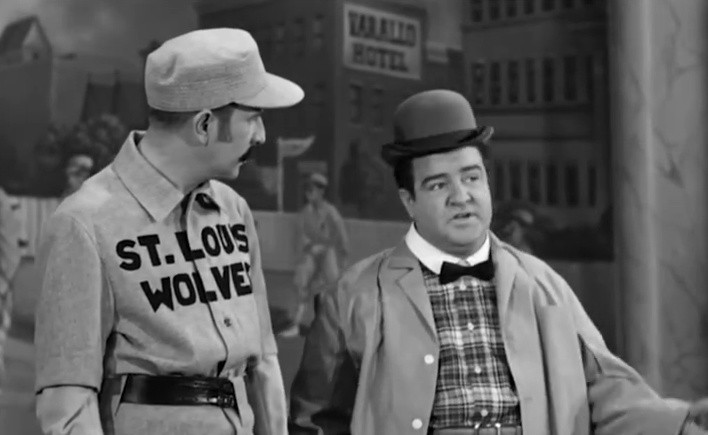
Eventually the routine reached what many consider its definitive filmed form in the 1945 Universal comedy The Naughty Nineties.
In that version, Costello plays Sebastian Dinwiddle and Abbott plays Dexter Broadhurst. The fictional team being discussed is the St. Louis Wolves.
That’s why the uniform visible in these clips says ST. LOUIS WOLVES.
Why the Joke Never Runs Out
One of the most remarkable things about “Who’s on First?” is how long Abbott and Costello can sustain essentially the same misunderstanding.
Normally, repeating a joke makes it weaker.
Here, repetition makes it stronger.
First comes Who.
Then What.
Then I Don’t Know.
Just when Lou thinks he understands one player, another name creates an entirely new problem.
Eventually the routine expands beyond simply identifying positions.
Lou begins constructing baseball scenarios.
Who receives money?
Whose wife collects it?
Who fields the ball?
Who throws to whom?
Every ordinary baseball sentence becomes dangerous because practically every pronoun or question word might actually be somebody’s name.
The routine has created its own universe.
Normal English no longer works.
And poor Lou is trapped inside it.
Lou Costello’s Frustration Is the Real Punchline
The wordplay is clever, but the routine wouldn’t have become legendary from wordplay alone.
Lou Costello makes it work.
Watch his face.
At first, he’s simply curious.
Then confused.
Then suspicious.
Then irritated.
Eventually he looks like he’s questioning reality itself.
His entire body becomes part of the joke.
Meanwhile Abbott barely needs to change his expression.
That contrast creates the rhythm.
Abbott tightens the knot.
Costello struggles to escape.
Every attempt only makes the knot tighter.
It’s one of the purest examples of the straight-man/comic relationship ever filmed.
When Lou Accidentally Gets It Right
Perhaps the cleverest development comes when Lou finally begins explaining a baseball play.
He imagines himself catching while Tomorrow is pitching. A batter bunts. Lou picks up the ball and says he will throw it to Who.
Suddenly Abbott is delighted.
That’s correct!
For once, Lou has correctly used the first baseman’s name.
The problem?
Lou still doesn’t realize it.
The joke has come full circle.
That moment demonstrates how carefully constructed the routine really is.
What initially sounds like random confusion gradually develops its own internal logic.
The audience learns the lineup.
Lou doesn’t.
Eventually viewers are effectively ahead of him.
We know why Bud’s answers make sense.
So every new misunderstanding becomes even funnier.
More Than Just an Old Comedy Sketch
“Who’s on First?” eventually became much bigger than Abbott and Costello themselves.
In 1956, a gold record honoring the routine was placed at the National Baseball Hall of Fame, and the famous filmed performance has become closely associated with the museum.
Even more impressively, the surviving 1938 radio performance was selected for preservation in the Library of Congress National Recording Registry.
Those honors tell us something important.
This isn’t simply an old joke people remember because of nostalgia.
It is an extraordinarily precise piece of comedy writing and performance.
Remove the costumes.
Remove the baseball setting.
Remove the black-and-white film.
The central idea still works.
Two people are having a conversation.
Both believe they’re communicating perfectly.
Neither understands why the other person doesn’t understand.
Everyone has experienced some version of that.
Abbott and Costello simply pushed the experience to its funniest possible extreme.
Comedy That Still Works Generations Later
That’s why these clips remain so effective for audiences today.
You don’t need to understand baseball deeply.
You don’t need to know anything about 1940s America.
You don’t even need to know who Abbott and Costello are before watching.
You only need to understand one thing:
Lou wants a name.
Bud keeps giving him the name.
And Lou has absolutely no idea.
More than eight decades after the routine first reached radio audiences, Who is still on first, What is still on second, I Don’t Know is still on third — and Lou Costello is still trying desperately to figure out what Bud Abbott is talking about.
That’s not just classic comedy.
That’s comedy built to last. 😂⚾