Abbott and Costello’s “Who’s on First?” — The Comedy Routine That Never Gets Old
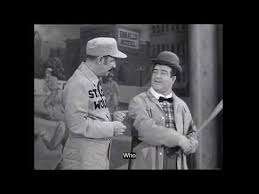
Few comedy routines in American entertainment history have achieved the legendary status of Abbott and Costello’s “Who’s on First?” Originally performed by the famous comedy duo Bud Abbott and Lou Costello, the routine transformed a simple conversation about baseball into one of the most brilliantly confusing exchanges ever seen on stage and screen. Its humor is remarkably simple: two men are trying to understand each other, yet every attempt at clarification only creates even more confusion.
Decades after it was first performed, “Who’s on First?” continues to entertain audiences around the world. Its rapid-fire dialogue, impeccable timing, exaggerated frustration, and clever wordplay demonstrate why great comedy can survive long after the era in which it was created.
The Simplest Question Becomes Complete Chaos
The premise of “Who’s on First?” could hardly be more straightforward. Abbott is explaining the names of the players on a baseball team to Costello, who wants to understand who plays each position.
The problem is that the players’ names sound like ordinary words used in everyday conversation.
The first baseman is Who. The second baseman is What. The third baseman is I Don’t Know.
From that moment, communication becomes nearly impossible.
When Costello asks who is playing first base, Abbott naturally answers “Who.” Costello interprets “Who” as a question rather than a person’s name. He asks again, expecting a normal answer, but Abbott gives the same response. The more Costello tries to make sense of the information, the more ridiculous the conversation becomes.
This clever linguistic setup is the foundation of the entire routine.
What makes it so effective is that Abbott never seems particularly confused. He remains calm, confident, and almost instructional while Costello becomes increasingly frustrated. Their opposite reactions create the central comedic tension.
Lou Costello’s Growing Frustration
Much of the routine’s magic comes from Costello’s escalating emotional reaction.
At first, he is simply curious. Then he becomes confused. Soon, he is irritated. Eventually, his frustration explodes as he desperately tries to understand what Abbott is telling him.
Yet Abbott continues responding as though everything is perfectly normal.
That contrast is essential.
Costello’s increasingly frantic delivery gives the audience an emotional connection to the situation. We understand exactly what he is feeling because we have all experienced moments when someone’s explanation seemed to make less and less sense.
The difference is that in “Who’s on First?”, the misunderstanding never ends. Every clarification produces another misunderstanding.
The result is a perfect comedic loop.
A Masterclass in Timing and Delivery
The brilliance of “Who’s on First?” is not only in its written dialogue. The routine depends heavily on timing, rhythm, pauses, facial expressions, and delivery.
Abbott knows exactly when to respond and when to let Costello become more confused. Costello knows precisely when to raise his voice, pause, react, or repeat a question.
Their performances work almost like musical composition.
One line sets up another. A question creates an answer. The answer creates another question. The rhythm accelerates while the audience follows the increasingly absurd logic.
Despite the complexity of the verbal exchange, the basic structure remains remarkably easy to understand.
That is one reason the routine has remained so accessible to different generations.
Why the Wordplay Still Works
At the heart of the sketch is a linguistic trick: ordinary question words become proper names.
“Who,” “What,” and “I Don’t Know” are normally phrases used to request information. In the world of the baseball team, however, they are simply names.

This creates a situation in which grammatically correct statements sound completely nonsensical.
Costello asks a genuine question.
Abbott gives a genuine answer.
Yet Costello hears the answer as another question.
Neither character is necessarily lying or misunderstanding the English language. They are simply interpreting the same words in different ways.
That simple concept allows Abbott and Costello to build an enormous amount of comedy from a very small premise.
More Than Just a Baseball Joke

Although baseball provides the setting, audiences do not need to understand the sport to enjoy the routine.
The real subject is communication.
“Who’s on First?” captures the absurdity of trying to communicate when two people assign completely different meanings to the same words. That idea remains relevant even in modern life.
Anyone who has experienced a confusing conversation, misunderstood message, or frustrating explanation can recognize the situation.
The routine turns an everyday communication problem into an extraordinary comedic performance.
That universality is one of its greatest strengths.
The Chemistry Between Abbott and Costello
Another major reason the routine works is the extraordinary chemistry between Bud Abbott and Lou Costello.
Abbott plays the calm straight man, delivering his lines with confidence and control. Costello serves as the increasingly exasperated character whose confusion drives the action forward.
Their roles complement each other perfectly.
If Abbott became as frustrated as Costello, much of the tension would disappear. If Costello remained calm, the audience would lose the emotional reaction that makes the situation hilarious.
Instead, they maintain a carefully balanced relationship.
Abbott pushes the misunderstanding forward while Costello reacts to it.
The audience becomes caught between them, understanding the joke while watching Costello struggle to understand it himself.
A Legacy That Continues
“Who’s on First?” has become far more than a famous comedy sketch. It is now part of the history of American entertainment and is frequently remembered whenever discussions turn to legendary comedy routines.
Its influence can be seen in the countless sketches, television scenes, movies, and performances that use misunderstanding and wordplay as their central comedic devices.
The routine also demonstrates something important about comedy: technology and production value are not what make people laugh.
There are no elaborate special effects.
There is no complicated action sequence.
There are simply two performers, a clever premise, and exceptional timing.
That is enough.
Why We Still Laugh
Perhaps the greatest achievement of “Who’s on First?” is that it never feels dependent on its original era.
The clothing may look old-fashioned. The baseball references may belong to another generation. The performance style may remind modern viewers of classic vaudeville and television.
But the basic human experience remains exactly the same.
We laugh because Costello wants a simple answer and cannot get one.
We laugh because Abbott appears completely certain that everything is perfectly clear.
And we laugh because every attempt to solve the problem only makes the problem worse.
That is the genius of the routine.
“Who’s on First?” is not simply a piece of comedy history. It is a masterclass in timing, character, language, and performance—a reminder that the funniest ideas are sometimes the simplest ones.

More than generations later, Abbott and Costello’s unforgettable exchange continues to prove one timeless truth: great comedy never really gets old. 😂⚾