John Travolta Didn’t Just Win the Contest — He Proved No One Can Play John Travolta Better Than John Travolta
Some television games are designed to be competitive.
Others are designed to be entertaining.
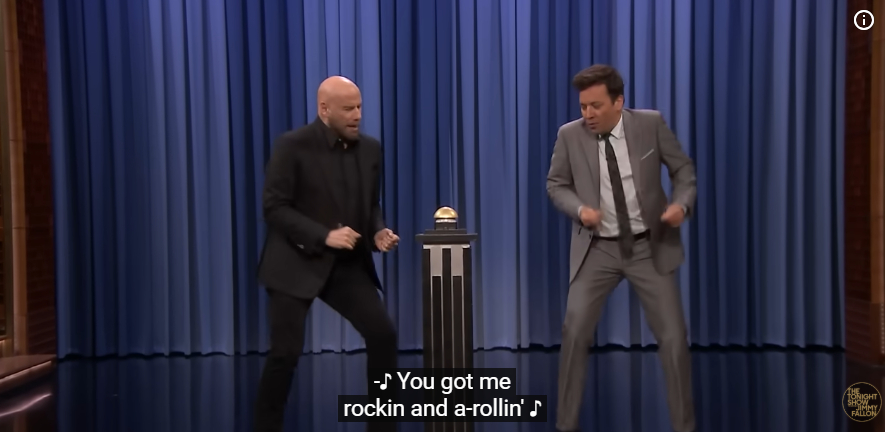
And then there is the night Jimmy Fallon invited John Travolta onto The Tonight Show for a game called “John Travolt-Off” and accidentally staged a master class in why certain performers remain unmatched.
The premise was simple. A random generator selected famous roles from Travolta’s career. Fallon and Travolta took turns performing them. At the end, the audience would decide who was the better John Travolta.
Spoiler: it was never really a contest.
The Setup That Could Only Go One Way
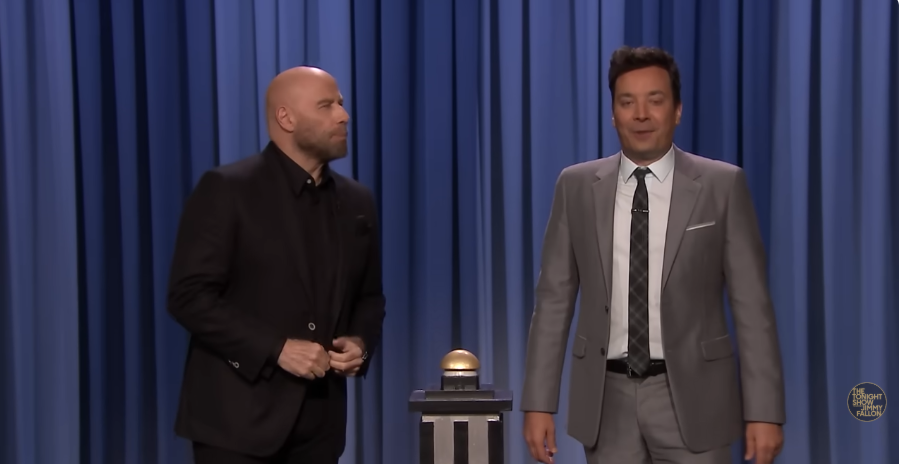
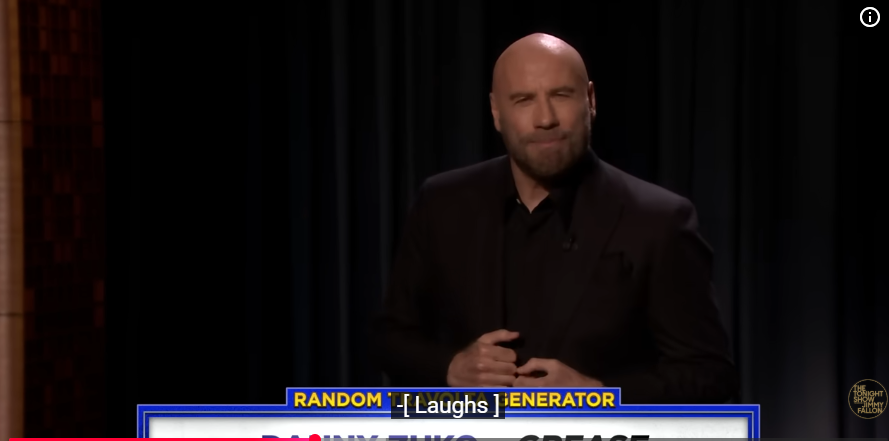
Fallon went first with Tony Manero from Saturday Night Fever. He gave it a solid effort — the posture, the voice, the attitude. It was funny and committed. Then Travolta stepped up, landed on Danny Zuko from Grease, and the temperature in the room changed.
He did not just imitate the character. He slipped back into him. The smile, the cadence, the easy cool that defined a generation of moviegoing all returned as if no time had passed. The audience response made the difference obvious immediately.
From that moment, the segment stopped being a game and became something closer to a demonstration.
A Career in Five Minutes
What followed was a rapid tour through some of Travolta’s most recognizable work. Vincent Vega’s dry “Royale with cheese” monologue from Pulp Fiction. The unhinged energy of Castor Troy in Face/Off, complete with a Nicolas Cage impression so precise that Fallon could only shout in disbelief. And finally, the joyful chaos of Vinnie Barbarino from Welcome Back, Kotter, complete with the signature dance and the “Bar-Bar-Bar Barbarino” chant.
Each turn revealed the same truth. Travolta was not reaching for these characters. He still owned them. The muscle memory, the vocal precision, and the physical ease had not disappeared. They had simply been waiting for the right invitation.
The Cage Moment
The highlight for many viewers came when the generator landed on Castor Troy. Travolta had to play a version of himself that was already playing Nicolas Cage — a hall-of-mirrors challenge that could have collapsed into confusion. Instead, he delivered a performance so sharp that Fallon broke character completely, asking over and over how he had just done that.
It was the kind of moment that reminds you why certain actors endure. Technique can be studied. Charisma can be approximated. But the ability to inhabit a role so completely that even a talk-show game feels like a legitimate performance is rare.
Still the Standard
There is an unspoken rule in entertainment: the originator of a role usually remains the definitive version. Travolta has spent decades proving that rule holds. Whether the character is a disco king, a greaser with a soft heart, a hitman with strong opinions about European fast food, or a criminal wearing someone else’s face, the performances remain his.
The “Travolt-Off” simply made the point in the most entertaining way possible. Fallon was game, talented, and clearly having a great time. He was also, by design, outmatched. Trying to out-Travolta Travolta is a bit like trying to out-sing Sinatra or out-cool Steve McQueen. The comparison is flattering. The outcome is inevitable.
Why the Segment Still Works
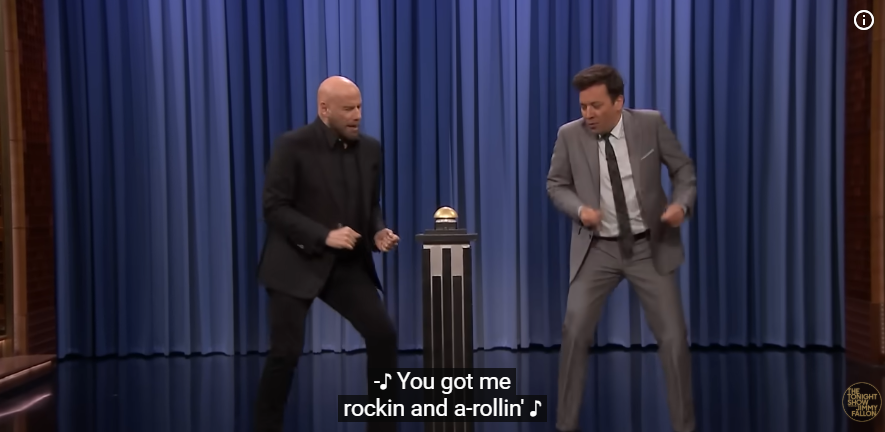
Years later, the clip continues to circulate because it delivers on multiple levels at once. It is funny without being mean. It is nostalgic without being dusty. And it offers something rarer than either of those qualities: a living reminder of how completely Travolta once dominated popular culture — and how much of that presence he still carries.
For audiences who grew up with Grease and Saturday Night Fever, the segment is a time machine. For those who discovered him later through Pulp Fiction or Face/Off, it is a compact greatest-hits reel performed by the only person who could make it feel authentic. For everyone else, it is simply a master entertainer enjoying himself in public.
The Joy of Watching Him Work
What stands out most is how little strain appears in Travolta’s performances. He is not grinding to recapture past glory. He is playing. The laughter is real. The physicality is still there. The timing remains sharp. Even the final group performance of the Barbarino number feels less like a bit and more like two people who understand that the best television moments happen when everyone stops trying so hard and simply commits.
That ease is part of Travolta’s enduring appeal. Plenty of stars can still deliver when the cameras are rolling. Fewer make it look like they are having more fun than the audience.
A Quiet Assertion of Ownership
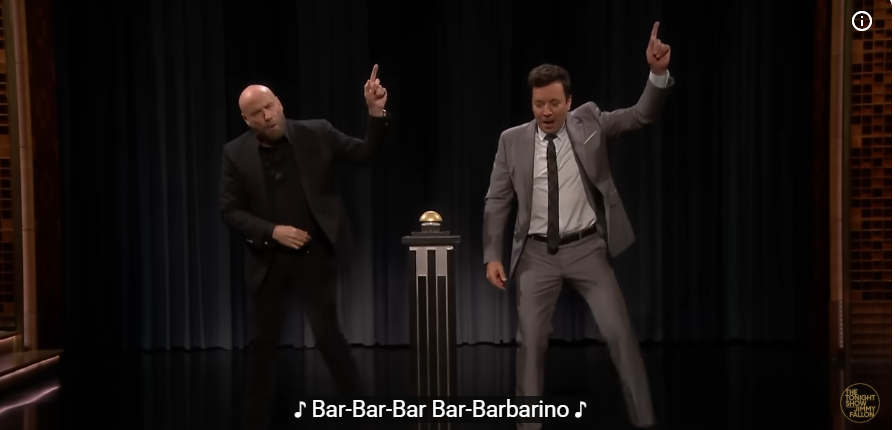
By the end of the game, Fallon declared Travolta the winner. The verdict was never in doubt. What the segment really delivered was something subtler: a public confirmation that certain cultural roles remain permanently attached to the people who created them.
No one else gets to be the definitive Danny Zuko. No one else owns Vincent Vega’s particular brand of cool detachment. And no one else can step into those characters decades later and make it feel immediate rather than archival.
John Travolta has always been more than the sum of his most famous parts. The “Travolt-Off” was simply a reminder that those parts still belong to him — and that he can still wear them better than anyone else alive.
The Pleasure of the Inevitable
There is a special satisfaction in watching a contest whose outcome feels predetermined in the best possible way. Audiences did not tune in hoping Fallon would somehow dethrone the original. They tuned in to watch Travolta do what he has always done: occupy the center of the room with a combination of skill, charm, and unforced authority.
He did exactly that. And in the process, he turned a light talk-show game into one of the more rewatchable celebrity segments of its era.
If you have never seen the full “John Travolt-Off,” set aside a few minutes. If you have seen it before, watch it again. Notice how quickly the energy shifts once Travolta starts performing. Notice how little he needs to do to reclaim each role. Notice how completely the room belongs to him by the final chorus.
That is not nostalgia talking.
That is simply the fact of the matter.
John Travolta did not just win a silly game on late-night television.
He reminded everyone, once again, that when it comes to playing John Travolta, there is still only one man for the job.
Would you have taken the challenge if you were in Fallon’s position?
Or would you have done the smart thing — stepped aside, enjoyed the show, and let the master work?
Watch the segment again and decide for yourself. Then tell us which Travolta role still ranks as your personal favorite in the comments.