Long before Weekend Update became one of the longest-running institutions on American television, it was still an experiment.
There was a desk.
There were fake news stories.
There was Chevy Chase.
And every once in a while, John Belushi would sit down beside him.
At that point, almost anything could happen.
During the earliest years of Saturday Night Live, Belushi frequently appeared on Weekend Update in a newsroom-style role, sometimes delivering editorials or acting as a correspondent.
Those appearances were perfectly suited to his style.
Belushi could begin relatively calmly.
Then the energy would build.
His voice became louder.
His gestures became bigger.
And before long, whatever serious subject he had supposedly come to discuss was almost irrelevant.
The real entertainment was watching John Belushi lose himself in the performance.
Chevy Chase Behind the Desk
To understand why the pairing worked, it’s important to remember how different Chevy Chase’s original Weekend Update persona was.
Chase was the original anchor when the segment debuted with SNL in 1975. He developed catchphrases including “I’m Chevy Chase… and you’re not,” and closed the broadcast with his familiar pleasant-tomorrow sign-off.
His style was controlled.
Dry.
Smug.
Belushi was almost the opposite.
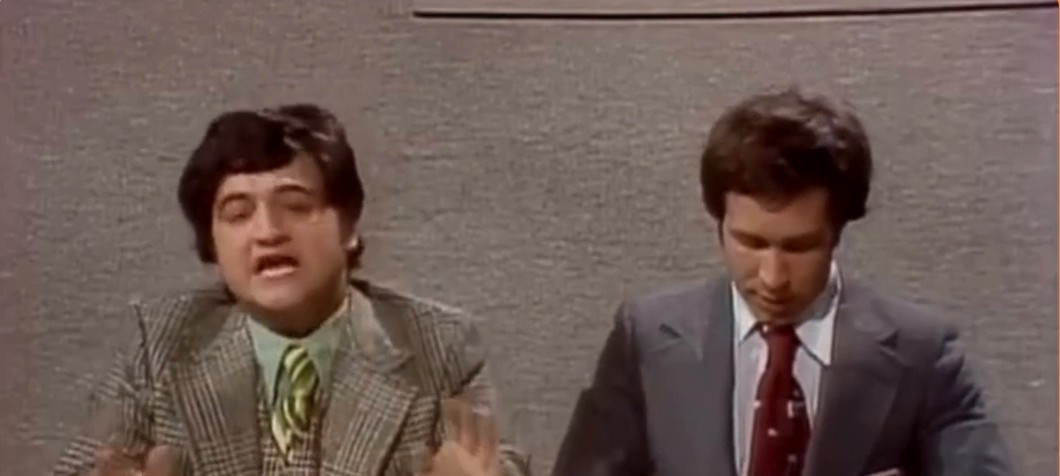
Where Chevy could get a laugh by barely changing his expression, Belushi often seemed capable of using every muscle in his body to make a joke work.
Put those approaches beside each other and the contrast became the comedy.
Chevy sits at the desk.
Belushi begins talking.
Chevy listens.
Belushi gets increasingly committed to whatever absurd point he is making.
Suddenly the calm fake-news program has become something else entirely.
Belushi’s Weekend Update Appearances
Belushi became a recurring presence around the Update desk during SNL’s original era.
One documented example is his famous March commentary from March 13, 1976.
The premise is almost ridiculously small: Belushi discusses the different ways the month of March can “come in.”
That’s it.
Yet SNL’s official YouTube description still highlights the segment decades later.
Why?
Because with Belushi, the premise was often only the starting point.
The joke was his commitment.
He could take an ordinary observation and attack it with the intensity of someone delivering the most important speech of his life.
That mismatch was hilarious.
The Power of Escalation
Belushi understood escalation extraordinarily well.
Many comedians begin with their funniest energy and then have nowhere else to go.
Belushi could start small.
He gave the audience time to understand the premise.
Then he increased the intensity.
A little louder.
A little faster.
A little more physical.
Eventually the audience wasn’t simply laughing at the words.
They were laughing because Belushi had transformed himself into a human explosion.
That style would become one of his signatures.
You can see variations of it across his SNL characters and later in movies such as National Lampoon’s Animal House and The Blues Brothers.
Belushi’s body was part of the joke.
His face was part of the joke.
Even the way he sat in a chair could become part of the joke.
Two Very Different SNL Stars
The contrast between Belushi and Chase also reflected something fascinating about the original SNL cast.
There wasn’t one dominant comedy style.
Chevy Chase had his.
John Belushi had his.
Gilda Radner had hers.
Dan Aykroyd could disappear into remarkably specific characters.
Garrett Morris and Laraine Newman brought still other sensibilities.
That variety helped make the earliest seasons feel unpredictable.
You never quite knew what the next segment would look like.
Weekend Update was especially useful because it could accommodate all of them.
Chase might deliver fake headlines.
Gilda Radner could appear as Emily Litella.
Garrett Morris could turn the show’s parody of news accessibility into another running gag.
And John Belushi could arrive with an “important” commentary that gradually descended into chaos. Contemporary histories of the segment specifically remember Belushi among its recurring early guests.
Before Belushi Became a Movie Star
There’s another reason these clips are so fascinating today.
We’re watching Belushi before his movie career exploded.
In 1978, National Lampoon’s Animal House would make him a major movie star.
That same period also saw the Blues Brothers become much more than a television comedy bit.
By 1980, Belushi and Dan Aykroyd were Jake and Elwood Blues on the big screen in The Blues Brothers.
But the raw ingredients were already visible during these early SNL appearances.
Confidence.
Physical comedy.
Musical energy.
An ability to take something completely ridiculous with absolute seriousness.
And above all, commitment.
Belushi rarely seemed interested in performing a joke halfway.
The Complicated Belushi–Chase Dynamic
Offstage, the relationship between John Belushi and Chevy Chase was more complicated than the effortless comedy might suggest.
Accounts from people around the original SNL describe a competitive relationship between the two men, particularly as Chase became the show’s earliest breakout star.
But competition can also produce interesting television.
Both performers had enormous confidence.
Both wanted laughs.
And both understood that their personalities were very different.
On camera, that difference became useful.
Chevy didn’t need to compete with Belushi’s physical intensity.
He could simply sit beside him.
In fact, the calmer Chevy remained, the crazier Belushi could appear.
It’s the classic comedy principle of contrast.
One performer creates chaos.
The other gives the audience something normal to measure the chaos against.
Why These Old Clips Still Work
Nearly fifty years later, the production looks unmistakably vintage.
The suits.
The desk.
The hairstyles.
The television picture quality.
But the comedy structure hasn’t aged nearly as much.
One person is trying to maintain order.
Another person is becoming increasingly ridiculous.
That’s timeless.
Modern viewers don’t necessarily need to understand every topical reference from the 1970s to appreciate Belushi’s delivery.
Sometimes his expression tells you everything you need to know.
That’s one of the reasons short clips from early Saturday Night Live continue circulating.
They preserve more than individual jokes.
They preserve personalities.
John Belushi Could Make a Desk Feel Dangerous
There’s something particularly funny about putting Belushi behind a news desk.
A desk represents control.
News anchors are supposed to be composed.
Everything should be organized.
John Belushi looked like he might destroy that organization at any second.
And that tension was exactly what made him perfect for Weekend Update.
Chevy Chase could deliver the news.
John Belushi could arrive and turn the entire desk into a comedy stage.
No elaborate scenery was necessary.
No special effects.
Sometimes all SNL needed was two chairs, a desk, Chevy Chase trying to keep a straight face…
and John Belushi getting increasingly worked up about something that absolutely did not deserve that level of intensity.
That was early Saturday Night Live: simple premises, fearless performers, and the constant possibility that John Belushi was about to take things completely off the rails. 😂🔥