Television comedy reached one of its most unforgettable peaks when Chris Farley introduced audiences to Matt Foley, the spectacularly unsuccessful motivational speaker whose idea of inspiration sounded more like a warning from a man whose own life had already gone completely off the rails.
On a legendary 1993 episode of Saturday Night Live, Farley entered an ordinary suburban living room with an extraordinary amount of energy. The premise could hardly have been simpler: two worried parents bring in a motivational speaker to straighten out their rebellious teenagers. But the moment Matt Foley walked through that door, the sketch stopped belonging to the premise.
It belonged entirely to Chris Farley.
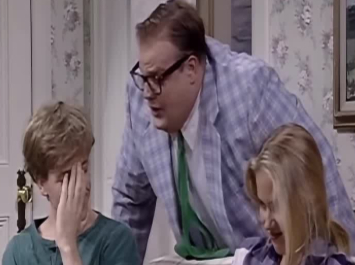
Playing the parents were Phil Hartman and Julia Sweeney, while David Spade and guest host Christina Applegate played the teenagers forced to endure Foley’s unusual lecture. Before Farley even began delivering the biggest jokes, his appearance told the audience exactly what kind of man had arrived.
His suit seemed slightly too tight. His tie and clothing looked uncomfortable. His glasses sat on his face as though they were barely surviving the performance. He constantly adjusted himself, pulled at his pants, leaned forward, and invaded everyone’s personal space.
Nothing about Matt Foley suggested that this was a man qualified to give anybody advice.
And that was precisely why the character worked.
Farley understood something fundamental about physical comedy: sometimes the funniest joke begins before the comedian says anything. Matt Foley’s body was part of the punchline. His posture, movements, sudden pauses and explosive bursts of motion created an atmosphere in which the audience never knew what he might do next.
Then came the warning that would follow Chris Farley for the rest of his career.
Foley tells the teenagers that if they continue down the wrong path, they may eventually find themselves “living in a van down by the river!”
The line itself is funny.
Farley’s delivery makes it immortal.
He doesn’t simply tell them about the van. He attacks the sentence. His voice rises, his body twists, and his frustration seems completely disproportionate to everything happening around him. It feels less like motivational advice and more like Matt Foley reliving his own personal nightmare in front of a confused family.
That contradiction is at the heart of the character.
Foley has supposedly arrived to teach two teenagers how to succeed, yet almost everything he reveals about himself suggests failure. His stories aren’t examples of triumph. They’re warnings. His authority comes not from having mastered life but from having apparently lost every argument he ever had with it.
The more he tries to appear inspirational, the more obvious his own desperation becomes.
And Farley commits to that contradiction completely.
The moment the cast started losing control
One of the greatest pleasures of watching the sketch today is paying attention to everyone who isn’t Chris Farley.
David Spade and Christina Applegate are supposed to be teenagers listening to Matt Foley. Instead, at several points, they appear to be fighting desperately against their own laughter.
Spade lowers his head.
Applegate covers her face.
Their reactions make the sketch even funnier because viewers can sense that the laughter isn’t simply part of the fictional scene. They are watching performers attempting to survive another performer’s comic intensity.
Farley keeps going.
Every movement becomes bigger.
Every warning becomes more dramatic.
Every piece of furniture begins to look increasingly unsafe.
Meanwhile, Phil Hartman provides the perfect contrast. Hartman was one of the great straight men of his generation, and his controlled presence allows Farley’s madness to become even more effective. He doesn’t need to compete with Farley. He simply creates a stable world for Matt Foley to destroy.
That balance is essential.
Physical comedy becomes much funnier when chaos has something normal to collide with.
And eventually, Farley literally collides with the set.
The coffee table moment that became SNL history
As Foley’s motivational speech becomes increasingly physical, Farley backs toward the living room furniture.
Then comes the crash.
He falls through the coffee table.
It is one of those perfect live-television moments where performance, timing, physical commitment and surprise suddenly become indistinguishable.
Farley doesn’t cautiously approach slapstick. He throws himself into it.
That willingness to look ridiculous was one of his greatest strengths as a comedian. There is no visible concern about appearing cool or sophisticated. Matt Foley is sweaty, frustrated, awkward, loud and completely out of control.
Farley embraces every bit of it.
The destruction of the table feels like the natural conclusion of everything the character represents. Matt Foley has entered this respectable suburban home supposedly to restore order, yet within minutes he has become the most disruptive person in the building.
That reversal turns a relatively straightforward family sketch into controlled comic anarchy.
The audience explodes.
The other performers struggle to maintain composure.
Farley keeps pushing forward.
That is the magic of live sketch comedy: everyone knows what is supposed to happen, but nobody can completely predict what will happen once the performers are standing in front of a live audience.
Why Matt Foley was more than screaming
It is easy to remember Chris Farley primarily for his volume and physicality. But reducing this performance to a man shouting and falling over furniture misses much of what made him extraordinary.
There is careful rhythm underneath the chaos.
Farley frequently begins quietly. He allows uncomfortable pauses to develop. He bends forward, looks directly at another character, and seems almost reasonable for a few seconds.
Then he explodes.
That contrast makes the explosions much funnier.
If Matt Foley screamed continuously, audiences would quickly become accustomed to it. Instead, Farley repeatedly resets the tension. He lowers the energy just long enough for viewers to wonder what is coming.
Then another eruption arrives.
His movements work the same way.
A small adjustment of his pants becomes a recurring character detail. A simple step across the room suddenly turns into an aggressive lunge. Sitting down never looks completely safe. Standing still seems almost impossible.
The character always appears to contain more energy than his body can comfortably hold.
That is not accidental chaos.
It is highly disciplined physical comedy disguised as complete loss of control.
The strange sadness underneath the laughter
There is also something surprisingly human hiding beneath Matt Foley’s ridiculous exterior.
He desperately wants people to listen to him.
He wants respect.
He wants his miserable experiences to mean something.
The teenagers may see an embarrassing stranger shouting in their living room, but Foley sees himself as someone delivering an urgent message about the dangers of wasting your future.
The tragedy, of course, is that he cannot communicate that message without revealing how badly his own future has apparently turned out.
That tiny element of sadness gives the character depth.
Many of the greatest comic characters are funny because they take themselves far more seriously than the world does. Matt Foley isn’t trying to entertain anyone. In his own mind, this is important work.
That sincerity makes every ridiculous moment stronger.
Farley never appears to wink at the audience and say, “Look how funny I’m being.”
Matt Foley believes in Matt Foley.
And that makes the audience believe in him too.
A perfect example of 1990s Saturday Night Live
The sketch also represents something special about Saturday Night Live during the early 1990s.
There were no elaborate digital effects required to create the moment. There was no complicated cinematic editing hiding the performance.
There was a living-room set, several talented performers, a live audience and Chris Farley.
That was enough.
Farley’s style belonged perfectly to live television because danger was part of the attraction. His performances often created the sensation that something might genuinely go wrong.
Would he break the furniture?
Would another cast member start laughing?
Would Farley himself lose control?
That uncertainty gave his comedy electricity.
Viewers weren’t simply watching jokes being performed. They were watching performers attempt to stay inside a sketch while one enormous comic personality kept pushing against its boundaries.
Why people still remember the van
Decades later, countless comedy sketches have disappeared from popular memory.
Matt Foley hasn’t.
The phrase about living in a van down by the river became permanently associated with Chris Farley because it captured everything special about the character in a single moment: desperation, exaggeration, failure, confidence and absurdity.
But the real reason the sketch survives isn’t merely the famous line.
It’s Farley’s commitment.
Watch his face.
Watch how quickly his body changes direction.
Watch Spade and Applegate trying not to laugh.
Watch Hartman remain remarkably composed while chaos unfolds beside him.
And watch the audience gradually realize that they are witnessing something much bigger than an ordinary sketch.
The performance feels alive.
That’s difficult to manufacture.
Comedy can be carefully written, rehearsed and planned, but occasionally a performer walks onto a stage and adds something that cannot be fully captured on the page.
Chris Farley had that ability.
A performance that became part of comedy history
Matt Foley would return in later Saturday Night Live appearances, but that first famous encounter remains the defining version for many fans.
It introduced a character who was simultaneously confident and catastrophically unsuccessful, intimidating and pathetic, aggressive and strangely lovable.
Most importantly, it showed exactly what Chris Farley could do when given a stage large enough for his personality.
He didn’t merely deliver punchlines.
He transformed himself into the punchline, the setup and sometimes even the collapsing furniture.
Years later, watching the sketch still produces the same anticipation. You know the famous warning is coming. You know the cast members are going to struggle not to laugh. You know that coffee table’s future isn’t particularly bright.
Yet somehow it remains funny.
That’s the difference between a popular sketch and a classic.
A popular sketch belongs to its moment.
A classic survives it.
And somewhere in the strange mythology of American television comedy, Matt Foley is still standing in that suburban living room, pulling up his pants, leaning toward two terrified teenagers and preparing to explain exactly what could happen if they don’t straighten out their lives.
Because according to Matt Foley, the alternative is waiting for them.
Right down by the river.