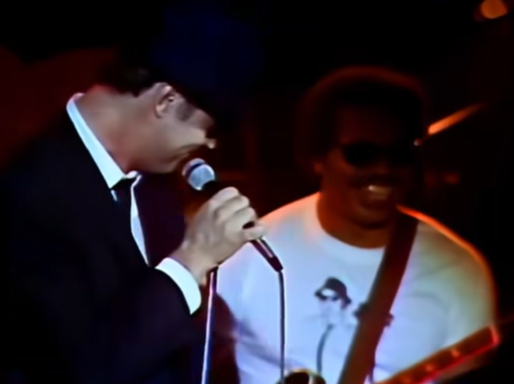
On the final night of 1978, music fans packed San Francisco’s Winterland Arena to say goodbye to one of America’s most storied concert halls. They were there for a marathon Grateful Dead celebration, but before the headliners began, two men in black suits, hats and dark sunglasses walked onto the stage.
One carried a harmonica. The other looked ready to explode from the force of the music.
They were Dan Aykroyd and John Belushi—Elwood and “Joliet” Jake Blues—and they were about to prove that the Blues Brothers were far more than a television joke.
The surviving footage captures them at exactly the right moment. The characters were new, the band was ferocious, and the 1980 movie that would make Jake and Elwood international icons was still in the future. Belushi and Aykroyd were famous comedians, but at Winterland they played like working musicians with something to prove.
Nearly five decades later, the grainy picture cannot contain their energy. When the band hits, Aykroyd leans into his harmonica and Belushi begins moving, the years disappear. For a few electric minutes, Winterland is alive again.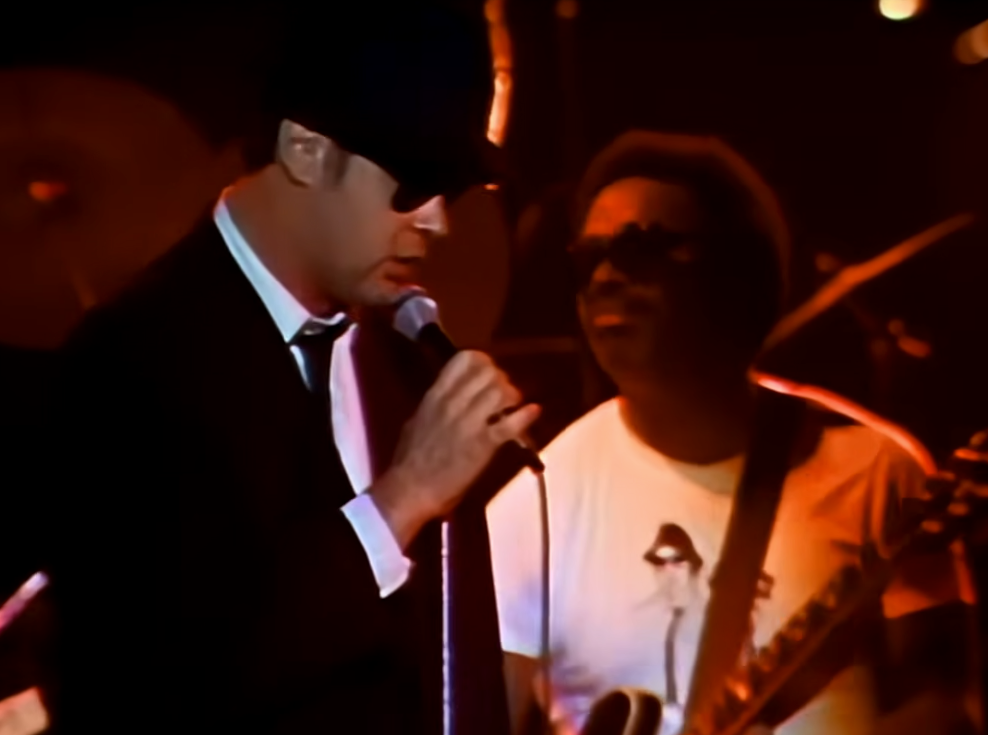
A Historic Stage on Its Final Night
December 31, 1978 was not simply another tour date. It was the final concert at Winterland, the venue promoter Bill Graham had made a central address in American rock culture. The Grateful Dead headlined the all-night celebration, New Riders of the Purple Sage also performed, and the Blues Brothers opened.
That setting makes their appearance remarkable. They were entering a room full of dedicated rock fans on an emotional night. Many had not bought tickets to see two actors from Saturday Night Live, and an opening act could easily have become background noise.
Belushi, Aykroyd and their band refused.
They began with the urgency of “I Can’t Turn You Loose.” The horn section announced that this would not be a quiet routine. Jake and Elwood had the silhouettes that would soon become famous, but their commitment was serious. The joke was in the characters. The music was never the joke.
Before the Movie, They Were Already a Real Band
Modern viewers often meet the Blues Brothers through the 1980 film: the Bluesmobile, the “mission from God,” enormous police chases and appearances by Aretha Franklin, James Brown, Ray Charles and Cab Calloway. The Winterland show came before all of that.
Belushi and Aykroyd developed their shared musical obsession while working on Saturday Night Live. The fully formed act reached the SNL stage in April 1978, and live performances later that year produced Briefcase Full of Blues. By New Year’s Eve, they were demonstrating that the concept could thrive outside a comedy studio.
Belushi did not approach Jake as a comedian pretending to sing. He attacked the material with a rough, forceful voice. Aykroyd did not hold a harmonica as a prop; he played it with respect for the tradition he loved.
Behind them stood exceptional musicians, including guitarists Steve Cropper and Matt “Guitar” Murphy, bassist Donald “Duck” Dunn, keyboardist Paul Shaffer and a powerhouse horn section. Cropper and Dunn brought direct connections to the Memphis soul sound associated with Stax Records. Their presence gave the act weight that celebrity alone could never provide.
Famous comedians stood at the front, world-class musicians stood behind them, and classic songs were treated with affection rather than parody. At Winterland, that combination caught fire.
John Belushi Could Turn Movement Into a Hook
The first thing viewers notice is how completely Belushi uses his body. He bends his knees, snaps his shoulders, points, pivots and throws himself into the rhythm. Even when he pauses, he seems to be storing energy. His black suit makes the physicality funnier because it looks too formal for what he demands from it.
The movement is exaggerated but connected to the music. A horn stab produces a gesture. A shift in the groove changes his posture. A vocal line sends him across the stage.
That is why fifty seconds can work so well as a modern social clip. Viewers need no biography or plot summary. They see a man in sunglasses moving with astonishing commitment and want to know what he will do next.
Even with his eyes concealed, Belushi’s face communicates urgency, confidence and mischief. Jake appears both completely in control and one beat away from chaos. He makes the audience laugh without asking for a laugh. The more seriously he takes every note, the more entertaining his wild choices become.
Dan Aykroyd Was the Essential Counterweight
Belushi’s energy becomes stronger because Aykroyd offers the opposite. As Elwood, he is contained and mysterious, delivering vocals and harmonica lines as if the spectacle around him is perfectly normal. Where Jake bursts outward, Elwood holds the center.
Jake is the ignition. Elwood is the engine.
Belushi can race toward the edge of the frame because Aykroyd remains a stable reference. Aykroyd can preserve his deadpan cool because Belushi supplies unpredictability. Their act was not based on one catchphrase, but on two distinct characters, a recognizable visual identity and a genuine musical partnership.
Elwood’s harmonica matters. Aykroyd is not waiting for Belushi to finish a comic dance; he is part of the musical conversation. The two men initially look like outsiders who wandered into a historic rock concert. Within minutes, they appear to own it.
Five Moments That Capture the Performance
The selected songs reveal how many versions of Jake and Elwood could exist within one set.
During “Messin’ With the Kid,” the groove leaves space for Belushi’s personality. His vocal attack is blunt and confident, while the band answers with tight, economical power. Jake delivers a phrase, the musicians react, and his body sells the attitude. The moment proves that he did not need a stunt to hold attention; timing was enough.
“Rubber Biscuit” moves closer to comedy without turning the music into a spoof. Its rapid, playful vocal sounds let Belushi use rhythm like an SNL performer uses a setup and payoff. He commits to every eccentric sound so completely that nonsense becomes showmanship.
Then “Soul Man” reveals the act’s mass appeal. The famous guitar figure hooks the room immediately, and the vocal structure lets Jake and Elwood work as a pair. Cropper’s guitar, Dunn’s bass, the drums, keyboards and horns create a disciplined wall of sound. Aykroyd stays cool while Belushi pushes against the song’s boundaries. It no longer feels like celebrities covering a hit; it feels like a real soul revue.
“Flip, Flop and Fly” places Belushi’s dancing at the center. His steps are funny in their scale and intensity, but they also reveal coordination. He listens closely enough to land movement inside the beat. What looks uncontrolled is supported by exact timing.
Finally, “Jailhouse Rock” provides a late-set sprint. Its instant recognition gives Belushi permission to lean into rock-and-roll physicality. He does not imitate Elvis Presley so much as run the song through the Jake Blues machine—heavier, sweatier and more chaotic. The band is sharp, the tempo is alive, and Belushi appears determined to leave nothing unused.
Together, these moments form a miniature portrait: blues authority, comic rhythm, soul power, physical performance and pure rock-and-roll release.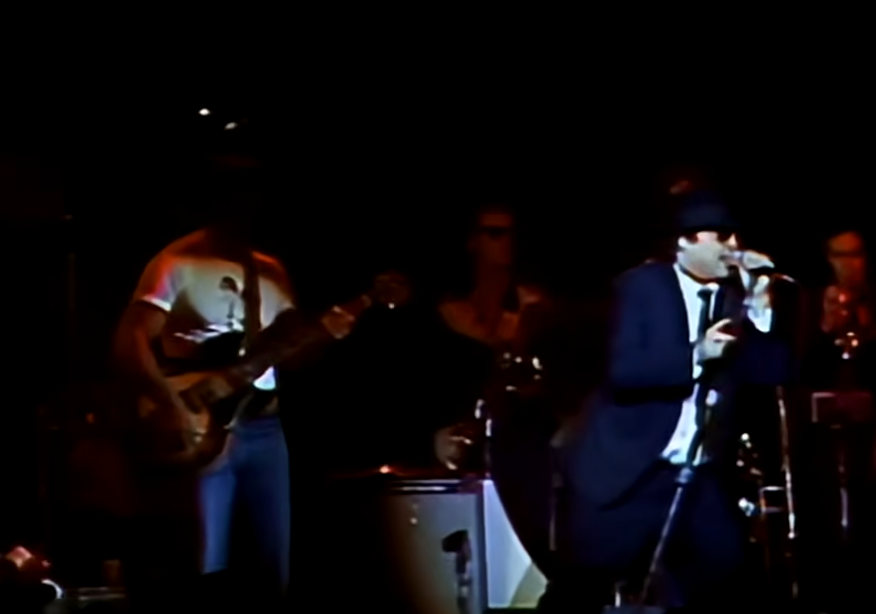
Why This Footage Still Stops the Scroll
The Winterland clips have nearly every quality that short-form video platforms reward, even though the performance happened decades before those platforms existed.
The wardrobe creates instant recognition. The opening notes of familiar songs provide an audio hook. Belushi delivers constant visual motion. Aykroyd supplies contrast. The horn section gives the music sharp peaks, and the camera regularly moves between close views and the full stage.
Most importantly, the footage contains genuine stakes.
Belushi and Aykroyd were not performing in the protected environment of their own movie. They were opening a historic show for another band’s audience. They had to win the room. Every gesture carries the feeling of performers earning attention rather than assuming it.
That effort translates across time and screen size.
A viewer may stop because of the black suits. Another may recognize “Soul Man.” A longtime fan may feel nostalgia for Belushi. A younger viewer may know none of the history and simply be stunned by the energy. Each path leads to the same question: Who were these two men, and why did they look as if this music mattered so much?
The answer is that it did matter.
Why the Music Still Feels Authentic
The Blues Brothers helped bring a broad audience toward songs rooted in blues, soul and rhythm and blues. Belushi and Aykroyd understood that affection alone was not enough; the material needed players who could give it authority.
The Winterland set moves through music associated with Otis Redding, Floyd Dixon, Junior Wells, the Chips, King Floyd, Sam & Dave, Big Joe Turner and Elvis Presley. It is not a random stack of novelty numbers. It is a guided tour through traditions the two frontmen admired.
The band keeps that respect audible. The arrangements are tight without becoming sterile. Horns punch at exactly the right moments, the rhythm section swings, and the guitars serve the songs instead of fighting for attention. Comedy opens the door, but musicianship keeps the performance standing after the joke has landed.
That balance is difficult to reproduce. If Jake and Elwood had treated the songs carelessly, the act would have aged like a costume party. If they had removed every trace of theatrical humor, they would have lost what made the partnership unique. Instead, Belushi’s comic instincts made the show accessible, Aykroyd’s musical commitment gave it credibility, and the band made it durable.
People could laugh, dance and leave curious about the artists behind the songs. That may be the Blues Brothers’ most lasting accomplishment.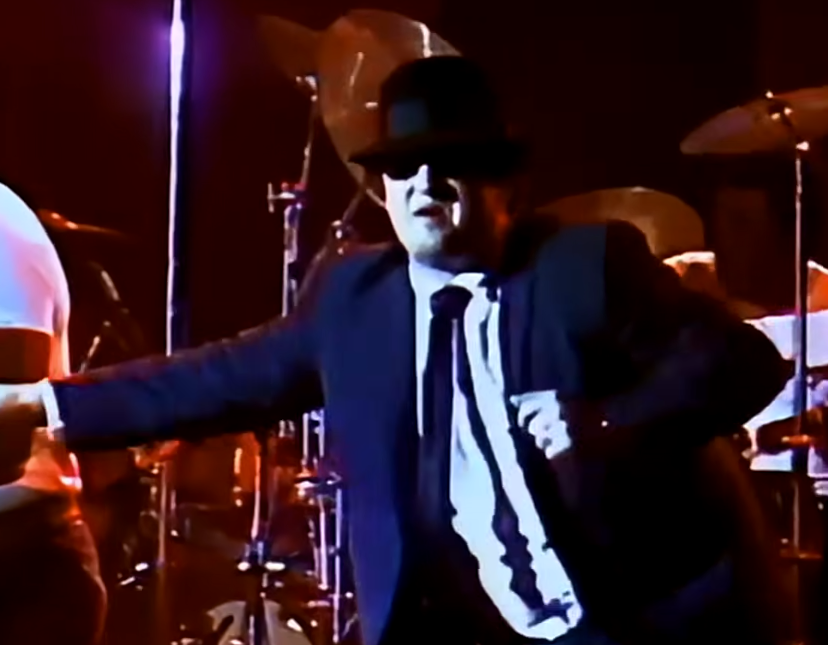
The Bittersweet Power of Watching John Belushi Now
Any old footage of John Belushi carries knowledge that the original audience did not have. He died in 1982 at only 33 years old.
At Winterland, none of that ending is visible. He looks unstoppable. His voice is forceful, his movement is fearless and his appetite for the moment seems limitless. He performs as if conserving energy would be a kind of dishonesty.
That makes the footage joyful, but it also gives it an ache.
There would be no long sequence of reunion tours featuring an older Jake and Elwood. There would be no chance to watch Belushi gradually reinterpret the character across decades. His time as Jake was compressed into a few extraordinary years.
The concert therefore preserves more than a successful act. It preserves possibility. The film had not yet been released. The characters’ future seemed wide open. Belushi and Aykroyd stood on the edge of something enormous, and the Winterland audience witnessed them before the rest of the world fully understood what was coming.
That sense of discovery remains embedded in the images.
A Farewell That Became a Beginning
Winterland closed after that New Year’s celebration, ending a major chapter in San Francisco music history. For the Blues Brothers, however, 1978 felt less like an ending than a launch.
They had moved from a shared obsession behind the scenes at SNL to television, a live album and major concert stages. The movie would soon expand their world into an epic collision of music, comedy and automotive destruction. Jake and Elwood would become permanent figures in American popular culture.
But the Winterland footage captures them before the mythology hardened.
They are not yet untouchable screen icons. They are two performers in black suits trying to win over a demanding room—and succeeding through commitment, contrast and an exceptional band.
That is why the video continues to feel alive.
You can admire Aykroyd’s cool precision. You can hear the authority of Cropper, Dunn and the musicians around them. You can laugh at Belushi’s movements and then realize how carefully those movements ride the rhythm. You can feel an audience gradually accept that the opening act is not a distraction from the historic night. It is part of the history.
On December 31, 1978, Winterland was preparing to disappear.
John Belushi performed as if he could keep the building standing through energy alone.
For the length of the set, it almost seemed possible.