Some of the funniest moments on The Carol Burnett Show weren’t sketches.
There were no elaborate costumes.
No carefully constructed sets.
No Tim Conway character slowly driving Harvey Korman insane.
Sometimes there was only Carol Burnett standing onstage and a person in the audience asking a question.
That was enough.
The audience question-and-answer segment became one of the defining traditions of The Carol Burnett Show. Before Carol disappeared backstage and returned as one of her outrageous characters, viewers had an opportunity to see something completely different.
They saw Carol herself.
And nobody — including Carol — knew exactly what was going to happen.
“Let’s Bump Up the Lights”
The concept was wonderfully simple.
At the beginning of the show, the studio lights would come up and Carol would invite members of the audience to ask questions.
It sounds ordinary today.
In the late 1960s, putting such an unpredictable interaction into the actual television program was much more unusual.
Burnett later explained that the idea had roots in her experience working with Garry Moore. Moore interacted with audiences before his programs, but those exchanges weren’t normally part of the televised show. When Burnett got her own series, executive producer Bob Banner suggested allowing viewers to meet the real Carol before she disappeared into the costumes and characters.
There was one obvious problem.
Nobody could control what the audience would ask.
Burnett remembered being frightened that nobody would have a question — and equally frightened that somebody would. But once the program had been on the air for several weeks, audiences began arriving ready to participate and Carol started enjoying the uncertainty.
That uncertainty became the magic.
One Question About a Floor
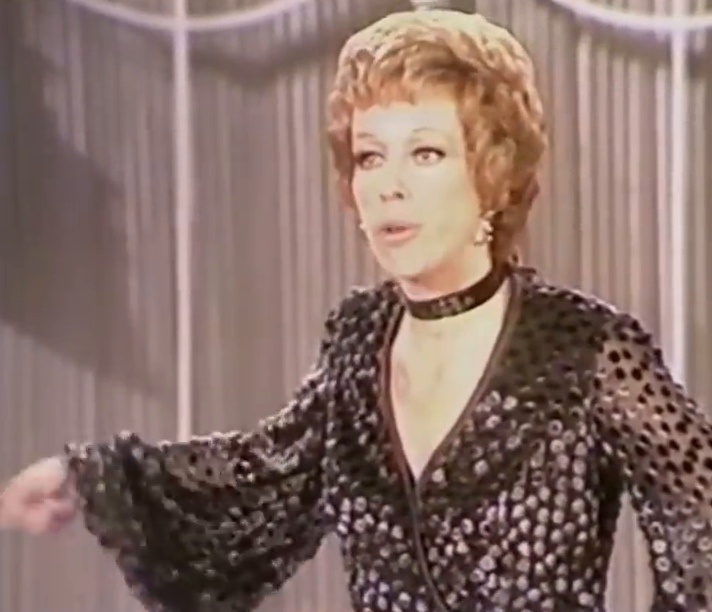
The clip here demonstrates exactly why the format worked.
An audience member isn’t asking Carol about Hollywood.
She isn’t asking about a famous guest star.
She isn’t even asking about comedy.
She wants to know what they use to clean the studio floor.
It’s an almost hilariously practical question.
Carol’s reaction immediately makes it funny.
Instead of dismissing the question, she plays with it.
She gets somebody backstage involved and learns that a vinyl cleaner is apparently used. Then she turns back to the woman and starts asking about the vinyl flooring in her own home.
Is it in the kitchen?
The bathroom?
All over?
The woman answers that it is all over — then clarifies, with perfect accidental comic timing, that she means only on the floor.
The audience erupts.
Accounts of the show’s memorable Q&A moments specifically preserve this exchange, which tells you how well such a tiny unscripted moment stuck with viewers.
Nobody needed to write the punchline.
It simply happened.
Carol’s Greatest Weapon Was Listening
What makes the scene particularly interesting isn’t the question.
It’s what Carol does with it.
A less experienced entertainer might answer quickly and move to another person.
Carol listens.
Then she asks another question.
The audience member answers.
Carol notices something funny in that answer and follows it.
Suddenly an ordinary exchange has developed a comic rhythm.
That’s improvisation in its simplest form.
Carol wasn’t simply waiting for an opportunity to deliver a joke.
She was paying attention.
That’s an important distinction.
The funniest response frequently came from whatever the audience member had just said.
That required confidence because Carol couldn’t prepare.
She had to trust her instincts.
The Audience Became Part of the Cast
The Q&A also changed the relationship between The Carol Burnett Show and its viewers.
Normally, television audiences watch performers.
Here, the audience could temporarily become part of the performance.
PBS’s Pioneers of Television specifically highlights these opening audience questions as a source of spontaneity on the program. Burnett recalled being nervous about the format at first before eventually embracing it.
That created a special intimacy.
The person asking about the floor wasn’t a professional comedian.
That’s exactly why the exchange feels so genuine.
You can hear people realizing that something funny has happened at essentially the same moment Carol realizes it.
There’s no elaborate setup.
No dramatic editing.
No social-media caption telling you when to laugh.
Just people in a room enjoying an unexpectedly funny conversation.
“Clean” Comedy Didn’t Mean Safe Comedy
The headline attached to this particular social-media edit — “Carol Burnett Is CLEAN!” — also points toward another important aspect of the show’s legacy.
The Carol Burnett Show developed a reputation for comedy that families could watch together.
Tim Conway later said Burnett was careful about maintaining a broad audience. He recalled that the show generally avoided political and religious division and that keeping the comedy family-friendly never felt like a creative sacrifice.
Burnett herself has similarly argued that comedy doesn’t need constant profanity to work. In a 2007 interview, she pointed to Conway’s work as an example of humor that could remain timeless without deliberately going off-color.
But “clean” didn’t mean predictable.
That’s crucial.
The audience Q&A could go almost anywhere precisely because the audience wasn’t scripted.
Someone could ask about Carol’s age.
Someone could ask for directions to the ladies’ room.
Someone could ask what kind of cleaner was used on the studio floor.
Carol’s job was to catch whatever came flying toward her and make something entertaining from it.
Why These Moments Work So Well Today
Ironically, the Q&A segments may be even better suited to modern social media than many elaborate television sketches.
They’re short.
They have an immediate setup.
They feature an unexpected response.
And they feel authentic.
Someone asks something strange.
Carol reacts.
Twenty or thirty seconds later, everybody is laughing.
That’s almost the perfect structure for a modern Facebook Reel.
But unlike content specifically manufactured for a 15-second attention span, these moments weren’t created that way.
They were simply conversations.
That’s part of their charm.
More than fifty years later, viewers can still recognize the situation immediately.
You don’t need to know the episode.
You don’t need to know who the guest stars were.
You don’t even need to know much about The Carol Burnett Show.
A woman asks a strangely specific question.
Carol thinks it’s funny.
They start talking.
And suddenly the audience member accidentally delivers the best line.
The Real Carol Burnett
Perhaps that’s why these Q&A segments became so beloved.
The sketches showed audiences what Carol Burnett could perform.
The questions showed them who she was when she couldn’t prepare.
Quick.
Warm.
Playful.
And willing to make herself part of the joke.
One account describing the series notes that these unscripted opening exchanges could occasionally go off the rails — and that unpredictability was precisely what made some of them so funny.
Carol didn’t always need Harvey Korman.
She didn’t always need Tim Conway.
She didn’t always need a Bob Mackie costume.
Sometimes all she needed was someone in the audience raising a hand.
And occasionally, that person just wanted to know:
What do you use to clean the floor?
Carol Burnett could take it from there. 😂❤️