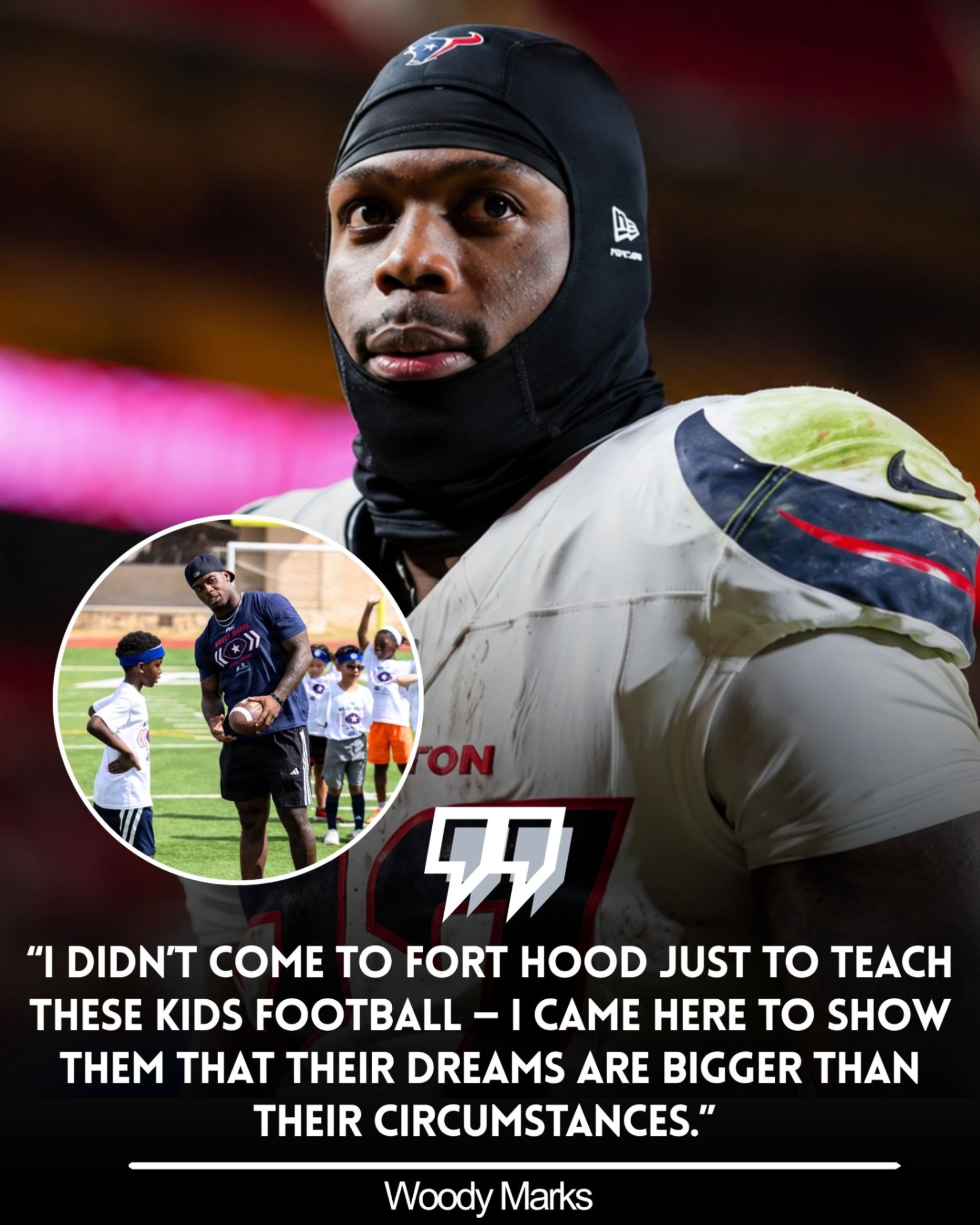
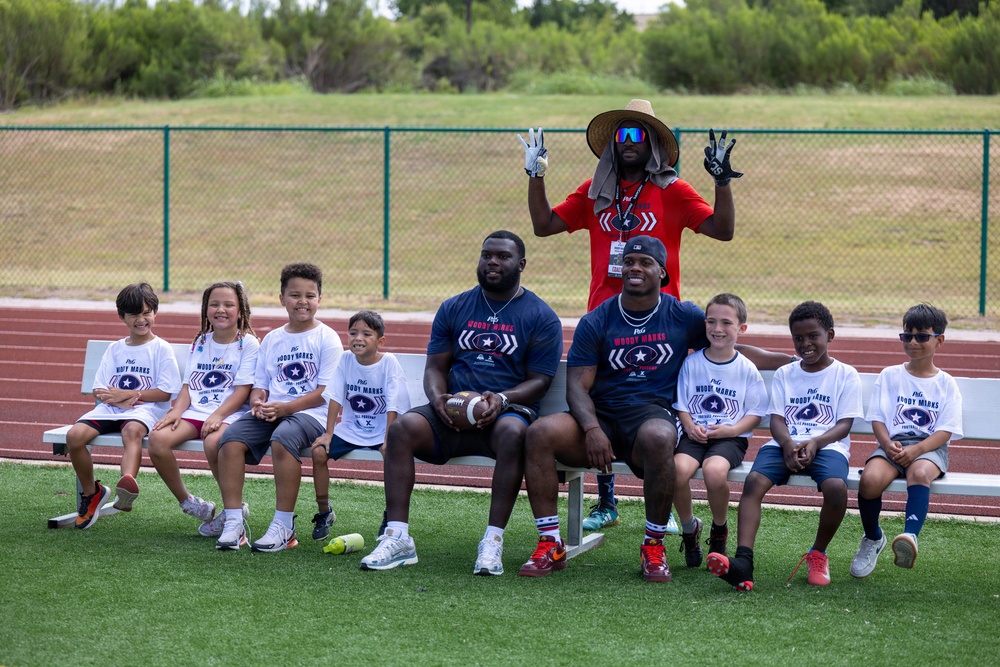
FORT HOOD, Texas — The sound of footballs flying through the air echoed across Phantom Warrior Stadium as more than 100 children sprinted between drills, competed against one another and listened carefully to coaches offering instructions.
For some, it was simply a weekend of football.
For others, it became something much more meaningful.
The two-day youth football camp, hosted at Fort Hood and led by Houston Texans running back Woody Marks, gave military-connected children an opportunity to learn football fundamentals, develop teamwork and meet an NFL player whose journey began long before he reached the professional stage.
But Marks made it clear from the beginning that the camp was never meant to be only about football.
The bigger goal was to help young athletes understand the importance of character, relationships, confidence and taking advantage of opportunities whenever they appear.
“Football is football,” Marks said. “Being a better person is what you want to be.”
That message became the foundation of the weekend.
A football camp with a bigger purpose
The energy at Phantom Warrior Stadium was unmistakable.
Children moved from station to station, practicing fundamentals and competing in different challenges. Coaches worked with them on position-specific techniques while Marks interacted directly with campers and encouraged them throughout the weekend.
There were drills.
There were competitions.
There were plenty of footballs in the air.
But the most important lessons were not necessarily about running routes, carrying the football or making tackles.
Marks wanted the children to leave with something they could use long after the camp ended.
Confidence.
Friendships.
A willingness to work with others.
And perhaps most importantly, the understanding that their current circumstances do not determine what they can eventually accomplish.
For many military children, life can involve frequent changes. Families may move from one installation to another, sometimes every few years. New schools, new neighborhoods and new teammates become part of everyday life.
That can be difficult.
But it can also build resilience.
Marks understood that connection was especially important for children growing up in military families.
“The best part about this world is just meeting new people, having connections,” he said.
That philosophy helped shape the entire event.
Why Fort Hood?
The decision to bring the camp to Fort Hood was not random.
Marks had previously visited military installations, including an earlier trip to Hawaii where he spent time with military children and families.
Those experiences stayed with him.
He saw firsthand the unique challenges military-connected families face and how meaningful it can be when professional athletes take time to connect with their children.
Those visits ultimately inspired Marks to create a similar experience for military youth in Texas.
The goal was simple: give kids something positive to look forward to.
“Just coming out here, seeing the kids, being around a great environment — I know what these guys go through,” Marks said.
Military families can face uncertainty that most people never experience.
Parents may travel for extended periods.
Families may move across states or even across the world.
Children can find themselves constantly adapting to new environments.
For Marks, creating a weekend where those children could simply play, compete, laugh and meet new people was incredibly important.
He wanted them to have a reason to smile.
“Just coming back and giving the kids something to be happy about,” Marks said.
More than 100 young athletes take the field
More than 100 children participated in the two-day camp.
The event brought together young athletes with different levels of football experience.
Some arrived already passionate about the sport.
Others were still discovering what position they enjoyed or whether football would become part of their future.
That did not matter to Marks.
The camp was designed to welcome everyone.
Children rotated through drills, competitions and instructional stations, learning from Marks and the coaching staff.
The emphasis was on fundamentals.
But the coaches also emphasized communication, cooperation and confidence.
For a young athlete, those lessons can be just as important as the technical skills.
Knowing how to work with teammates can help a child become a better football player.
Knowing how to communicate can help in school.
Learning how to respond after losing a competition can help throughout life.
And understanding that mistakes are part of development can help young athletes continue pursuing their goals instead of giving up.

Marks repeatedly returned to that broader message.
“It’s not about us,” he said.
“It’s about the kids.”
A lesson in resilience
Command Sgt. Maj. Loyd Rhoades, U.S. Army Garrison-Fort Hood command sergeant major, understands the challenges military children face.
He described military-connected youth as some of the most resilient children because of the frequent moves and changes they experience.
Military families may relocate every two or three years.
That means children are regularly asked to start over.
New classmates.
New teachers.
New neighborhoods.
New sports teams.
New friends.
For some children, that constant transition can make it difficult to establish lasting relationships.
That is why events such as the football camp can be so valuable.
They create a common environment where children can meet one another, compete together and discover that they share many of the same experiences.
Rhoades said the camp demonstrated Fort Hood’s commitment to military families by giving children an opportunity to build relationships while enjoying football.
The game became the connection point.
But the relationships were the real reward.
“There’s no ‘I’ in team”
One of the most important messages from the weekend came from Rhoades.
“There’s no ‘I’ in team,” he said.
It may sound like a familiar sports cliché, but in the context of military life, the lesson carries considerable weight.
Teamwork is essential on a football field.
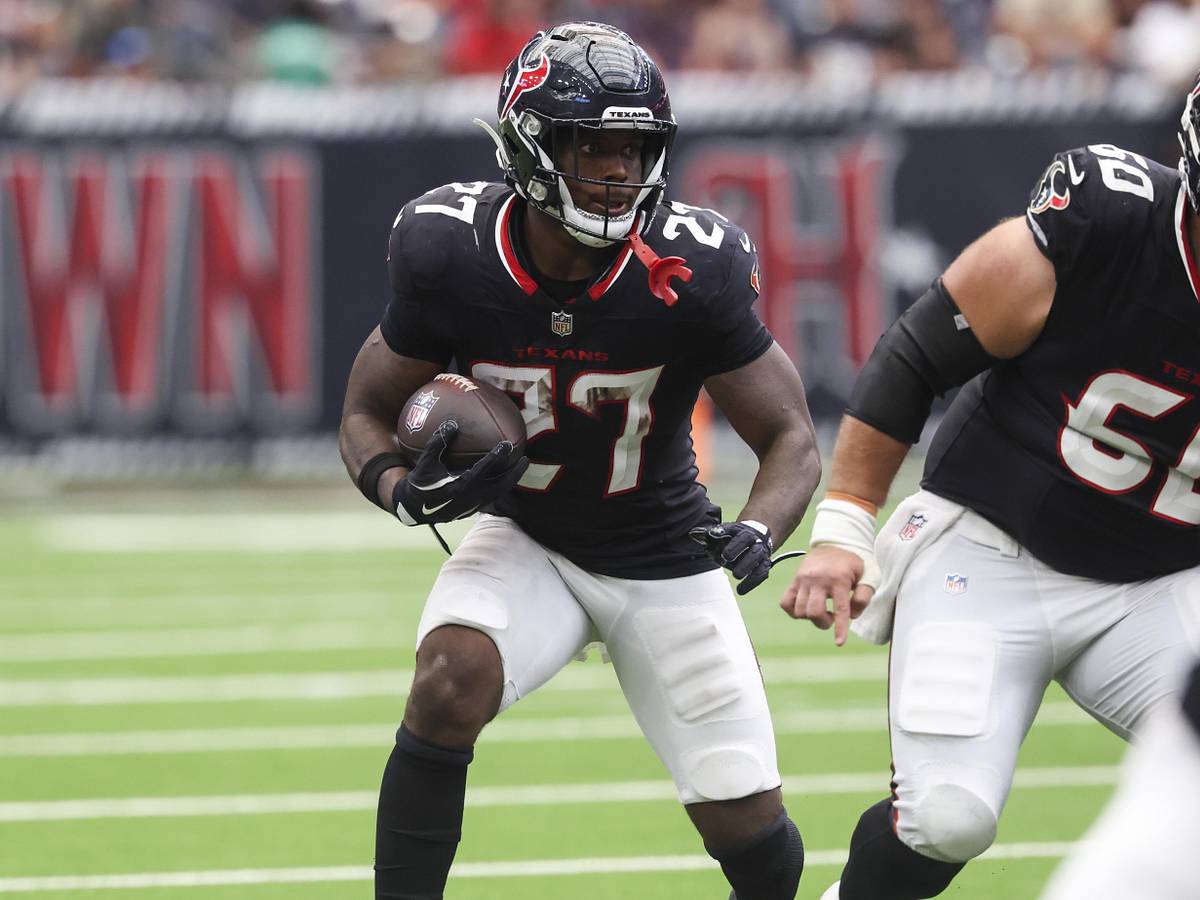
No running back succeeds alone.
No quarterback can win without protection.
No defense can function if players ignore their assignments.
And no football team can accomplish its goals if individual players care more about personal recognition than collective success.
The same principle applies outside sports.
Families work together.
Communities work together.
Military units work together.
Schools work together.
Successful people often rely on others along the way.
“Everything in life, you work together as a team,” Rhoades said.
For the children at Fort Hood, that lesson may become one of the most valuable things they take home.
A young athlete discovers new competition
Among the campers was 13-year-old Jason Estrada of South Belton Middle School in Belton, Texas.
For Estrada, the weekend was an opportunity to compete with other young athletes and meet someone he had previously watched from a distance.
But perhaps the most interesting part of his experience was discovering just how much talent existed around him.
“I learned that there’s a lot of talented kids here,” Estrada said.
That realization can be powerful for a young athlete.
Competition teaches children that there will always be someone faster, stronger or more experienced.
Instead of being discouraged by that reality, athletes can learn to use it as motivation.
They can watch what others do well.
They can learn from teammates.
They can challenge themselves.
And they can build friendships with people who share their passion.
Estrada said he was glad to meet the other campers.
That simple statement captures one of the central goals of the event.
The camp was not just about creating better football players.
It was about creating connections.
Opportunity can appear anywhere

For parents, the camp represented something more than a fun weekend.
James Smith, whose child participated, emphasized the importance of giving young people opportunities to discover what they are capable of achieving.
“I would like him to gain an opportunity,” Smith said.
That message mirrors one of the most important themes of Marks’ own journey.
Opportunity does not always arrive in an obvious form.
Sometimes it comes through a coach.
Sometimes through a teammate.
Sometimes through a chance encounter.
Sometimes it comes from simply showing up.
The challenge is recognizing the opportunity when it appears.
Smith pointed out that opportunities can exist anywhere and at any time.
For children growing up in military families, that perspective may be particularly meaningful.
Every new city can provide a new beginning.
Every new school can introduce a new mentor.
Every new football field can introduce a new teammate.
And every setback can potentially become another opportunity to grow.
Marks understands the message personally
Perhaps the reason Marks was able to connect so effectively with the campers is because he understands the uncertainty of pursuing a football dream.
Reaching the NFL is not guaranteed.
There are thousands of talented players competing for limited roster spots.
For every athlete who becomes a professional star, countless others see their football careers end before reaching that level.
Marks knows that the path can be unpredictable.
That is why his closing message resonated so strongly.
“No matter what round you’re picked in, no matter if you’re drafted or not, you still have an opportunity,” Marks said.
Then came the key lesson:
“Once you get the opportunity, you’ve got to take advantage of it.”
That is bigger than football.
It applies to school.
It applies to relationships.
It applies to careers.
It applies to life.
The NFL player becomes the mentor

For the children at Fort Hood, seeing an NFL player in person can make the idea of professional football feel more real.
Television can make athletes seem distant.
They appear on enormous screens inside stadiums.
They play in front of tens of thousands of fans.
Their names appear on jerseys.
But when a professional athlete stands on the same field as a group of children and works directly with them, the distance disappears.
Marks became a mentor rather than simply a player.
He could answer questions.
He could demonstrate techniques.
He could encourage a child after a difficult drill.
And he could share experiences about the journey that brought him to the NFL.
Those moments can have lasting effects.
A child may forget a specific drill years from now.
But they may remember the feeling of an NFL player telling them to keep working.
They may remember being encouraged.
They may remember being told that their opportunity could come at any moment.
Those memories can become motivation.
The real victory was off the scoreboard
There was no traditional scoreboard at the end of the weekend.
No championship trophy was handed out.
No statistics determined who had the best camp.
And no NFL contract was waiting for the most talented participant.
That was intentional.
The real measure of success was whether the children left feeling better than when they arrived.
Did they make a new friend?
Did they learn something new?
Did they gain confidence?
Did they discover a new passion?
Did they understand the importance of teamwork?
Did they walk away believing that they could accomplish more than they previously thought possible?
If the answer was yes, the camp accomplished its mission.
A weekend the children may remember for years
For many of the young participants, the memory of running onto Phantom Warrior Stadium and seeing footballs flying through the air will likely remain with them.
They will remember the drills.
They will remember the competition.
They will remember their teammates.
And many will remember meeting Woody Marks.
But perhaps the most important memory will be the message behind the event.
Your circumstances do not define your future.
Your opportunity may come from somewhere you never expected.
And when it arrives, you have to be ready to take advantage of it.
That is a powerful lesson for any young person.
For military children, who already demonstrate resilience through frequent changes in their lives, it may carry even greater significance.
Building something that lasts beyond the weekend
The greatest impact of a youth camp is rarely measured on the final day.
Its influence can continue long after the children leave the stadium.
A young athlete might continue practicing.
A new friendship might develop into a lasting relationship.
A child who was previously uncertain might gain confidence.
Another might decide to pursue football more seriously.
Someone else might discover that teamwork is one of their greatest strengths.
That is the kind of impact Marks hoped to create.
His goal was never simply to teach children how to play football.
He wanted to give them an experience.
He wanted them to meet people.
He wanted them to feel supported.
And he wanted them to leave with a greater belief in themselves.
Marks’ message extends beyond Fort Hood
The story of the Fort Hood camp ultimately reflects something much bigger than one weekend in Texas.
It demonstrates the influence professional athletes can have when they use their platform to connect with young people.
Marks could have spent his weekend elsewhere.
Instead, he chose to spend it on a military installation surrounded by children who may face challenges that most professional athletes never experience.
He showed up.
He coached.
He listened.
He encouraged.
And he reminded the campers that football is only part of the equation.
“Football is football,” Marks said.
Being a better person is the greater goal.
That message may be what the children remember most.
The opportunity is still theirs
As the camp came to an end, the children left Phantom Warrior Stadium with more than football drills in their memories.
They left with new connections.
They left with lessons about teamwork.
They left with an example of what hard work can eventually become.
And they left with a message from an NFL player who understands how quickly an opportunity can change a person’s life.
For Marks, the NFL represents the result of years of work and persistence.
For the children at Fort Hood, their journeys are only beginning.
Some may continue playing football.
Others may pursue completely different dreams.
But the lesson remains the same.
Opportunities will come.
They may not look exactly as expected.
They may arrive on a football field, in a classroom, at a new school or in an unfamiliar city.
The important thing is being prepared when they do.
As Marks put it, “Once you get the opportunity, you’ve got to take advantage of it.”
That may have been the most important play of the entire weekend.
There was no final whistle for it.
No scoreboard could measure it.
And no trophy could capture its value.
But for more than 100 military-connected children at Fort Hood, the opportunity to learn, compete, connect and dream a little bigger may be something they carry with them for years to come.
And for Woody Marks, that was the real reason to be there.