Imagine taking one of John Belushi’s strangest characters, putting him in the middle of the disco craze of the late 1970s, adding Gilda Radner to the mix and then letting Belushi loose on the dance floor.
The result could only have happened on early Saturday Night Live.
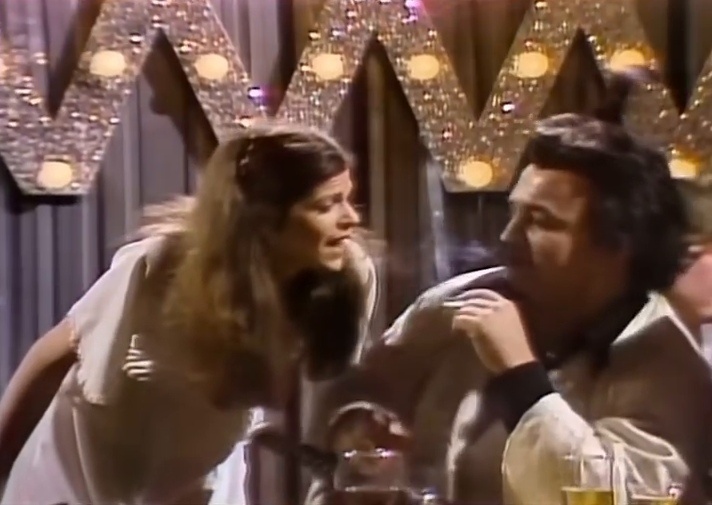
On February 25, 1978, SNL aired a sketch called “Samurai Night Fever.” It featured John Belushi as his recurring Samurai Futaba character and transformed one of the biggest pop-culture phenomena of the era into an unmistakably Belushi-style comedy.
More than four decades later, the premise is still wonderfully absurd.
Samurai Futaba Meets Disco
Belushi’s Samurai Futaba was already familiar to SNL viewers.
The basic joke behind the character was beautifully simple: Futaba looked and behaved like a warrior from another era, yet SNL repeatedly placed him in completely ordinary modern situations.
He could have a job.
Deal with customers.
Perform everyday tasks.
But he approached everything like a samurai.
The contrast did much of the comedic work.
Then SNL decided to send him somewhere even more ridiculous:
the disco.
The February 25 episode listing identifies Belushi as Samurai Futaba and Gilda Radner as his date, while O.J. Simpson appears as Joe, Futaba’s brother.
The Timing Couldn’t Have Been Better
The title “Samurai Night Fever” wasn’t subtle.
It was a direct play on Saturday Night Fever.
The John Travolta film had become one of the defining pop-culture sensations of the disco era, and SNL quickly found a way to filter that phenomenon through one of its own characters.
Even contemporary retrospectives describe the sketch as Belushi putting his own twist on Travolta’s disco persona.
But Belushi doesn’t simply dress like a disco dancer and imitate the movie.
He remains the Samurai.
That’s where the joke becomes stronger.
Instead of abandoning the character to parody something popular, the writers force two completely incompatible worlds together.
Samurai culture.
And 1970s disco.
Belushi Didn’t Need Normal Dialogue
One of the most remarkable things about Samurai Futaba was the way Belushi communicated.
The character famously spoke in exaggerated mock-Japanese rather than conventional English dialogue.
That meant the comedy depended heavily on physical performance.
Belushi’s face mattered.
His movements mattered.
His posture mattered.
His intensity mattered.
Buck Henry later recalled that working opposite Belushi in the Samurai sketches could be unpredictable because Futaba’s dialogue wasn’t conventional scripted dialogue in the normal sense.
That unpredictability suited Belushi perfectly.
He was an extraordinarily physical performer.
Give him a sword, a costume and a ridiculous situation, and he could communicate the joke without needing a long explanation.
Then Gilda Radner Enters the Picture
Pairing Belushi with Gilda Radner adds another dimension.
Radner was one of the defining performers of the original SNL cast, but her comedy operated differently from Belushi’s.
Belushi could be explosive.
Gilda could communicate enormous amounts through a reaction.
That makes their interaction particularly useful in a sketch this absurd.
Futaba behaves as though everything happening is completely natural.
The people around him have to respond to that reality.
And that’s often where the laughter comes from.
John Belushi Was Built for Physical Comedy
Look at Belushi’s best-known performances and a pattern becomes obvious.
Bluto in Animal House.
Jake Blues.
Samurai Futaba.
His Joe Cocker impression.
Even when dialogue mattered, Belushi’s body was always part of the performance.
He could throw himself into a scene with an intensity that made it feel dangerous.
Sometimes he looked as though he was only seconds away from losing control.
But that was part of the illusion.
Belushi understood timing.
He knew how long to hold a look.
He knew when to explode.
He knew when simply standing perfectly still could be funnier than moving.
“Samurai Night Fever” gives him another opportunity to use that physical vocabulary.
A Very Different Kind of SNL
Watching early SNL today can feel like opening a time capsule.
The show was willing to take ideas that sound almost impossible to explain in a pitch meeting and simply put them on television.
A samurai disco parody?
Why not?
The original cast included Belushi, Radner, Dan Aykroyd, Jane Curtin, Garrett Morris, Laraine Newman and Bill Murray.
Their styles were different enough that the show could move from political satire to character comedy to complete absurdity within a single episode.
The February 25, 1978 episode demonstrates that variety particularly well. Its lineup included “Samurai Night Fever,” a Babe Ruth sketch with Belushi, Weekend Update, several commercials and musical performances from Ashford & Simpson.
Samurai Futaba Was Bigger Than One Sketch
Another reason the clip matters is that Futaba wasn’t created specifically for this parody.
He was already an established Belushi character.
Writer Alan Zweibel later discussed how the Samurai concept kept generating new versions, including “Samurai Deli,” “Samurai Tailor,” “Samurai Stockbroker,” “Samurai Optometrist” and “Samurai Night Fever.”
That’s classic sketch-comedy character construction.
Find a character with a strong comic rule.
Then keep changing the environment around him.
The Samurai remains the Samurai.
The world changes.
And every new location creates a new collision.
Why This Clip Works So Well Today
“Samurai Night Fever” has something especially useful for modern short-form video:
you understand the joke visually almost immediately.
You don’t need five minutes of exposition.
You see John Belushi dressed as a samurai.
He’s in a disco.
Gilda Radner is there.
Something ridiculous is clearly happening.
That’s an excellent visual hook.
A viewer scrolling Facebook doesn’t necessarily need to know which season of SNL they’re watching.
The image itself creates curiosity.
Why is a samurai in a disco?
That’s enough to make someone stop scrolling.
Belushi’s Commitment Makes the Absurdity Work
There’s a lesson underneath many great Belushi performances.
He commits.
The funniest version of Samurai Futaba isn’t a comedian constantly reminding viewers that the costume is ridiculous.
Futaba takes himself seriously.
Belushi plays the absurdity as reality.
That allows everyone else to react to him.
It’s the same principle that helped make Jake and Elwood Blues work.
The Blues Brothers were funny partly because Belushi and Dan Aykroyd treated Jake and Elwood as though they were absolutely legitimate musicians.
Belushi understood that sometimes the funniest way to perform something ridiculous is to refuse to acknowledge that it’s ridiculous.
Before Animal House Changed Everything
The timing of this SNL appearance is also fascinating.
“Samurai Night Fever” aired in February 1978.
Later that year, National Lampoon’s Animal House would turn Belushi into a major movie star.
A September 1978 profile in The Washington Post described how dramatically Belushi’s public recognition had increased following the movie’s success and specifically mentioned his samurai character and “Samurai Night Fever” among the performances audiences already knew from SNL.
So this clip captures Belushi at a particularly interesting moment.
He was already a television comedy star.
But the enormous movie fame associated with Bluto was still just ahead.
Two Original SNL Legends in One Frame
There’s another reason this footage feels special now.
John Belushi and Gilda Radner became two of the most beloved figures from SNL’s original generation.
Seeing them together immediately evokes that first era of the show.
They represented different kinds of comedy.
Different energies.
Different characters.
But both possessed the ability to make something bizarre feel completely natural inside the strange universe of Saturday Night Live.
And That’s “Samurai Night Fever”
There are sketches that require pages of explanation.
This isn’t one of them.
John Belushi.
Gilda Radner.
A disco.
A samurai.
And the spirit of Saturday Night Fever turned completely upside down.
Sometimes comedy doesn’t need to be more complicated than that.
John Belushi didn’t just take Samurai Futaba to the disco.
He turned the dance floor into one more place where absolutely anything could happen. 😂⚔️🕺