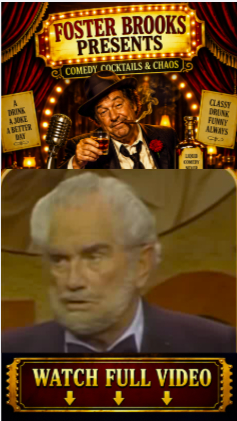
Foster Brooks’ “Lovable Lush” Was a Comedy Masterpiece
Foster Brooks’ signature character worked because audiences immediately understood the joke.
He appeared to be struggling through every sentence. Words seemed to arrive in the wrong order. Thoughts appeared to disappear halfway through a story. A simple observation could suddenly become an elaborate detour.
Yet somehow, Brooks always seemed to know exactly where he was going.
That contradiction made the character so funny.
The audience was watching a comedian pretend that he could barely keep himself together while delivering material with remarkable precision.
His pauses were carefully placed. His facial expressions were part of the routine. Even the apparent mistakes were controlled.
That is what separated Foster Brooks from someone simply pretending to be drunk.
He turned the illusion into an art form.
Bob Hope Was an Ideal Target
Bob Hope was one of the most recognizable names in American entertainment, making him an ideal target for a celebrity roast.
He had spent decades entertaining audiences with comedy, movies, television appearances, and live performances. More importantly, Hope understood the language of show business.
He knew that being the target of a roast was part of the entertainment.
That created an interesting dynamic when Foster Brooks stepped into the spotlight.
Brooks brought his deliberately disorganized “lovable lush” character, while Bob Hope represented the polished confidence of an established comedy legend.
The contrast alone was funny.
One performer looked like he was struggling to get through a sentence. The other had spent a lifetime mastering the stage.
And somehow, that combination worked perfectly.
The Art of Taking Aim Without Losing the Fun
A great roast is supposed to push boundaries while remaining entertaining.
Foster Brooks understood that balance.
His comedy could be outrageous, but the performance never felt like genuine hostility. The audience understood that this was part of the game.
Brooks was there to take aim at Bob Hope, but he was also there to entertain him.
That distinction is important.
The best celebrity roasts create the feeling that everyone involved is part of the joke. The honoree becomes the center of attention, while the comedians get permission to exaggerate, tease, and play with the celebrity’s public image.
Foster Brooks was particularly effective in this environment because his character naturally made everything feel absurd.
He could deliver an insult with such exaggerated innocence that the audience laughed at the performance as much as the actual joke.
Why Foster Brooks’ Timing Made Everything Funnier
One of the greatest strengths of Foster Brooks was his timing.
He rarely rushed.
Instead, he allowed the audience to wait.
A sentence might begin normally, then slow down. Brooks might pause, look uncertain, and continue as though he had just remembered where he was going.
That delay created anticipation.
The audience knew something was coming, but they had to wait for it.
Sometimes the waiting itself became the joke.
This is a classic comedy technique, but Brooks made it feel completely personal. His delivery was so distinctive that even the simplest line could sound like something only Foster Brooks could say.
His performance style was almost musical.
The pauses created rhythm.
The stumbles created movement.
The punchline provided the release.
The “Drunk” Character Was Smarter Than It Looked
At first glance, Foster Brooks’ character might seem simple.
But the simplicity was deceptive.
To maintain that persona successfully, Brooks needed complete control over his voice, timing, expressions, and physical mannerisms.
The character appeared unpredictable, but the performance was carefully structured.
That was the brilliance behind the “lovable lush.”
Brooks understood that audiences enjoy watching someone struggle toward a destination, especially when they suspect the destination will be funny.
Every hesitation increased anticipation.
Every exaggerated mistake created another opportunity for laughter.
And when the punchline finally arrived, it felt earned.
The Classic Celebrity Roast Atmosphere
There was something uniquely entertaining about celebrity roasts from the classic television era.
The stage was filled with familiar faces. Comedians knew the honoree personally or professionally. The audience understood the personalities involved.
That familiarity gave the jokes an extra layer.
When Foster Brooks took aim at Bob Hope, viewers were not simply watching an unknown comedian make jokes about a celebrity. They were watching one established entertainer playfully challenge another.
That made the moment feel like an inside look at show business itself.
It also created a sense of spontaneity that modern audiences may find especially charming.
The performers were not relying on fast editing or elaborate visuals.
They were relying on each other.
Bob Hope’s Ability to Be the Target
Part of the fun of a roast is seeing a famous entertainer become the target for once.
Bob Hope was normally the person delivering jokes and controlling the room. During a roast, that position could be reversed.
Suddenly, another comedian had the microphone.
Foster Brooks took advantage of that opportunity in the most Foster Brooks way possible.
Rather than approaching Bob Hope with an aggressive style, he used his confused, slow-moving character to make the situation even more ridiculous.
The comedy came from the contrast.
Bob Hope was the established legend.
Foster Brooks was the seemingly bewildered comedian trying to make his way through the routine.
That dynamic gave the performance its charm.
Why Classic Foster Brooks Comedy Still Works
Decades later, Foster Brooks remains memorable because his comedy was built around fundamentals that never disappear.
Timing still matters.
Character still matters.
Audience anticipation still matters.
And a great punchline still works.
His “lovable lush” character may belong to a particular era of television, but the craftsmanship behind it is timeless.
He understood how to make an audience wait.
He understood how to make silence funny.
And he understood that sometimes the journey toward a punchline can be just as entertaining as the punchline itself.
That is why clips of Foster Brooks continue to attract fans of classic comedy.
A Roast That Captured the Spirit of an Era
The Foster Brooks and Bob Hope roast represents something larger than one comedian making jokes about another.
It captures the personality-driven style of classic television.
These performances were built around entertainers who knew how to hold an audience without needing elaborate production.
Foster Brooks could command attention simply by walking to a microphone and beginning his familiar routine.
Once that voice appeared, audiences knew they were in for something special.
His “lovable lush” was instantly recognizable, and his ability to place that character into a celebrity roast made the format even more entertaining.
Final Thoughts
The “lovable lush” Foster Brooks taking aim at Bob Hope is exactly the kind of classic comedy moment that reminds viewers why vintage television remains so enjoyable.
Brooks brought his unmistakable character, his slow-burn delivery, and his incredible comedic timing. Bob Hope provided the perfect larger-than-life target.
Together, they created the kind of roast moment that feels less like a scripted television segment and more like a gathering of comedy legends having fun.
That was Foster Brooks’ greatest strength.
He could make a carefully planned routine feel completely spontaneous.
He could turn a pause into a punchline.
And he could make audiences laugh simply by pretending he had forgotten what he was talking about.
The “lovable lush” may have looked like he was barely keeping it together, but underneath the character was a master comedian who knew exactly how to make a room laugh.