Some comedy scenes need complicated setups, elaborate costumes, or a long series of misunderstandings before the audience starts laughing.
Carol Burnett could create comedy with something much simpler.
A hospital room.
A nervous patient.
A nurse.
And one very unexpected distraction.
This classic sketch from The Carol Burnett Show begins with what appears to be an ordinary visit to an emergency room. Jim Nabors plays a patient who needs medical attention, while Carol Burnett plays the nurse responsible for taking care of him.
Everything seems straightforward.
At least for a few seconds.
The patient is uncomfortable with the idea of removing his shirt. He’s hesitant, embarrassed, and clearly not enthusiastic about undressing in front of the nurse.
Carol’s character tries to reassure him.
After all, she’s a professional.
She’s a nurse.

She’s seen patients before.
There shouldn’t be anything unusual about a man taking off his shirt during a medical examination.
That’s the logic, anyway.
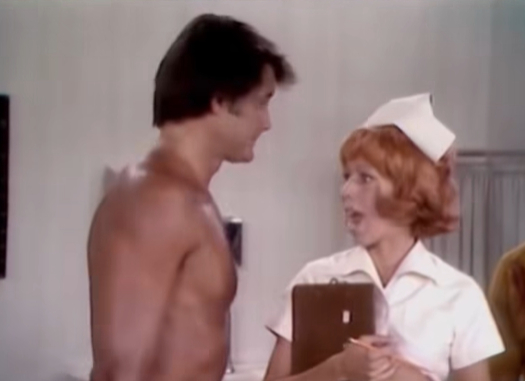
Then Lyle Waggoner enters the equation.
Suddenly, Carol’s professionalism is about to face a much bigger challenge.
The reluctant patient needs encouragement, so the idea is simple: have another man demonstrate that taking off a shirt isn’t such a big deal.
Lyle agrees.
And the moment his shirt comes off, the entire direction of the sketch changes.
Carol turns around.
She sees him.
And her reaction says everything.
That instant is what makes the scene work so beautifully.
Carol doesn’t need a complicated punchline.
Her face becomes the punchline.
One moment she’s behaving like a perfectly ordinary medical professional.
The next, she is completely captivated by the muscular man standing in front of her.
The actual patient suddenly becomes almost irrelevant.
And that reversal is hilarious.
Jim Nabors’ character came to the emergency room because he genuinely needs help.
But once Carol notices Lyle, her priorities begin changing very quickly.
The person who actually requires medical attention becomes an inconvenience.
The healthy man becomes the center of her attention.
That simple reversal gives the sketch its comic engine.
Every time Jim tries to remind her that he’s the patient, Carol becomes increasingly annoyed that he’s interrupting.
Meanwhile, she suddenly finds endless reasons to examine Lyle.
Does something hurt here?
How about here?
Maybe she should check something else.
Her professional concern becomes hilariously selective.
The joke isn’t simply that Carol finds him attractive.
The joke is how completely and immediately she abandons everything she was supposed to be doing.
That’s classic Carol Burnett.
She commits to the ridiculous situation without hesitation.
One of Burnett’s greatest strengths as a performer was her willingness to let her entire body participate in a joke.
She didn’t just deliver funny dialogue.
She reacted physically.
Her eyes changed.
Her posture changed.
Her voice changed.
Even the way she moved around another performer could become part of the punchline.
You can see all of that in this sketch.
Before Lyle removes his shirt, Carol’s nurse character controls the room.
She’s the professional.
She gives instructions.
She knows what she’s doing.
The patient is nervous, but she is confident.
Then she turns around.
Everything changes.
Suddenly, the nurse who seemed completely composed has trouble maintaining that professionalism.
That contrast is essential.
If Carol had behaved flirtatiously from the beginning, the scene wouldn’t be nearly as funny.
The audience needs to see the transformation.
Professional nurse first.
Completely distracted nurse second.
And Lyle Waggoner was perfectly cast for the joke.
Throughout his years on The Carol Burnett Show, Waggoner’s handsome appearance frequently became part of the comedy.
He could play the charming leading man, the romantic interest, or simply the impossibly attractive person whose presence disrupted everyone around him.
Here, his appearance is practically the entire setup for Carol’s reaction.
But Lyle doesn’t need to behave outrageously.
That’s another reason the scene works.
He mostly allows Carol to create the chaos around him.
The more normal he behaves, the more ridiculous Carol’s reaction becomes.
Jim Nabors provides another essential part of the equation.
His character has a legitimate problem.
He’s the reason everyone is in the emergency room in the first place.
Yet he gradually discovers that getting Carol’s attention may be harder than whatever brought him there.
That creates a second layer of comedy.
While Carol becomes increasingly fascinated by Lyle, Jim becomes increasingly frustrated.
He needs help.
She has more important things to do.
At least, more important from her perspective.
The audience understands the unfairness immediately.
That’s why each interruption becomes funnier.
Jim tries to redirect the nurse toward the actual emergency.
Carol treats him like the interruption.
It’s completely backwards.
And comedy often thrives on exactly that kind of reversal.
The person who should receive attention gets ignored.
The person who doesn’t need attention gets all of it.
The professional suddenly becomes the least professional person in the room.
The patient who was originally embarrassed becomes the only person behaving reasonably.
Everything is turned upside down.
Yet the situation remains simple enough that audiences can understand it instantly.
That’s one reason sketches like this continue working decades after they originally aired.
You don’t need to understand a complicated story.
You don’t need to know every character’s history.
You don’t even need to have watched another episode of The Carol Burnett Show.
The premise is immediately recognizable.
A nurse is trying to do her job.
An attractive man takes off his shirt.
She completely loses focus.
That’s it.
From that point forward, the performers can simply escalate the situation.
And escalation was something The Carol Burnett Show did extremely well.
A great comedy sketch rarely stays at the same level.
The first joke establishes the idea.
The next joke pushes it further.
Then further again.
Eventually, the characters are behaving in ways that would have seemed ridiculous at the beginning but now feel completely natural within the comedy.
Carol’s reaction follows that pattern.
At first, she’s simply surprised.
Then she’s interested.
Then she becomes increasingly focused on Lyle.
Meanwhile, the real patient receives less and less sympathy.
The audience knows exactly where things are going, but that doesn’t make it less funny.
In fact, anticipation becomes part of the experience.
Every time Jim tries to get Carol’s attention, viewers are waiting to see how she will dismiss him this time.
Every time Carol moves closer to Lyle, viewers know professionalism is disappearing a little more.
And Carol Burnett’s facial expressions sell every moment.
That’s especially important because physical comedy doesn’t always require someone falling down or crashing into furniture.
Sometimes physical comedy is simply a reaction.
A look.
A pause.
A sudden change in posture.
Carol mastered that kind of humor.
She understood how long to hold an expression.
She understood when to look at the audience.
She understood when to move quickly and when to freeze for just long enough to let the laughter build.
Those instincts can’t easily be taught.
They come from years of performing in front of live audiences.
And The Carol Burnett Show gave Carol an ideal environment for that style.
The audience’s laughter became part of the rhythm.
A reaction would get a laugh.
Carol would wait.
Then the next line would arrive.
That timing gives classic variety comedy a feeling that is difficult to recreate.
The performers aren’t simply acting for cameras.
They’re playing directly to people in the room.
You can feel that energy.
The cast could sense when something was working.
And when Carol found a reaction that the audience loved, she knew exactly how to use it.
This sketch also demonstrates why the show’s ensemble mattered so much.
Carol may be at the center of the joke, but the scene depends on everyone around her.
Jim Nabors provides the frustrated patient.
Lyle Waggoner provides the distraction.
Carol stands between them.
Remove any one of those elements and the joke becomes weaker.
Together, however, they create a perfect comic triangle.
One man desperately wants the nurse’s attention.
The other man isn’t even trying to get it.
And naturally, the nurse becomes interested in the wrong one.
It’s a beautifully simple structure.
More than fifty years later, audiences can still laugh at it because the humor isn’t dependent on some forgotten news story or political reference.
It’s based on human behavior.
Attraction.
Embarrassment.
Jealousy.
Distraction.
And the universal frustration of trying to get someone’s attention when they’re interested in absolutely anything except you.
Those ideas haven’t disappeared.
The setting may look unmistakably like television from another era, but the comedy itself remains easy to understand.
That’s part of Carol Burnett’s lasting appeal.
Her greatest moments weren’t funny only because of the words in the script.
They were funny because of what she did with them.
Another performer could play the same nurse, say the same lines, and follow the same stage directions.
It still wouldn’t necessarily produce the same result.
Carol brought something uniquely expressive to the role.
She could turn one look into an entire joke.
And when Lyle Waggoner took off his shirt in this sketch, Carol didn’t need to explain what her character was thinking.
Everyone already knew.
The nurse had officially forgotten about her patient.
And from that moment forward, the emergency room had an entirely different emergency.