One of the strangest things about the legendary dance in Pulp Fiction is that John Travolta and Uma Thurman don’t perform it like two people desperately trying to entertain us.
They don’t beam at the audience.
They don’t turn toward the camera and announce how much fun they’re having.
They don’t perform enormous choreography designed to prove how talented they are.
Instead, Vincent Vega and Mia Wallace look almost completely serious.
And somehow that makes everything better.
Their faces say cool; their bodies say play.
That contradiction is the secret ingredient hiding inside one of the most recognizable movie dances of the 1990s.
How-To, DIY & Expert Content
The movements can be funny.
Sometimes they’re deliberately strange.
Hands move across the face.
Fingers point.
Bodies twist.
One performer answers the other.
Yet Vincent and Mia rarely behave as though anything about this is particularly amusing.
They dance with the seriousness of people involved in something far more important than a restaurant dance contest.
That gives the sequence its hypnotic quality.
We aren’t simply watching choreography.
We’re watching two characters communicate.
And for a few minutes, dialogue becomes unnecessary.
The dance works because Vincent and Mia don’t move like professional dancers performing the same routine.
They remain distinct.
Mia has her rhythm.
Vincent has his.
Sometimes they mirror one another.
Sometimes one person initiates something and the other responds.
Sometimes they seem almost to occupy separate worlds.
Then suddenly they’re connected again.
That creates the feeling of a conversation.
It’s not:
Here is Step One.
Now Step Two.
Now Step Three.
It feels closer to:
Your move.
My move.
What about this?
Fine. Try this.
Thriller, Crime & Mystery Films
That structure gives the dance personality.
And personality matters more here than technical perfection.
Travolta obviously arrived with an enormous history of screen dancing.
Audiences knew that history.
But Uma Thurman’s nervousness about the scene actually contributed something interesting to the final result.
She later recalled feeling awkward and shy about dancing with Travolta.
That could have been a problem.
Instead, the contrast became useful.
Mia doesn’t need to dance like John Travolta.
She needs to dance like Mia Wallace.
And that’s exactly what Thurman does.
Uma Thurman turns apparent simplicity into character.
Watch the small movements.
The hands.
The eyes.
The head.
That famous black bob becomes almost another element of the choreography.
She doesn’t need to cross huge distances.
Mia can command attention while remaining relatively contained.
She looks as though she expects Vincent to keep up with her rather than the other way around.
That fits the larger dynamic of their evening.
Vincent is there because he has been assigned to accompany his boss’s wife.
Mia is the person setting much of the social rhythm.
She chooses the direction.
She challenges.
Vincent reacts.
Then the dance allows him to answer.
For a brief period, they meet on more equal territory.
No complicated conversation is necessary.
Movement tells us that these two people have discovered a rhythm together.
That doesn’t mean they’re identical.
Their differences are precisely what make the chemistry interesting.
Travolta performs one of the smartest tricks an experienced dancer can perform: he makes dancing look casual.
That’s much harder than it sounds.
A performer who knows how to dance can easily show too much.
The audience becomes aware of skill.
Technique moves into the foreground.
The character disappears.
Travolta avoids that.
Vincent Vega never suddenly transforms into Tony Manero.
There is no giant Saturday Night Fever display.
No attempt to remind everyone that Travolta once became an international symbol of disco-era screen dancing.
Vincent stays Vincent.
The movements are controlled but relaxed.
The body understands rhythm without advertising expertise.
Travolta dances below his maximum ability because the character requires it.
That is acting through movement.
And it is one reason the sequence aged so well.
The scene isn’t impressive because Vincent performs something impossible.
It’s memorable because his movements feel like something Vincent would actually choose.
The dance scene also carries a wonderful piece of cinematic history: Quentin Tarantino wrote it before John Travolta had officially become Vincent Vega.
Tarantino later explained that people naturally assumed the scene existed because he had cast the star of Saturday Night Fever.
It didn’t.
The dance was already part of the story.
Once Travolta was cast, however, the connection became irresistible.
That accidental alignment gave the scene another dimension.
Movie history walked onto the dance floor with Vincent Vega.
Audiences could watch Vincent.
But they couldn’t completely forget Travolta.
That’s impossible.
Put John Travolta on a dance floor and decades of cultural memory arrive with him.
Tarantino doesn’t fight that association.
He uses it.
But he doesn’t simply repeat it either.
That’s the important part.
If Travolta had recreated his old dancing persona, the scene might have become a nostalgic stunt.
Look!
John Travolta is dancing again!
Instead, Pulp Fiction turns audience memory sideways.
Yes, Travolta is dancing.
But not like before.
He’s older.
The clothes are different.
The character is different.
The setting is deliberately artificial.
The music comes from another cultural moment.
Everything is familiar and unfamiliar at once.
That combination is central to Pulp Fiction itself.
The movie constantly takes recognizable pieces of American popular culture and rearranges them.
Restaurants.
Crime stories.
Old songs.
Television imagery.
Movie archetypes.
They feel familiar individually.
Together, they feel strange again.
The dance does exactly the same thing with John Travolta.
We know this man can dance.
But we have never watched him dance quite like this.
Travolta also brought personal knowledge into the sequence rather than simply following a fixed routine.
He later recalled that Tarantino wanted the Twist, while Travolta suggested incorporating other novelty dances he remembered, including movements associated with dances such as the Batman, the Hitchhiker and the Swim.
Travolta demonstrated the possibilities, and the vocabulary expanded.
That history explains the variety of movement.
But knowing the names of the dances isn’t what makes the finished scene great.
The important thing is what Travolta and Thurman do with them.
They transform recognizable dance vocabulary into character behavior.
The dance isn’t presented as a history lesson.
Nobody stops to explain anything.
The movements simply exist inside Vincent and Mia’s strange little universe.
Tarantino’s camera helps enormously because it gives us time to watch the bodies.
This sounds obvious.
It isn’t.
Dance can be destroyed by filmmaking.
Too many cuts can fragment movement.
Too many close-ups can remove our sense of the performer’s body.
Overly complicated camera movement can compete with the performers.
The Pulp Fiction sequence understands that the actors are already visually interesting.
Sometimes the best thing a director can do is allow movement to remain visible.
Travolta later described Tarantino calling out different dance styles while filming, allowing the pair to move between them.
The resulting sequence maintains a playful unpredictability.
We can watch one movement become another.
We can see Travolta and Thurman react.
The performers remain the center of attention.
Professional choreographers have pointed to another fascinating quality: the seriousness of the faces against the silliness of some of the movements.
In a later analysis of the scene, choreographers Lauren Yalango-Grant and Christopher Grant highlighted exactly that contrast—the characters’ expressions remain intensely serious while their bodies perform playful movements.
They also noted the push-and-pull quality between Vincent and Mia.
That observation gets to the heart of the scene.
Imagine exactly the same movements performed with giant smiles.
It changes everything.
Suddenly the scene becomes cute.
Perhaps cheerful.
Maybe even conventional.
But that’s not Vincent and Mia.
The seriousness protects their coolness.
Their bodies can become ridiculous because their faces refuse to admit anything ridiculous is happening.
That tension creates comedy without turning the sequence into a joke.
Mia’s face is particularly important.
She often looks directly toward Vincent.
Not nervously.
Not apologetically.
Almost challengingly.
She appears to be studying him.
Can you do this?
Are you going to follow?
Vincent answers with movement.
Their eye contact becomes choreography.
That’s easy to overlook because audiences naturally watch arms and legs during a dance.
But faces are moving too.
Eyes are communicating.
Tiny reactions change the meaning of a gesture.
The choreography doesn’t stop at the shoulders.
Travolta’s performance has another subtle quality: he doesn’t try to dominate Thurman.
This is especially impressive given his dancing reputation.
The obvious temptation would be to make Travolta the star of the sequence and let Mia respond.
Instead, the scene needs both characters.
Mia can initiate.
Vincent can follow.
Vincent can introduce a movement.
Mia can answer.
The chemistry depends on exchange rather than display.
That is why the scene remains memorable as “John Travolta and Uma Thurman dancing,” not merely “the John Travolta dance scene.”
Thurman is essential.
Without Mia’s particular physical attitude, Vincent’s movements lose their counterpoint.
The sequence also demonstrates how chemistry can exist without conventional romance.
Screen chemistry is sometimes misunderstood as simply two attractive actors looking good together.
Real screen chemistry is about response.
Does one performer change what we notice about the other?
Does an action produce an interesting reaction?
Does silence between them contain information?
Travolta and Thurman constantly alter each other’s energy.
That is chemistry.
One becomes more interesting because the other is present.
Remove either performer and the rhythm changes completely.
Thurman herself later admitted she hadn’t expected that chemistry.
Years afterward, while discussing working with Travolta again, she reflected that she wouldn’t necessarily have predicted their screen connection when they first met.
Travolta similarly described chemistry as something difficult to predict.
That’s another reason the dance feels special.
You cannot manufacture every ingredient.
Production can cast carefully.
A director can create the circumstances.
Actors can rehearse.
A cinematographer can frame them beautifully.
But sometimes two performers simply create an energy together that nobody can fully engineer.
Vincent and Mia have it.
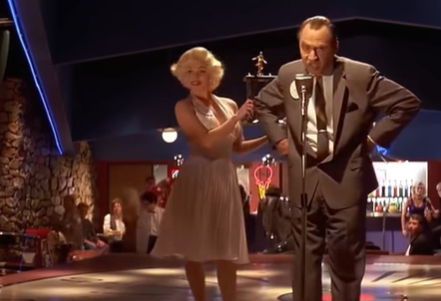
The setting makes their connection even stranger.
Jack Rabbit Slim’s is not designed to feel natural.
It’s an exaggerated fantasy of American nostalgia.
Everything around Vincent and Mia reminds us of another era.
The environment is artificial by design.
Then these two characters step onto the floor and somehow become the most natural thing inside it.
The fake nostalgia surrounds a strangely genuine interaction.
That’s a beautiful contrast.
The restaurant performs the past.
Vincent and Mia simply perform each other.
And then there’s the music.
The scene’s rhythm doesn’t require elaborate dialogue because music changes the rules.
Characters who have spent the evening talking can suddenly stop explaining themselves.
Movement becomes enough.
This gives the scene an almost dreamlike interruption from the rest of the story.
For a few minutes, narrative urgency loosens.
The movie allows itself to dance.
That interruption is important.
Tarantino’s film is built from sharp tonal shifts.
Conversation can become tension.
Tension can become humor.
A mundane situation can suddenly become significant.
The dance sequence represents another unexpected turn.
A crime movie temporarily becomes something close to a musical.
Then it moves on.
That’s part of why the scene remains so easy to isolate and watch independently.
You don’t need the entire plot to enjoy it.
You can discover the clip online decades later and understand the basic relationship immediately.
Two people.
A contest.
Music.
A challenge.
Movement.
Chemistry.
The scene contains its own miniature story.
They step up.
They assess each other.
They begin.
They connect.
They finish.
That completeness makes the sequence unusually portable.
It can leave the movie and still function.
But inside the movie, the dance accomplishes something more important: it makes us spend time with Vincent and Mia without requiring exposition.
We learn how they behave around each other.
Mia’s confidence.
Vincent’s coolness.
Their curiosity.
Their ability to temporarily find a shared rhythm.
The scene tells us something emotional while appearing to stop the plot.
That’s efficient filmmaking disguised as a detour.
Some of cinema’s most memorable scenes work exactly this way.
They don’t appear to be delivering necessary information.
They simply let characters exist.
Later, we realize that existence was the information.
The dance also arrived at a pivotal moment in John Travolta’s career.
Pulp Fiction competed at Cannes in 1994 and won the Palme d’Or. Cannes’ official record lists Travolta as Vincent Vega and Thurman as Mia Wallace in Tarantino’s film.
Travolta’s performance also brought him another Academy Award nomination, something Cannes notes in its career profile of the actor.
So the man audiences remembered dancing became newly relevant partly through a film that let him dance again—but refused to make the dance a simple repeat of his past.
That’s almost too perfect.
The scene became iconic because it contains multiple versions of American movie memory at once.
There’s Travolta’s dancing history.
There’s Tarantino’s fascination with earlier popular culture.
There are vintage novelty dances.
There is the deliberately nostalgic restaurant.
There is a 1990s filmmaker remixing earlier eras into something contemporary.
Then Uma Thurman enters the equation and prevents everything from becoming merely a John Travolta retrospective.
Mia Wallace makes the dance belong to Pulp Fiction.
Her bob.
Her white shirt.
Her controlled expression.
Her fingers moving through the air.
Those images became as important to the scene’s identity as Travolta’s movements.
Together, the two actors created something instantly recognizable.
Perhaps the greatest compliment to the scene is that people still want to imitate it even though there isn’t one impossible move to master.
That’s unusual.
Many famous dance scenes become famous because audiences are amazed by technique.
This one became famous because audiences want to inhabit the attitude.
People don’t necessarily want to dance better after seeing Vincent and Mia.
They want to dance like them.
That distinction explains everything.
The scene sells personality.
Not perfection.
Confidence without showing off.
Playfulness without smiling for approval.
Two people completely committed to looking cool while doing movements that sometimes look wonderfully ridiculous.
And maybe that’s why the scene feels freer with age rather than more dated.
Modern audiences are surrounded by highly polished choreography.
Perfect synchronization.
Multiple camera angles.
Performances engineered for short clips.
Vincent and Mia offer something almost refreshingly small.
Two bodies.
One floor.
A handful of movements.
A great song.
A camera watching.
The magic comes from the people, not the difficulty.
Anyone can understand the movements.
Nobody can exactly reproduce Travolta and Thurman’s chemistry.
That’s the part that cannot be taught.
The previous story about John Travolta’s contribution explains where some of the steps came from; watching the finished scene reveals something even more important—why those steps mattered.
They gave Vincent and Mia a language.
A way to challenge each other.
A way to flirt with danger without explaining it.
A way to become playful while keeping their masks of coolness intact.
And a way for two very different performers to discover a rhythm neither could have created alone.
John Travolta brought decades of instinct to that dance floor, and Uma Thurman brought exactly the uncertainty and attitude the scene needed.
One performer could have dominated.
Neither did.
They watched.
Answered.
Mirrored.
Separated.
Returned.
And kept those wonderfully serious faces through almost all of it.
Thirty years later, that may still be the strangest and most beautiful thing about the Pulp Fiction dance: Vincent Vega and Mia Wallace look like they’re barely trying—and John Travolta and Uma Thurman make that look impossible to forget.