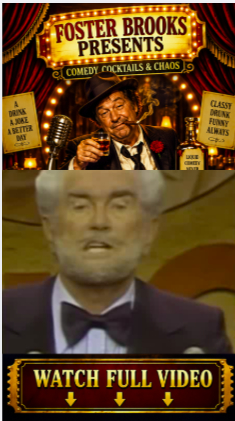
Foster Brooks Knew How to Make an Entrance
Foster Brooks did not need a complicated introduction to capture an audience’s attention.
His character did most of the work.
Once Brooks settled into his familiar persona, viewers immediately understood the kind of comedy they were about to experience. He appeared ready to share another story, another observation, or another piece of advice, usually with far more confidence than the situation deserved.
That confidence was crucial.
The humor came from watching someone who seemed completely convinced that he was making perfect sense while everything around him suggested otherwise.
Brooks never treated the character as a throwaway gag. He committed to every detail, from his voice to his expressions and physical mannerisms.
That commitment turned a simple comedy character into a signature performance.
“I’ve Got One More for You!” Builds the Perfect Setup
One of the most entertaining things about Foster Brooks was his ability to create anticipation.
A line such as “I’ve got one more for you!” immediately makes the audience wonder what is coming next.
That is the beauty of a good comedy setup.
The audience knows another story is coming, but they do not know where it will lead.
Brooks could take that anticipation and stretch it for as long as necessary. A pause might come before the next sentence. He might appear to search for the right words. His expression might suggest that he was about to reveal something incredibly important.
Then the story would begin.
And almost immediately, the audience could sense that things were going to become complicated.
The “Lovable Drunk” Was More Than a Gimmick
Foster Brooks became famous for his “lovable drunk” character, but reducing the performance to the character alone misses what made it work so well.
Brooks was an exceptional comedic actor.
He understood how to communicate humor through small movements and subtle changes in expression. He knew when to pause and when to continue. He understood how to make the audience anticipate a punchline without giving it away too quickly.
Most importantly, he understood character consistency.
Every ridiculous statement had to sound completely natural coming from the person he was portraying.
That is why the persona became so memorable.
The audience was not simply watching Foster Brooks tell jokes. They were watching a character who genuinely believed every word he said.
His Comedy Was Built Around Escalation
A typical Foster Brooks routine could begin with something completely harmless.
Then another detail would be added.
Then another.
Before long, the original situation had become something much more absurd.
That gradual escalation was one of Brooks’ greatest comedic strengths.
He did not necessarily need the biggest joke at the beginning. Instead, he allowed the story to build naturally.
The audience followed along because each new detail seemed to make the situation even more ridiculous.
And just when viewers thought the story could not possibly become stranger, Brooks could find another way to raise the stakes.
That structure helped his routines remain engaging from beginning to end.
Dean Martin Made the Moments Even Better
Foster Brooks was particularly effective in the relaxed environment of classic television variety programs and celebrity specials.
His appearances connected especially well with the atmosphere surrounding The Dean Martin Celebrity Roast, where comedians and celebrities were encouraged to play off one another.
Dean Martin’s presence created an ideal contrast.
Martin was famously cool, relaxed, and effortlessly charismatic. He did not need to dominate every moment. Instead, he could sit back and allow performers like Brooks to take the spotlight.
That made Martin’s reactions especially valuable.
When Foster Brooks delivered another ridiculous line, Martin’s smile or laughter could become part of the entertainment. Viewers were watching both sides of the exchange.
Brooks created the chaos.
Martin enjoyed the chaos.
The audience enjoyed watching both.
Why Foster Brooks Could Steal the Show
The phrase “steals the show” is often used loosely, but Brooks had a particular ability to make it happen.
He did not need to be the loudest person on stage.
He simply needed enough time to develop his character.
Once he began telling a story, attention naturally shifted toward him.
The audience wanted to hear the next sentence.
They wanted to see the next expression.
They wanted to know how badly the story was going to unravel.
That level of attention is one of the clearest signs of a great performer.
Brooks could take a relatively simple premise and make the audience feel as though they were waiting for a major revelation.
Then he would deliver the next part with that perfectly measured comedic timing.
The Pauses Were Part of the Joke
Perhaps one of the most underrated elements of Foster Brooks comedy was his use of silence.
His pauses were not empty spaces.
They were part of the performance.
A pause could create anticipation. It could make a line funnier. It could allow the audience to react before Brooks continued.
Sometimes his facial expression during a pause communicated more than the words themselves.
That is an important reason his comedy remains enjoyable today.
His performances rewarded viewers who paid attention to the smallest details.
Classic Television Gave Him Room to Perform
Foster Brooks’ style was perfectly suited to an era of television that allowed comedians more time to develop a routine.
Modern entertainment can move quickly, but classic variety television often gave performers the opportunity to establish a character and let the audience settle into the rhythm.
Brooks took full advantage of that format.
He could build anticipation slowly.
He could react to laughter.
He could extend a story.
And he could allow the room to become part of the performance.
That atmosphere helped create the feeling that viewers were witnessing a live comedy experience rather than simply watching a series of scripted punchlines.
Why Audiences Still Love Foster Brooks
The enduring popularity of Foster Brooks comes down to more than nostalgia.
His comedy works because the character is immediately understandable.
You know who this person is.
You know how he speaks.
You know that his confidence is probably going to get him into trouble.
And you know that the story is likely to become much more complicated than it needs to be.
That familiarity creates comfort, while the unpredictable details keep the routine entertaining.
It is a combination that few performers manage to achieve.
The Lasting Appeal of His Classic Bits
A great comedy routine can survive long after its original television broadcast.
Foster Brooks created many moments with that kind of staying power.
His routines were built around recognizable human behaviors: confidence, confusion, storytelling, exaggeration, and the desire to have one more thing to say.
That is why “I’ve got one more for you!” feels so appropriate for his comedy style.
There was always another story.
Another pause.
Another strange explanation.
Another reason for the audience to laugh.
And Brooks always seemed ready to continue.
Final Thoughts
Foster Brooks had an extraordinary talent for making audiences believe that the next story would be even better than the last.
His unforgettable “lovable drunk” character, careful timing, expressive reactions, and relaxed storytelling created a comedy style that remains instantly recognizable.
When he announced that he had “one more” bit, audiences knew they were probably getting more than just another joke. They were getting another carefully crafted performance built around one of television’s most memorable comedy characters.
That is why Foster Brooks could walk onto a classic television stage and steal the show without ever appearing to try.
He simply became the character, started telling the story, and let the laughter take care of the rest.
And decades later, that formula still works.