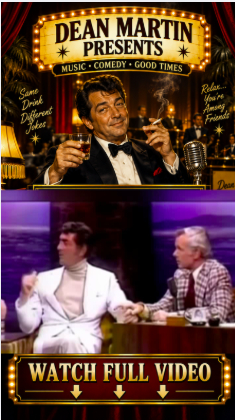
Dean Martin Made “Cool” Look Effortless
Dean Martin’s public persona was built around effortless charm.
He never appeared desperate for attention. He did not need to shout to command a room. His relaxed body language and understated delivery gave him an unmistakable presence.
That quality became especially valuable on television.
As a host, Martin understood that the show did not always have to revolve around him. He could introduce a performer, sit back, listen, and let the guest create the comedy.
But while Martin could easily maintain a cool expression through ordinary jokes, particularly funny performers could eventually break through that calm exterior.
And when they did, audiences got to see a side of Dean Martin that was even more entertaining.
The Comedy Became Harder to Contain With Every Joke
The funniest part of a great comedy exchange is often the buildup.
One joke lands.
The audience laughs.
Then another joke arrives.
Martin smiles.
Another punchline follows.
Now he is trying not to laugh.
The comedian notices the reaction and keeps going.
Suddenly, the situation becomes almost impossible to control.
That kind of escalation was perfect for classic television comedy.
Instead of relying on a single punchline, performers could build momentum. Each successful joke made the next one more effective because the audience was already laughing.
Dean Martin’s reactions became part of that momentum.
Foster Brooks Knew How to Stretch a Joke
Foster Brooks was one of the performers particularly well suited to this type of comedy.
His famous “lovable drunk” character relied heavily on pacing and personality.
Brooks could take a simple story and make it increasingly ridiculous without ever appearing to realize just how absurd the situation had become.
His pauses were carefully timed.
His facial expressions added another layer.
His exaggerated confidence made everything sound completely believable within the strange world of his character.
That approach made it difficult for other performers to predict where the routine was heading.
For Dean Martin, that unpredictability was a dangerous combination.
Why Dean Martin’s Laughter Made the Scene Better
Dean Martin did not need to become the comedian to contribute to the comedy.
His reaction was enough.
When Martin tried to maintain a straight face, viewers could immediately see the effort.
A smile might appear at the corner of his mouth.
His eyes might give away the fact that he was amused.
Then, after another perfectly timed joke, the composure could finally disappear.
The laughter felt genuine.
And genuine laughter is one of the most powerful forms of comedy.
The audience was not only laughing at the joke. They were laughing because Dean Martin was laughing too.
The Perfectly Cool Host Finally Breaks
The contrast was what made these moments so memorable.
Dean Martin was famous for looking cool.
The comedian was doing everything possible to destroy that calm atmosphere.
The audience was already laughing.
Martin was attempting to recover.
That created a small dramatic question inside the comedy:
Could Dean Martin keep it together?
Eventually, the answer was often no.
And that was perfectly fine.
In fact, it was usually even funnier when he gave up trying.
Celebrity Roasts Were Built Around Personality
The Dean Martin Celebrity Roast was an ideal setting for this kind of interaction.
The show brought together famous entertainers and public figures and gave comedians permission to exaggerate their personalities.
The audience already knew the people being discussed.
That familiarity made the jokes easier to understand and gave performers more freedom to push their material.
But the real magic often came from the reactions.
A celebrity might laugh at a joke aimed at someone else.
Another performer might make an unexpected comment.
Dean Martin might suddenly lose his composure.
Those moments gave the roast a feeling of spontaneity.
Dean Martin Was an Expert at the Reaction Shot
One of Martin’s greatest television skills was knowing how to react without overpowering the performer.
He understood that a simple expression could sometimes be more effective than another line.
A raised eyebrow could suggest disbelief.
A grin could signal that he knew exactly what was coming.
A burst of laughter could tell the audience that the joke had landed.
Because Martin’s normal expression was so relaxed, any change became noticeable.
That made his reactions naturally entertaining.
Why Old-School Comedy Feels So Different
Classic television comedy had a slower rhythm than much of today’s entertainment.
There was time for a comedian to tell a story.
There was time for the audience to laugh.
There was time for the host to react.
And there was time for everyone to enjoy the moment before moving on.
That pacing was ideal for someone like Dean Martin.
His personality was not built around constant motion.
He could sit comfortably, listen to the performers, and allow the atmosphere to develop.
When the laughter finally became too much, the payoff felt natural.
The Chemistry Between Performers Was Everything
The best Dean Martin comedy moments were rarely about one person alone.
They depended on chemistry.
The comedian had to know how far to push.
The host had to know when to react.
The audience had to be willing to follow the performance.
When all three elements worked together, the result could feel almost spontaneous.
Dean Martin’s laughter became another instrument in the performance.
It gave the comedian encouragement.
It gave the audience another reason to laugh.
And it made the scene feel less like a perfectly controlled television production and more like something genuinely happening in the room.
Dean Martin’s Cool Image Made His Laughter Even More Valuable
There is a simple reason viewers enjoy watching someone normally composed lose control.
The contrast is funny.
Dean Martin could spend an entire segment looking completely relaxed.
Then one comedian would find the perfect joke.
Martin would try to suppress the smile.
The next joke would arrive.
The smile would become laughter.
And suddenly, the famously cool entertainer was no longer pretending to be unaffected.
That transformation was part of the entertainment.
A Moment That Captures Dean Martin’s Television Magic
The phrase “the jokes kept coming” perfectly describes the rhythm of classic roast comedy.
The performer builds momentum.
The audience gets louder.
Dean Martin tries to stay composed.
Then another punchline arrives.
At some point, there is simply no reason to fight the laughter anymore.
Martin’s willingness to let himself react was one of the qualities that made him such an effective television personality.
He understood that audiences appreciated authenticity.
They wanted to see entertainers having fun.
And when Dean Martin genuinely laughed, viewers could feel that he was enjoying the same moment they were.
The Legacy of Dean Martin’s Comedy Moments
Dean Martin is remembered for his music, movies, television appearances, and Rat Pack legacy.
But his spontaneous reactions remain some of the most charming pieces of his television career.
They reveal an entertainer who was not afraid to let another performer steal the spotlight.
More importantly, they show how much Martin appreciated comedy.
He could recognize a great joke.
He could appreciate excellent timing.
And when the jokes became too good to ignore, he could simply laugh.
Final Thoughts
Dean Martin’s perfectly cool composure was part of his legendary image.
But watching that composure finally disappear could be even more entertaining.
When the jokes kept coming, Martin’s reactions became part of the performance. His smile, his laughter, and his attempts to regain control gave the audience another reason to keep watching.
That is what made classic Dean Martin television so special.
The comedian delivered the jokes.
The audience delivered the laughter.
And Dean Martin, eventually, could not help but join them.