Few actors could dominate a Western scene with as little movement as Clint Eastwood. A glance, a slow turn of the head, a hand drifting toward a weapon—those small gestures were often enough to tell an audience that violence was about to erupt. The rescue sequence in Two Mules for Sister Sara captures that quality perfectly. What begins as a brutal encounter in the dry Mexican wilderness becomes a compact showcase of Eastwood’s legendary Western persona: quiet, observant, ruthless when necessary, and almost impossible to intimidate.
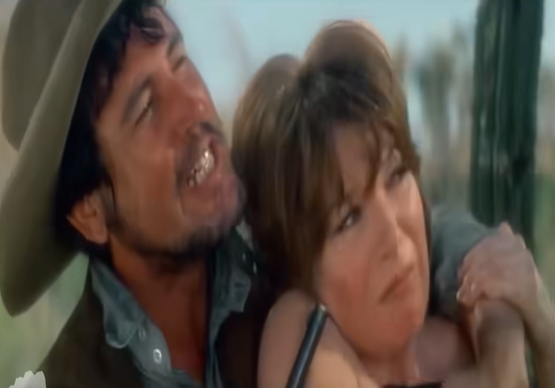
The scene follows Eastwood’s character, Hogan, as he comes across a woman dressed as a nun being attacked by a group of bandits. The landscape is harsh and exposed, the attackers appear confident in their control of the situation, and there seems to be little hope of outside intervention. Then Hogan enters the picture.
From that moment, the balance of power begins to change.
What makes the sequence memorable is not simply that Hogan rescues Sister Sara. Western heroes had been rescuing people from danger for decades. The difference is in the way Eastwood performs the rescue. Hogan does not rush into the situation with a grand speech or dramatic declaration of justice. He watches. He calculates. He chooses his moment.
And then he acts.
A Hero Who Does Not Need to Announce Himself
One of Eastwood’s greatest strengths as a Western star was his ability to make silence feel dangerous.
In this scene, Hogan initially appears less like a traditional knight in shining armor and more like a lone drifter who has happened upon trouble. His clothing is dusty, his face carries the exhaustion of the road, and nothing about him suggests that he is looking for heroism.
That makes his intervention more effective.
He is not saving Sara because he wants applause. There is no crowd to impress and no reward immediately waiting for him. He simply recognizes that the situation has crossed a line.
The bandits, meanwhile, behave as though they have complete control. They have numbers on their side and a vulnerable target in front of them. In a conventional action scene, the hero might charge directly into the group.
Hogan chooses something different.
He studies them carefully.
This creates suspense because the viewer knows that Eastwood is preparing something, even when the attackers do not. His calmness becomes part of the threat. Every second he waits increases the tension.
When the confrontation finally turns violent, it feels less like Hogan has entered a fight and more like he has already decided how the fight will end.
Violence With Purpose
The gunplay in the sequence is quick, harsh and remarkably controlled.
Eastwood’s Western characters rarely wasted motion. Hogan follows the same principle. He reacts with precision, using the terrain around him and refusing to panic even when surrounded by armed men.
That precision is an important part of the scene’s appeal.
Modern action sequences often rely on rapid editing, explosions and constant movement. This scene generates excitement through anticipation. The audience has time to understand where the danger is coming from. We can see Hogan evaluating his opponents and positioning himself.
Then, once the shooting begins, the scene explodes.
The contrast between stillness and sudden violence gives the rescue its power.
Eastwood looks especially effective because he never appears overwhelmed. Even when the physical situation is dangerous, Hogan behaves as though fear would only waste valuable time.
It is the same kind of controlled confidence that made Eastwood such a powerful figure in the Western genre.
The Landscape Becomes Part of the Fight
The Mexican wilderness is not simply a background in Two Mules for Sister Sara. It feels like another character.
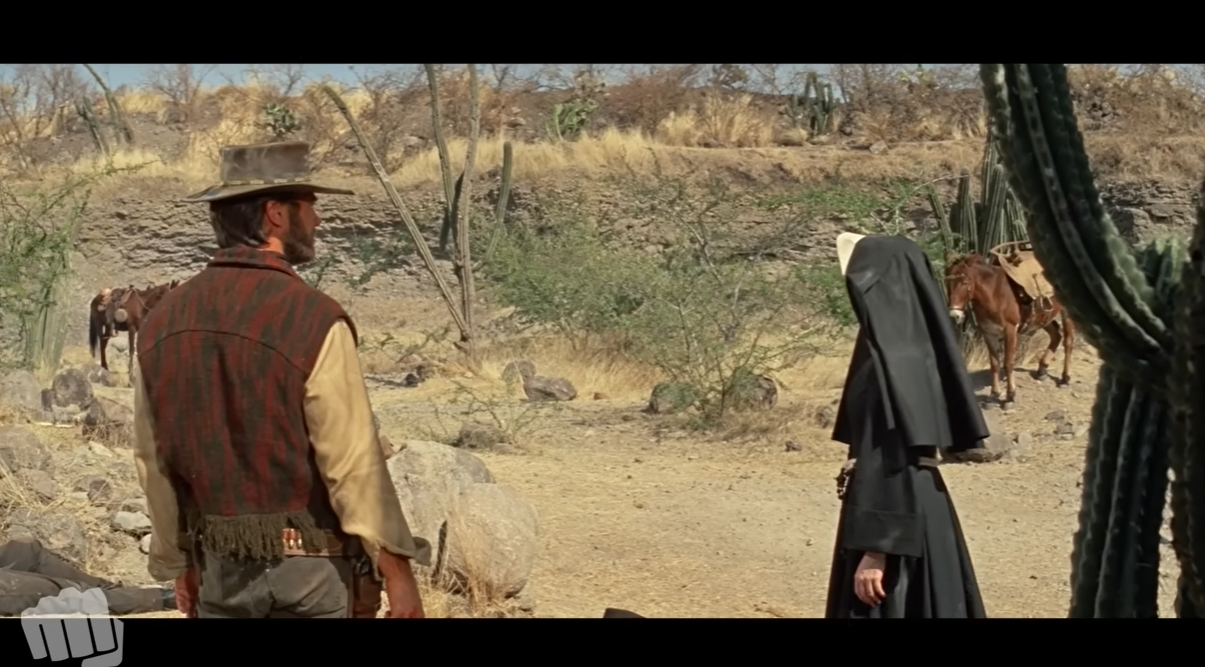
The sequence takes place among rocky hills, dry brush, tall cactus and sun-bleached terrain. There is almost nowhere to hide. Anyone standing in the open becomes vulnerable.
This visual environment makes the gunfight feel raw and immediate.
Hogan moves through the terrain like someone who understands it. He uses rocks and vegetation as cover rather than fighting recklessly. His knowledge of survival becomes just as important as his ability with a weapon.
The bandits may have the advantage in numbers, but Hogan has patience.
That distinction matters.
Western cinema often celebrates the individual who can survive in an environment where law and civilization are far away. Hogan fits that tradition perfectly. In this isolated landscape, there is no sheriff arriving to restore order.
Justice depends on whoever is willing—and capable enough—to enforce it.
In this moment, that person is Hogan.
Sister Sara Changes the Dynamic
Once the immediate threat disappears, the scene becomes more interesting.
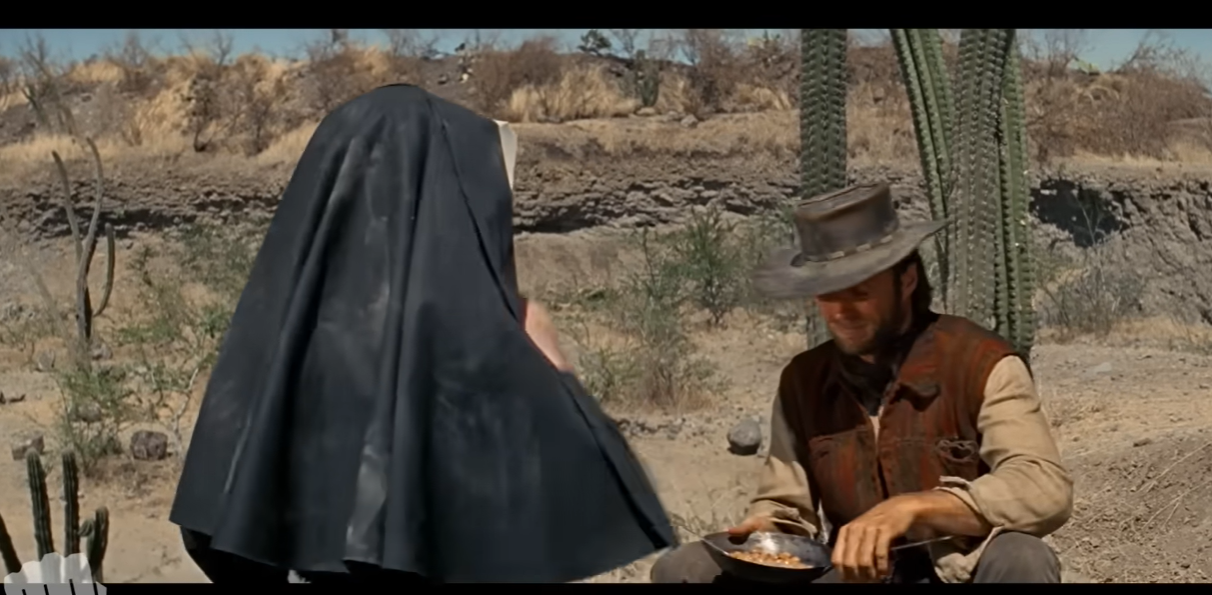
The rescued woman is Sister Sara, played by Shirley MacLaine, and Hogan quickly finds himself facing a very different challenge.
Gunmen are easy for him to understand.
Sara is not.
She appears to be a nun, which immediately creates an unusual contrast with Hogan. He is a hardened mercenary accustomed to violence, weapons and survival. She seems to represent faith, morality and restraint.
Their first interactions establish the chemistry that drives much of the movie.
Hogan may have saved her life, but Sara is not presented simply as a helpless victim. She speaks her mind and does not respond to Hogan with the kind of unquestioning gratitude he might expect.
That is where the humor begins.
Eastwood’s restrained performance works especially well beside MacLaine’s more expressive personality. Hogan often seems slightly confused by Sara, even when he tries not to show it.
The man who could calmly defeat a group of armed bandits suddenly finds himself dealing with a woman he cannot easily read.
The contrast is deliberate and extremely entertaining.
Clint Eastwood’s Familiar Western Persona
By the time Two Mules for Sister Sara was released, Eastwood had already become internationally associated with the Western.
His image had been shaped by characters who spoke little, observed everything and were willing to use violence without hesitation when circumstances required it.
Hogan continues that tradition but adds something different.
He is tough, cynical and practical, yet the rescue scene reveals that he also follows an internal moral code.
He could have continued riding.
Instead, he intervenes.
That choice tells the audience more about Hogan than any long speech could.
This is one reason Eastwood’s characters were so effective. Their morality was often revealed through actions rather than explanations.
Hogan may not describe himself as a good man.
He may not even think of himself that way.
But when he sees helpless people being brutalized, he refuses to ignore it.
That contradiction—between the hardened mercenary and the instinctive protector—makes him more compelling than a straightforward hero.
The Scene’s Mixture of Danger and Humor
Another reason the clip works so well is its shifting tone.
The opening situation is genuinely threatening. Sara is surrounded by men with violent intentions, and there is little reason to believe she can escape without help.
Then Hogan arrives and the scene becomes a tense Western confrontation.
After the fighting, however, the atmosphere slowly changes.
Sara’s personality starts to emerge. Hogan discovers that traveling with the woman he rescued may be considerably more complicated than rescuing her in the first place.
This combination of danger and comedy gives Two Mules for Sister Sara a distinctive character.
It is certainly a Western, but it is not relentlessly grim. The relationship between Hogan and Sara allows the movie to move between action, sarcasm, frustration and unexpected affection.
Even during their earliest encounter, viewers can sense that their journey together will not be simple.
Hogan expects the world to operate according to clear practical rules.
Sara constantly disrupts those rules.
Why the Rescue Still Feels Satisfying
There is something timeless about watching a bully suddenly realize that he has picked the wrong victim—or, in this case, that someone far more dangerous has arrived.
The bandits begin the sequence believing themselves untouchable.
Hogan destroys that confidence.
Audiences naturally respond to that reversal. The scene presents injustice clearly, builds tension around it, and then gives viewers the satisfaction of seeing the aggressors confronted.
But the filmmakers do not make Hogan look invincible through exaggerated spectacle.
His victory comes from experience, awareness and intelligence.
That makes the action more believable.
Eastwood’s physical performance is also crucial. Notice how rarely he wastes energy. He moves only when necessary and keeps his attention fixed on the threat.
His calm body language communicates experience.
This is a man who has been in dangerous situations before.
The Beginning of an Unlikely Partnership
In a larger sense, the rescue matters because it brings Hogan and Sara together.
Their meeting feels accidental, but it becomes the foundation of the story.
Hogan soon discovers that Sara has knowledge connected to Mexican revolutionaries and the French forces operating in the region. Their goals begin to overlap, even though their personalities could hardly be more different.
This gives the film its central relationship.
The hardened gunfighter and the apparently devout nun travel together through a violent country, arguing, surviving and gradually learning more about one another.
The rescue scene therefore works on two levels.
It is a complete miniature Western adventure by itself.
But it is also the starting point of a much larger story.
A Perfect Example of Classic Eastwood
Watching the scene today, it is easy to understand why Clint Eastwood became one of cinema’s most recognizable Western stars.
He does not demand attention.
He simply holds it.
Hogan is compelling because he remains calm when everyone else is losing control. He does not need elaborate dialogue to establish authority.
His presence does the work.
The bandits have weapons.
Hogan has experience.
And in the world of the Western, experience usually wins.
The rescue of Sister Sara captures many of the ingredients that make classic Western cinema so enjoyable: a dangerous frontier, ruthless villains, a mysterious stranger, sudden gunfire and an unexpected partnership.
But above all, it captures Eastwood at his most iconic.
A solitary figure enters a violent situation.
He says little.
He watches carefully.
And when the moment comes, he reminds everyone exactly why confronting Clint Eastwood in a Western is usually a very bad idea.