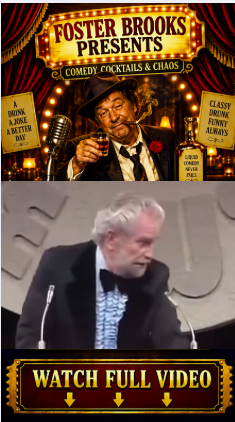
Foster Brooks Had a Character Audiences Instantly Recognized
Foster Brooks’ famous “drunk” persona was one of the most recognizable character styles in classic television comedy.
His voice was slow and slurred. His pauses seemed to appear at the least expected moments. His expressions suggested that he was completely confident, even when his words were becoming increasingly ridiculous.
The brilliance of the character was that Brooks never treated him like a joke.
He played the fictional drunk as though he were an ordinary, capable person having a perfectly normal conversation.
That serious commitment was what made the character so effective.
Once Brooks stepped into the role, the audience immediately understood the comedic premise.
Turning a Scoutmaster Into a Comedy Character
The Scoutmaster role provided Brooks with an excellent setting for his signature character.
A Scoutmaster is traditionally expected to be organized, responsible, and capable of keeping a group under control.
Brooks’ character appeared determined to fulfill those expectations.
Unfortunately, almost everything about his delivery suggested the opposite.
That contradiction created the central joke.
He could speak with complete authority while sounding as though he was struggling to organize his own thoughts.
He could deliver instructions with enormous confidence even when the audience could clearly see how ridiculous the situation had become.
The more seriously Brooks approached the role, the funnier it became.
Dean Martin Was the Perfect Reaction
Dean Martin’s presence made the routine even more entertaining.
Martin was famous for his relaxed television persona and his ability to work comfortably with comedians. He understood that sometimes the best response to a funny performer was simply to let the performer take control of the moment.
With Foster Brooks, however, remaining completely composed was not always easy.
Brooks’ deliberately slow delivery gave Martin plenty of time to react.
A strange phrase.
An unexpected pause.
A ridiculous explanation.
Each moment could trigger another smile or laugh.
Those reactions became part of the routine.
The audience was watching Brooks perform, but they were also watching Martin try to process the increasingly absurd Scoutmaster character.
Brooks’ Timing Created the Comedy
Foster Brooks understood that comedy is often about timing rather than speed.
His routines were rarely rushed.
He allowed words to hang in the air.
He stretched pauses.
He sometimes appeared to lose his place before finding the next part of his sentence.
Every one of those techniques became part of the character.
The Scoutmaster routine was especially effective because the character was supposed to be giving instructions.
That gave Brooks endless opportunities to stretch simple statements into elaborate comedic moments.
Instead of delivering a short instruction, he could make the audience wait for the conclusion.
By the time the punchline arrived, everyone was already anticipating it.
The Straight Face Was Essential
Brooks’ greatest weapon may have been his seriousness.
He did not constantly smile at his own jokes.
He did not acknowledge the absurdity of the character.
He simply remained in character.
That created a powerful contrast between what the audience knew and what the character believed.
The audience understood that the Scoutmaster was behaving absurdly.
The character believed he was doing an excellent job.
That disconnect is one of the fundamental principles of character comedy.
Brooks understood it perfectly.
Dean Martin’s “Speechless” Reaction Added Another Layer
When a comedian has a strong character, the reaction of the other performers can become part of the entertainment.
Dean Martin was particularly effective in this role because his own personality was so relaxed.
He did not need to compete with Brooks.
Instead, his reactions gave the audience a second perspective.
Martin could appear amused, surprised, or simply unable to believe what Brooks was saying.
That response reinforced the humor.
The audience could laugh at Brooks’ character while simultaneously enjoying Martin’s reaction to him.
It was comedy happening on two levels.
Why the Scoutmaster Premise Worked So Well
The strength of the routine came from its simplicity.
The audience did not need a complicated story to understand what was happening.
They immediately recognized the role of a Scoutmaster.
They immediately recognized Brooks’ character.
The humor came from putting those two ideas together.
A supposedly responsible leader was being played by a character whose behavior was anything but conventional.
That contrast gave Brooks a clear comedic direction.
He could focus on delivery and interaction rather than spending time explaining the premise.
Foster Brooks Could Make Simple Situations Feel Bigger
This was one of Brooks’ greatest strengths as a performer.
He could take a basic scenario and stretch it into a complete routine.
His character did not need a complicated plot.
Instead, the humor came from watching him navigate the situation.
The longer he remained in character, the more opportunities he had to create unexpected moments.
The Scoutmaster routine followed that formula perfectly.
The role gave him authority.
The character gave him confusion.
The combination gave him comedy.
The Chemistry With Dean Martin Made It Special
Foster Brooks and Dean Martin represented two very different approaches to television comedy.
Martin was understated and relaxed.
Brooks was exaggerated and deliberately awkward.
That difference created an ideal comedic partnership.
Brooks could push the character further because Martin provided a calm reaction.
Martin could remain entertaining without needing to take control because Brooks was generating enough material on his own.
The result was a natural back-and-forth that made the routine feel spontaneous.
A Showcase for Classic Television Comedy
The performance also illustrates why classic variety television remains so enjoyable.
The emphasis was placed on performers and their personalities.
There was no need for elaborate technology.
A comedian could walk onto the stage, establish a character, and hold an audience through timing and personality alone.
Foster Brooks was exceptionally good at that.
His performances depended on details that television audiences could immediately recognize: the voice, the pauses, the expressions, and the confident delivery.
Dean Martin’s shows provided an ideal environment for that style of comedy.
Why Foster Brooks’ Comedy Still Works
Comedy changes over time, but certain fundamentals remain universal.
Good timing still works.
Strong characters still work.
Unexpected contrasts still work.
And a genuine reaction from another performer still makes an audience feel connected to the moment.
Foster Brooks had all four.
His Scoutmaster routine may have been built around a simple premise, but his commitment transformed it into something much bigger.
Dean Martin’s reaction helped preserve the sense that the moment was genuinely entertaining rather than simply another scripted television segment.
Final Thoughts
Foster Brooks turned the Scoutmaster into comedy gold by combining an unexpected character with his unmistakable “drunk” persona and impeccable comedic timing.
His slow delivery, exaggerated pauses, misplaced confidence, and unwavering seriousness transformed a familiar role into something completely different.
Dean Martin provided the perfect reaction.
As Brooks continued to build the character, Martin’s laughter and disbelief became part of the performance itself.
That combination is what made the routine so memorable.
Foster Brooks brought the character, Dean Martin brought the reaction, and together they created the kind of classic television comedy moment that still feels fresh decades later.