Some comedy needs elaborate sets, complicated stories, or spectacular physical stunts to make an audience laugh.
Abbott and Costello often needed nothing more than a conversation.
Put Bud Abbott and Lou Costello together, give them an ordinary situation, and within moments something incredibly simple could become hopelessly complicated.
That is exactly the charm captured in this classic moment.
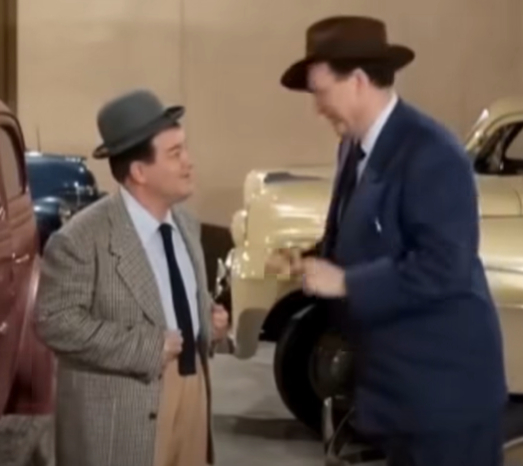
The setting itself doesn’t appear particularly unusual. Abbott and Costello are standing around talking near a group of cars. There is no enormous spectacle unfolding around them and no need for an elaborate setup.
Instead, the comedy comes from the two men themselves.
Costello wants to understand what is happening.
Abbott tries to explain.
And that’s usually where the trouble begins.
For decades, this basic formula helped make Abbott and Costello one of the most recognizable comedy teams in American entertainment.
Bud Abbott typically played the confident straight man.
He was fast-talking, composed, and usually convinced that he understood the situation better than everyone else.
Lou Costello was his perfect opposite.
Costello questioned everything.
He misunderstood explanations.
He became frustrated.
And the more Abbott attempted to straighten things out, the more complicated the situation often became.
It sounds simple.
But performing this kind of comedy successfully requires extraordinary timing.
A joke between Abbott and Costello wasn’t simply about the words being spoken.
It was about speed.
Pauses.
Expressions.
Interruptions.
Repetition.
And most importantly, escalation.
Abbott could begin with an explanation that seemed completely reasonable.
Costello would notice one small problem.
Abbott would attempt to correct him.
Costello would misunderstand the correction.
Abbott would become frustrated.
Costello would become even more confused.
Within seconds, both men could turn an ordinary conversation into complete comedic chaos.
That rhythm became their signature.
Their most famous routine, “Who’s on First?”, is perhaps the greatest example of this style.
The premise is almost unbelievably simple: baseball players have unusual names, and Costello is trying to understand who plays each position.
But language turns against him.
Every answer Abbott gives sounds like another question.
Costello becomes increasingly desperate for clarification.
Abbott continues providing technically correct answers.
The result is a masterpiece of verbal misunderstanding.
Yet the brilliance of Abbott and Costello was that they didn’t need to perform that specific routine to create the same energy.
The formula could work almost anywhere.
A restaurant.
A workplace.
A military base.
A doctor’s office.
A hotel.
Or simply a conversation beside a car.
The surroundings changed.
The chemistry didn’t.
Costello’s reactions were especially important.
Lou Costello had an extraordinary ability to make confusion entertaining.
When he didn’t understand something, the audience immediately knew.
His face changed.
His voice changed.
His entire body became part of the joke.
He might look at Abbott as though he’d just heard the most ridiculous statement imaginable.
Then he would challenge it.
Abbott, rather than admitting there might be a problem, would usually continue explaining.
That was the trap.
The more Abbott explained, the worse things became.
This dynamic made Costello an ideal comic character because the audience often experienced the confusion alongside him.
We could understand why he was frustrated.
Sometimes Abbott’s logic sounded perfectly reasonable.
Sometimes it was absurd.
Either way, Costello rarely accepted an explanation quietly.
He fought back.
And that resistance kept the routine moving.
Bud Abbott’s role was just as important, even though straight men in comedy teams sometimes receive less attention.
Abbott had to control the pace.
If he delivered a line too slowly, the energy disappeared.
If he reacted too strongly, he could steal attention from Costello’s punchline.
His job was often to remain confident while Costello became increasingly emotional.
That contrast created the comedy.
Abbott looked like a man attempting to have a normal conversation.
Costello looked like a man discovering that normal conversation had suddenly become impossible.
Together, they created a rhythm that could make even ordinary dialogue hilarious.
Another important part of their appeal was familiarity.
Audiences knew these characters.
They understood what would probably happen when Abbott started explaining something to Costello.
But knowing the general pattern didn’t ruin the joke.
It actually made the experience more enjoyable.
Viewers waited for Costello to realize something didn’t make sense.
They waited for Abbott to insist that it did.
They waited for the argument to escalate.
And then they watched the pair find a new variation on a familiar formula.
That’s one reason their comedy remains so watchable generations later.
Modern comedy often moves incredibly quickly.
Scenes are edited rapidly.
Punchlines arrive every few seconds.
Visual effects and elaborate setups can dominate entertainment.
Abbott and Costello remind us that two talented performers with exceptional chemistry can hold an audience’s attention using little more than dialogue.
Their comedy also demonstrates how powerful repetition can be.
Normally, repeating information would make a conversation less interesting.
Abbott and Costello turned repetition into escalation.
Costello might ask the same basic question again.
Abbott would provide the same answer.
Costello would hear it differently.
Suddenly the exact same words became funnier because the frustration had increased.
By the third or fourth repetition, the audience wasn’t merely laughing at the misunderstanding.
They were laughing because Costello couldn’t escape it.
That structure influenced countless comedy performers who came later.
The straight-man-and-comic partnership existed before Abbott and Costello, but few teams demonstrated its possibilities as memorably.
The key was balance.
Costello’s personality was huge.
He could be loud, emotional, childish, stubborn, frightened, or furious.
Abbott gave that energy something to push against.
Without Abbott’s calm confidence, Costello’s reactions would have had less contrast.
Without Costello’s confusion, Abbott’s explanations wouldn’t have been funny.
They needed each other.
That is the magic of a great comedy duo.
Neither performer is simply waiting for his turn to deliver a joke.
The joke exists in the relationship between them.
Watch Costello’s face while Abbott speaks.
Watch Abbott’s reaction when Costello misunderstands.
Those moments between the lines are often just as funny as the dialogue itself.
There’s also something universal about their style of comedy.
Everyone has experienced a conversation where two people seem to be speaking completely different languages.
Someone explains something.
The other person doesn’t understand.
The first person explains it again.
Somehow the second explanation is even more confusing.
Eventually both people are frustrated.
Abbott and Costello took that everyday experience and pushed it to hilarious extremes.
That’s why their comedy doesn’t require much historical knowledge to enjoy.
You don’t need to understand every reference from the era.
You simply need to understand what it’s like to be confused.
And Lou Costello may have been one of the greatest confused men in comedy history.
He could transform a misunderstanding into a complete emotional crisis.
Meanwhile, Abbott would stand beside him as though everything were perfectly obvious.
That contrast never really gets old.
The clip also captures something increasingly valuable about classic comedy: simplicity.
There’s no need to overcomplicate the premise.
Two men are talking.
One believes he understands the situation.
The other doesn’t.
That’s enough.
From there, personality takes over.
Abbott pushes forward.
Costello pushes back.
The misunderstanding grows.
And the audience gets to enjoy every second of it.
Decades after their peak, Abbott and Costello remain recognizable because their best comedy wasn’t dependent on spectacle.
It was built around human behavior.
Confusion.
Frustration.
Confidence.
Stubbornness.
And the strange way a simple conversation can become much harder than it needs to be.
That’s exactly why moments like this still work today.
You can watch Abbott begin explaining something and immediately sense what’s coming.
Costello listens.
He thinks about it.
Something doesn’t add up.
Then comes the look.
The question.
The argument.
And suddenly they’re doing what Abbott and Costello did better than almost anyone:
turning absolutely nothing into comedy gold.
The cars, location, and situation may provide the setting.
But they aren’t the real reason the scene is funny.
The reason is standing right there.
Bud Abbott.
Lou Costello.
Two completely different comic personalities working in perfect opposition.
Abbott explains.
Costello questions.
Abbott insists.
Costello gets frustrated.
And generations of viewers laugh.
Sometimes the simplest formula really is the best one.