The desert is silent, endless, and unforgiving. There are no crowds, no safety, and certainly no room for friendship. In The Good, the Bad and the Ugly, three men cross this harsh landscape with one thing in common: each is chasing the same fortune, but none is willing to trust the others.
Blondie, Tuco, and Angel Eyes are three completely different personalities. Yet their paths become connected by a hidden treasure and a series of dangerous secrets. Every step brings them closer to the money, but every step also brings them closer to betrayal.
Blondie, known as “The Good,” is calm, clever, and remarkably patient. He does not waste bullets when words, timing, or deception can accomplish the same goal. His greatest weapon is often his ability to stay one step ahead of everyone around him. Blondie understands that in this world, survival is not always about being the fastest with a gun. Sometimes, the smartest man in the room is the one who knows when not to pull the trigger.
Tuco, “The Ugly,” is almost the opposite. He is loud, unpredictable, greedy, and constantly searching for his next opportunity. His relationship with Blondie creates some of the film’s most memorable moments. They are partners when it benefits them, enemies when circumstances change, and reluctant allies when survival requires cooperation.
Their partnership is anything but simple.
Blondie and Tuco repeatedly attempt to outsmart each other, but they also discover that they need each other. Their strange relationship becomes a game of manipulation, revenge, and survival. One moment they appear to be working together. The next, one is already planning how to betray the other.
And then there is Angel Eyes.
Cold, calculating, and ruthless, Angel Eyes approaches the search for the treasure differently. He does not rely on friendship, loyalty, or humor. He follows information, eliminates obstacles, and pursues his objective with frightening determination.
If Blondie represents cleverness and Tuco represents chaos, Angel Eyes represents pure calculation.
The treasure itself becomes more than just a pile of gold. It becomes the force that brings these three men together and pushes them apart. Every character knows that whoever finds it first could change his fate forever. But knowing that the treasure exists is not enough. They must discover where it is hidden, and that information is carefully divided between the men.
This creates one of the film’s most fascinating elements: nobody has the complete answer.
Each man possesses part of the secret.
That means cooperation is necessary, but trust is impossible.
The result is a constant battle of deception. A conversation can hide a threat. A smile can conceal a plan. A seemingly harmless decision can completely change the balance between the characters.
This is where Blondie’s intelligence becomes particularly important. He understands that information can be more valuable than ammunition. Knowing what another person wants—and knowing what they do not know—can provide an enormous advantage.
Tuco, meanwhile, survives through instinct and determination. He may not always have the elegant strategy of Blondie, but he possesses something equally valuable: an extraordinary ability to survive situations that should have destroyed him.
That combination makes the two characters surprisingly effective together.
Their journey through the desert is filled with danger, exhaustion, deception, and sudden violence. Yet the film never allows the audience to forget the central prize waiting at the end of the road.
Gold.
The possibility of wealth changes everything.
It turns strangers into enemies, enemies into temporary allies, and temporary allies back into enemies. Nobody wants to share the prize. Nobody wants to be the person who gets tricked at the final moment.
And that is exactly why the tension continues to build.
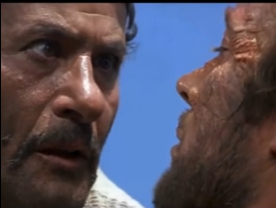
The desert becomes almost like another character in the story. Its enormous landscapes make the men appear small, while the emptiness creates a sense that danger could come from anywhere. The wide shots emphasize the isolation of the characters, while the close-ups bring attention to every glance, every expression, and every subtle movement.
Then comes the waiting.
A hand moves toward a gun.
A man looks across the room.
Another watches silently.
Nothing happens for a moment.
And somehow, that silence can feel more dangerous than an explosion.
This is one of the reasons The Good, the Bad and the Ugly remains such an influential Western. Its action is powerful, but the suspense often comes from anticipation. The audience knows that violence is coming. The question is simply when.
The legendary style of director Sergio Leone turns these confrontations into carefully constructed pieces of cinema. Ennio Morricone’s unforgettable music adds another layer, transforming the characters’ journey into something almost mythic.
But underneath the spectacle is a simple story about greed, survival, and trust.
Can three men who trust nobody cooperate long enough to reach the same treasure?
Can a clever trick defeat a loaded gun?
Can someone stay one step ahead when everyone else is trying to do exactly the same thing?
Those questions drive the story forward.
Blondie, Tuco, and Angel Eyes may be searching for the same destination, but their motivations are completely different. One relies on intelligence. One relies on survival instinct. One relies on ruthless determination.
And when those three personalities finally collide, the result is unforgettable.
The most exciting part is that the treasure is never simply about money. It represents freedom, power, and the possibility of changing one’s fate. For men who have spent their lives surviving from one dangerous situation to another, that possibility is worth almost any risk.
But the closer they get to the prize, the more dangerous the game becomes.
Friendship disappears.
Promises become meaningless.
Every alliance has an expiration date.
And every man knows that the final confrontation will ultimately come down to one question:
Who can stay alive long enough to claim the gold?
That is the brilliance of The Good, the Bad and the Ugly. It takes a straightforward treasure hunt and transforms it into a tense battle of personalities, strategy, deception, and survival.
The desert may look empty, but beneath its silence is a dangerous game involving three men who refuse to surrender.
Blondie has the brains.
Tuco has the nerve.
Angel Eyes has the determination.
But only one thing is certain: none of them came to the desert to make friends.
They came for the treasure.
And when the lead finally starts flying, every clever trick, every secret, and every betrayal leads toward the same unforgettable showdown.
Three men.
One treasure.
Zero trust.
And a desert where only the smartest—and luckiest—will walk away.