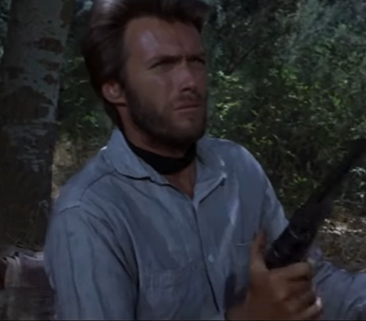
There are countless ways for a Western hero to prove that he isn’t afraid.
He can draw faster than everyone else.
He can survive a shootout.
He can ride directly into danger.
But Clint Eastwood’s Blondie rarely needs any of that to establish control.
Sometimes all he has to do is sit quietly, look at the men surrounding him, and count.
One.
Two.
Three.
Four.
Five.
Six.
That simple moment in Sergio Leone’s The Good, the Bad and the Ugly perfectly captures what makes Blondie such an unforgettable Western character.
He doesn’t shout.
He doesn’t panic.
He doesn’t make unnecessary movements.
He simply understands the situation before everyone else does.
And when Angel Eyes believes he has the advantage, Blondie calmly reminds him that appearances can be deceiving.
The scene comes during one of the most dangerous stretches of the 1966 film.
Blondie and Tuco have already discovered the secret of a Confederate fortune buried somewhere in Sad Hill Cemetery.
But there’s a problem.
Neither man knows everything.
Tuco knows the name of the cemetery.
Blondie knows the name written on the grave containing the gold.
That arrangement keeps them tied together.
Then Angel Eyes enters the hunt.
Played with terrifying calm by Lee Van Cleef, Angel Eyes is the third piece of the film’s famous trio.
If Blondie is “the Good” and Tuco is “the Ugly,” Angel Eyes represents “the Bad.”
But those labels are intentionally imperfect.
Blondie is hardly a traditional hero.
Tuco isn’t simply a villain.
And Angel Eyes isn’t dangerous because he behaves like a wild criminal.
Quite the opposite.
Angel Eyes is frightening because he is controlled.
He watches.
He waits.
He gathers information.
And when someone stands between him and what he wants, he removes them.
Eventually, the hunt for the Confederate gold brings Blondie under Angel Eyes’ control.
Tuco has been brutally interrogated at the prison camp, allowing Angel Eyes to learn part of the secret surrounding the hidden fortune.
Blondie, however, is different.
Angel Eyes understands that forcing the information out of him won’t be easy.
The film’s dialogue makes that point clear: Angel Eyes recognizes that Blondie is smart enough to understand that talking would not necessarily save him. SubtitleCat
So Angel Eyes changes tactics.
Instead of immediately killing Blondie, he proposes cooperation.
For a while, the two men travel together.
But nobody watching the movie believes this is friendship.
Blondie knows exactly what Angel Eyes is.
Angel Eyes knows Blondie cannot be trusted.
Both men are simply waiting.
That’s what makes the confrontation in the woods so effective.
Angel Eyes isn’t alone.
His armed men are nearby.
Blondie knows it.
And Angel Eyes knows that Blondie knows it.
The tension isn’t created through constant shooting.
It comes from the fact that everyone is waiting to see who will move first.
Then Blondie makes his move.
He warns that Angel Eyes’ friends hiding nearby might have a problem if they remain where they are.
The threat is delivered with typical Eastwood restraint.
No dramatic screaming.
No long speech.
Just enough information to make everyone understand what could happen next.
Angel Eyes calls his men out.
One by one, they appear.
And Blondie starts counting.
Six.
Angel Eyes responds by questioning whether three is supposed to be the perfect number.
Blondie’s answer has become one of the movie’s memorable exchanges: his gun still contains enough bullets for the men standing around him. Âm Thanh Phim
It’s classic Blondie.
The line works because of the situation surrounding it.
Technically, Blondie is badly outnumbered.
Angel Eyes has multiple armed men.
They could attack him from several directions.
By ordinary logic, Blondie should be nervous.
He isn’t.
Instead, he evaluates the problem mathematically.
Six enemies.
Six bullets.
Good enough.
That’s the entire Clint Eastwood persona condensed into a few seconds.
Confidence without noise.
Threat without unnecessary movement.
Humor without smiling.
Blondie doesn’t need to convince anyone that he’s dangerous.
Everybody already knows.
And Sergio Leone understood exactly how to photograph that kind of character.
Leone’s Westerns frequently rely on faces.
Eyes.
Hands.
Small movements.
The camera waits.
The audience waits.
The characters wait.
Then suddenly everything happens.
This approach is especially effective with Eastwood because his performance is built around restraint.
Tuco, played brilliantly by Eli Wallach, can fill a scene with words and movement.
Angel Eyes uses an icy stare to create menace.
Blondie often does almost nothing.
But that “nothing” is carefully controlled.
Watch him during tense confrontations.
He rarely wastes energy.
His eyes move before his body does.
He studies where everyone is standing.
He notices weapons.
He measures distance.
By the time the other characters realize something is happening, Blondie has usually already calculated his next move.
The six-gunmen scene is a perfect example.
He isn’t simply showing courage.
He’s gathering information.
Where are Angel Eyes’ men?
How many are there?
How dangerous is the situation?
Once they reveal themselves, Blondie has his answer.
Six.
Now the unknown threat has become something measurable.
That subtle shift gives Blondie psychological control of the scene.
Angel Eyes may have the numerical advantage, but Blondie refuses to behave like a prisoner.
And Angel Eyes understands exactly what that means.
This is important because Lee Van Cleef’s character is not easily intimidated.
Angel Eyes has spent the film intimidating other people.
Early in the story, he tracks down information about a man connected to the missing Confederate gold.
He takes payment for killing one man and then completes another killing because he has already been paid to do it.
His personal rule is simple:
When he’s paid, he finishes the job.
That cold professionalism separates him from Tuco.
Tuco is chaotic.
Angel Eyes is methodical.
Which makes his interactions with Blondie particularly interesting.
They’re similar in certain ways.
Both are observant.
Both remain calm under pressure.
Both understand that information can be more valuable than a gun.
And neither trusts the other.
Their temporary alliance therefore feels like two predators walking beside each other while waiting for the first opportunity to strike.
Blondie’s confrontation with Angel Eyes’ men is one more reminder that the alliance cannot last.
The gold is the only reason these men continue crossing paths.
That hidden fortune transforms every relationship in the movie.
Blondie and Tuco repeatedly betray each other, yet they keep reuniting because each possesses information the other needs.
Angel Eyes enters the same equation because he wants the money too.
Nobody wants to share.
Nobody trusts anyone.
And everyone understands that once the location of the gold becomes known, the temporary partnerships will no longer be necessary.
That’s what gives seemingly small conversations so much tension.
Every joke contains a threat.
Every partnership contains a future betrayal.
Every glance matters.
Even Blondie’s joke about six bullets isn’t really just a joke.
He’s establishing a boundary.
Angel Eyes may have six men.
But those six men do not automatically give him control.
Blondie wants him to know that.
And Angel Eyes listens.
The moment also demonstrates why The Good, the Bad and the Ugly remains so influential decades after its release.
Leone understood that Western tension doesn’t require constant action.
Sometimes anticipation is more powerful.
Put armed men in a quiet landscape.
Let them look at one another.
Let the audience understand that everyone could start shooting at any second.
Then wait.
Ennio Morricone’s legendary musical approach throughout the film strengthens that atmosphere, but even silence becomes part of Leone’s storytelling.
The viewer begins studying the frame just like Blondie does.
Where are the guns?
Who will move first?
Who is watching whom?
Who actually has the advantage?
The answers can change in seconds.
And eventually Blondie will reunite with Tuco.
That reunion changes the balance again.
Tuco may be unreliable, greedy and unpredictable, but when Blondie needs someone capable of fighting Angel Eyes and his men, their strange partnership suddenly becomes useful again.
The movie repeatedly returns to this idea:
Nobody survives entirely alone.
Even the most dangerous gunfighter sometimes needs an ally.
But an ally in Sergio Leone’s world doesn’t have to be a friend.
Blondie and Tuco prove that throughout the film.
They insult each other.
They betray each other.
They threaten each other.
They nearly kill each other.
Yet when circumstances demand cooperation, they can become an extremely effective team.
Angel Eyes eventually discovers just how dangerous that combination can be.
And all three men continue moving toward the same destination:
Sad Hill Cemetery.
That’s where the gold is waiting.
That’s where their temporary alliances will finally become unnecessary.
And that’s where Blondie, Tuco and Angel Eyes will eventually face one another in one of the most famous showdowns in Western cinema.
But before the cemetery…
before the final duel…
before Ennio Morricone’s music accompanies that legendary three-way standoff…
there are moments like this.
Blondie.
Angel Eyes.
Six armed men.
And one revolver.
Most men would look around and see terrible odds.
Blondie looks around and sees something much simpler.
Six targets.
Six bullets.
Problem solved.
That’s why Clint Eastwood’s Blondie became an icon.
He doesn’t need to tell you he’s the coolest man in the room.
He simply counts the men standing against him…
and makes sure he has enough bullets.