There are comedy sketches that make you smile.
There are sketches that make you laugh.
And then there are Tim Conway moments where the actual joke almost becomes secondary—because watching the other performers desperately trying not to fall apart is even funnier than the sketch itself.
This classic moment with Carol Burnett is a perfect example.
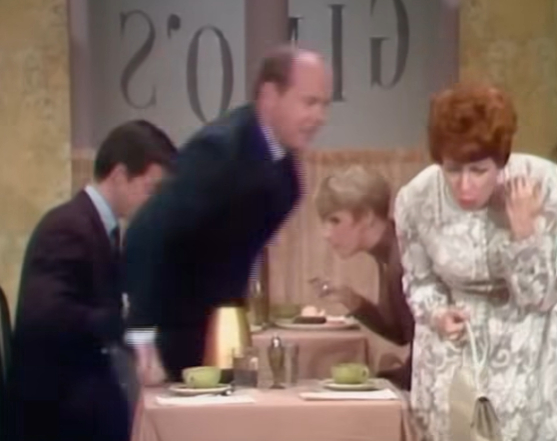
At first glance, absolutely nothing seems extraordinary. The setting is simple. A table is prepared, the performers are in position, and the scene appears ready to continue like any other television sketch.
Then Tim Conway starts doing what Tim Conway did better than almost anyone.
He takes one tiny moment…
slows it down…
pushes it just a little further…
and suddenly everyone around him is fighting for survival.
YOU CAN ALMOST SEE CAROL THINKING: “DON’T LAUGH!”
One of the funniest things about watching Carol Burnett perform alongside Conway is seeing the exact moment she realizes she may be in trouble.
Carol was a brilliant comedian in her own right.
She knew timing.
She knew improvisation.
She knew how to stay committed to a character.
But Tim Conway presented a special challenge because you could never be completely certain how he was going to play a moment.
He might take a movement that should last two seconds and stretch it into ten.
He might stare at an object just a little too long.
He might add an expression nobody expected.
And sometimes he didn’t need to say anything at all.
That unpredictability created magic.
In this scene, you can watch the reactions becoming increasingly important.
Carol is trying to remain inside the sketch.
She has a job to do.
But Conway is nearby, turning ordinary physical behavior into something increasingly ridiculous.
And then comes that familiar expression.
The lips tighten.
The eyes change.
The body begins to react.
You know exactly what’s happening.
She wants to laugh.
The audience knows it too.
And once the audience realizes that Carol Burnett herself is struggling not to break character, everything becomes twice as funny.
TIM CONWAY’S SECRET WEAPON WAS NEVER VOLUME
Many comedians dominate a scene by becoming bigger.
They talk louder.
Move faster.
Deliver increasingly outrageous lines.
Conway could dominate a scene by doing almost the exact opposite.
He became quieter.
Slower.
More deliberate.
He understood the incredible comedic power of making an audience wait.
A movement begins.
You expect it to finish.
It doesn’t.
Conway pauses.
The audience laughs.
He continues.
Another pause.
The laughter grows.
Then he adds one tiny expression or physical detail…
and suddenly the room explodes.
That was Conway’s rhythm.
He could make silence feel like a punchline.
More importantly, he trusted the audience enough to let them anticipate what was coming.
THE SMALLER THE MOVEMENT, THE BIGGER THE LAUGH
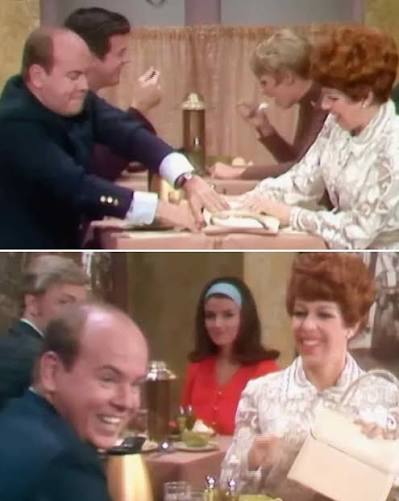
Watch Conway closely and you realize how controlled his physical comedy actually was.
Nothing needed to be enormous.
Sometimes a tiny shift of his body was enough.
A glance.
A bend.
A hesitation.
An awkward attempt to complete the simplest task.
That was all he needed.
And because Conway played everything with such seriousness, the comedy became even stronger.
He rarely behaved like a performer begging the audience to laugh.
Instead, his characters often seemed completely unaware that anything funny was happening.
Chaos could be developing around him and Conway would continue with the calm determination of a man simply trying to finish his job.
That contrast was devastating.
Everyone else could see the absurdity.
The audience could see it.
Carol could definitely see it.
But Conway’s character?
Apparently, everything was perfectly normal.
😂
THE REAL SHOW BECOMES WATCHING EVERYONE ELSE
This is where classic Carol Burnett Show moments become so special.
Eventually you stop watching only for the scripted joke.
You start watching the faces around Conway.
Can they survive?
Who is going to look away first?
Who is about to smile?
Who is desperately trying to remember the next line while Tim continues doing something ridiculous beside them?
That feeling adds an entirely different level to the comedy.
The performers know they are supposed to continue the scene.
But they are also human beings standing a few feet away from Tim Conway.
And Conway knew exactly how to exploit that.
He didn’t necessarily need to directly acknowledge their struggle.
Sometimes the funniest possible thing he could do was pretend not to notice.
The more desperately someone tried to recover, the calmer Conway became.
It was almost unfair.
WHY THESE MOMENTS FEEL SO REAL
There is something wonderfully human about seeing professional performers lose control.
Television is usually polished.
Everything has a schedule.
Lines are rehearsed.
Cameras are positioned.
Props are placed exactly where they belong.
But genuine laughter doesn’t care about any of that.
When somebody truly breaks, suddenly the polished television production disappears for a moment.
You’re no longer simply watching characters.
You’re watching people.
You see Carol Burnett genuinely amused by the man performing beside her.
And that laughter becomes contagious.
The studio audience senses it immediately.
They laugh harder.
The performer tries harder not to laugh.
Which makes the audience laugh even harder.
It creates a feedback loop.
And standing at the center of it all is Conway.
Usually looking innocent.
HE UNDERSTOOD EXACTLY HOW LONG TO WAIT
Timing is often described as one of the most important parts of comedy.
Conway demonstrated why.
Imagine performing in front of a live audience and intentionally doing almost nothing for several seconds.
That takes confidence.
Most performers would worry.
Is the silence too long?
Should I move?
Should I say something?
Am I losing them?
Conway seemed completely comfortable waiting.
He knew the audience was with him.
In fact, he often understood that the waiting itself was making them laugh.
He could stretch a simple physical action until the audience could barely stand the anticipation.
And just when you thought the joke had reached its peak…
he would add something else.
One extra movement.
One extra hesitation.
One extra look.
Boom.
Another explosion of laughter.
CAROL BURNETT WAS THE PERFECT PARTNER
Of course, these moments wouldn’t work nearly as well without performers capable of reacting brilliantly.
Carol Burnett was extraordinary at this.
Her reactions never felt disconnected from the scene.
Even when she was clearly struggling with laughter, there was something wonderfully natural about it.
That chemistry mattered.
Comedy is rarely about one performer operating alone.
It is about rhythm between people.
Conway creates the problem.
Carol reacts.
The audience reacts to Carol.
Conway senses the audience.
Then he pushes the moment further.
Suddenly everyone is participating.
That is the kind of chemistry television producers can try to create, but they can never completely manufacture.
It comes from trust.
Experience.
And performers who understand each other deeply enough to know exactly how far they can push.
THIS IS WHY CLASSIC COMEDY STILL FEELS DIFFERENT
Watching clips like this today can feel almost refreshing.
There are no giant visual effects required.
No complicated editing tricks.
No rapid series of cuts desperately trying to keep your attention.
It is simply performers in a room.
A situation.
A few props.
And exceptional timing.
The comedy happens right in front of you.
You can watch it develop.
You can see the moment approaching.
You know somebody is about to break.
And somehow knowing makes it even funnier.
That simplicity is one reason these performances remain so watchable decades later.
Great physical comedy doesn’t require much explanation.
A perfectly timed pause is still a perfectly timed pause.
A performer desperately fighting laughter is still hilarious.
And Tim Conway’s ability to turn ordinary situations into extraordinary comedy hasn’t disappeared with time.
CONWAY MADE CHAOS LOOK EFFORTLESS
Perhaps the greatest trick Conway ever pulled was making everything look easy.
His characters could appear confused, clumsy or completely overwhelmed.
But the performer behind them was incredibly precise.
Physical comedy requires control.
A movement has to happen at the right speed.
A reaction needs the right delay.
A pause needs to be long enough to build anticipation—but not so long that the audience disconnects.
Conway understood those details instinctively.
He could make a character look as though he had absolutely no idea what was happening while simultaneously controlling the entire rhythm of the room.
That is mastery.
The character is lost.
The comedian is completely in control.
THEN THE LAUGHTER TAKES OVER
Eventually there comes a point in moments like this where resistance becomes useless.
Someone cracks.
A smile escapes.
A laugh follows.
Then another performer sees it.
The audience gets louder.
And suddenly the carefully constructed sketch begins wobbling dangerously close to complete collapse.
But instead of ruining the comedy, that collapse becomes the best part.
Because now everyone watching knows they are witnessing something special.
Something that cannot be recreated exactly the same way.
You could perform the same lines tomorrow.
Use the same props.
Wear the same costumes.
But you could never perfectly reproduce that genuine moment of laughter.
That is what makes it memorable.
DECADES LATER, TIM CONWAY IS STILL WINNING
Think about that.
Years pass.
Television changes.
New comedians arrive.
Comedy styles evolve.
Yet people continue discovering these Tim Conway clips and laughing.
Why?
Because genuine comic timing doesn’t expire.
You don’t need to have watched the original broadcast.
You don’t need to know every character.
Sometimes all you need is to see Conway doing something ridiculously ordinary while Carol Burnett desperately tries to keep a straight face.
Within seconds, you understand everything.
You’re waiting for Carol to break.
You’re waiting for Conway to make things worse.
And you know he probably will.
That anticipation is timeless.
THE GENIUS WAS IN MAKING IT LOOK SO SIMPLE
Tim Conway didn’t need to announce that he was the funniest person in the room.
He simply waited.
Moved.
Paused.
Looked completely innocent.
And allowed everyone else to collapse around him.
That is why these moments remain comedy gold.
Underneath all the laughter was a performer with extraordinary control, patience and understanding of human reaction.
He knew exactly when the audience was ready.
He knew when his fellow performers were vulnerable.
And most dangerously of all…
he knew when to wait just one second longer.
That extra second could destroy Carol Burnett’s composure.
It could send the studio audience into hysterics.
And it could transform a simple television sketch into a moment people would still be sharing decades later.
Tim Conway didn’t need explosions.
He didn’t need special effects.
Sometimes he barely needed dialogue.
Give him a stage, a simple situation and a few talented performers desperately trying not to laugh…
and he could create television magic.
Carol Burnett tried to hold it together.
The audience tried to catch its breath.
And Tim Conway?
He just kept going.
That was the genius.
That was the danger.
And that is why, all these years later, Tim Conway can still make an entire room fall apart. 😂📺