The Cinematic Mastery of Violence and Justice in The Outlaw Josey Wales: Analyzing the “Hell Is Coming to Breakfast” Sequence
Clint Eastwood’s 1976 masterpiece, The Outlaw Josey Wales, stands as one of the most significant and defining entries in the revisionist Western genre. Directed by and starring Eastwood himself, the film captures a pivotal transitional era in American cinema, blending the gritty, cynical edge of the Italian Spaghetti Westerns popularized by Sergio Leone with the grand, expansive storytelling tradition of classic Hollywood Americana. Among the film’s many memorable sequences, none encapsulates its core themes—justice, vengeance, survival, and the inescapable presence of violence—quite like the famous encounter commonly referred to as the “Hell is coming to breakfast” scene. In this thrilling three-and-a-half-minute sequence, Wales confronts a ruthless gang of bounty hunters who have cornered a group of vulnerable travelers in the desert. Through meticulous visual storytelling, tight pacing, and sparse yet powerful dialogue, the scene delivers an unforgettable masterclass in cinematic tension and mythic heroism.

Cinematic Context and Narrative Setting
The scene opens in the middle of a stark, sun-baked desert landscape. A small family of weary travelers—an elderly woman, a younger woman named Laura Lee, and an elderly Native American man named Lone Watie—are struggling to pull an ox-drawn cart through the dusty terrain. The visual composition immediately establishes a strong contrast between the physical frailty of the travelers and the harsh, unforgiving environment surrounding them. Their plight is further complicated by the presence of a band of brutal bounty hunters who have taken control of the wagon train. These men represent the chaotic, predatory nature of the post-Civil War frontier, where lawlessness reigns supreme and the weak are routinely exploited by the strong.
The central villain of the scene, a menacing bounty hunter on horseback, harasses the young woman Laura Lee, ordering her to dress up so she looks presentable for their arrival at Ten Bears’ camp. His predatory demeanor and crude dialogue underscore the constant threat of violence faced by travelers on the open frontier. Meanwhile, Lone Watie quietly observes the situation, attempting to keep the elderly woman calm while subtly calculating their chances of survival. It is within this atmosphere of looming tragedy that Josey Wales enters the picture, transforming a dire hostage situation into an explosive display of swift and calculated retribution.

Visual Storytelling and Building Tension
Eastwood’s directorial vision relies heavily on spatial awareness, atmospheric sound, and visual iconography to construct tension before a single gun is fired. The camera tracks a lone figure riding across the distant desert ridge under the bright morning sun, carrying a white flag attached to his rifle. This solitary silhouette immediately draws the attention of both the audience and the men on the ground. A white flag traditionally signifies surrender or a desire for peaceful negotiation—a “parley.” However, within the context of Josey Wales’ reputation as a dangerous, unrelenting gunfighter, the white flag becomes an instrument of psychological deception and tactical surprise.
As Wales slowly approaches on horseback, the camera cuts between the faces of the bounty hunters, the anxious travelers, and Wales himself. Lone Watie, recognizing the incoming rider from afar, whispers a chilling warning to the elderly woman: “Get ready, little lady. Hell is coming to breakfast.” This line serves as the thematic anchor for the entire sequence. It frames Wales not merely as a mortal gunfighter, but as an elemental force of nature—an unstoppable harbinger of doom sent to exact judgment upon evil men. The contrast between the calm, serene desert horizon and the impending bloody clash creates a palpable sense of anticipation.
The Choreography of Action and Gunplay
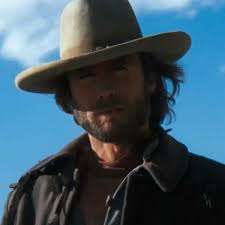
When Josey Wales reaches the group, the lead bounty hunter attempts to negotiate, offering to buy Wales’ horse and proposing a deal. Wales remains virtually silent, his face framed beneath the shadow of his wide-brimmed hat. He calmly chews tobacco, refusing to engage in idle talk. When the bounty hunter demands that Wales dismount and step down, Wales offers his quiet, decisive response: he spits tobacco juice onto the man’s jacket. This deliberate act of defiance signals the absolute breakdown of negotiation and initiates the violent climax.

What follows is a lightning-fast, masterfully edited gun battle. Drawing his Colt revolvers with unbelievable speed, Wales systematically eliminates the bounty hunters before they can fully react. The action choreography is precise, direct, and utterly devoid of romanticized flourish. Wales uses the element of surprise, his surroundings, and the movement of his horse to maintain tactical superiority throughout the shootout. The sound design amplifies the impact of every gunshot, filling the desert air with loud, echoing cracks that break the previous silence.
As the remaining bounty hunters scramble for cover behind the wooden wagon, Wales pursues them with cold, calculated precision. Even when an enemy attempts to take a position of high ground atop the wagon, Wales dispatches him without hesitation. The gunfight is over in a matter of seconds, leaving the sandy ground littered with defeated adversaries and heavy smoke drifting through the morning air.
Character Dynamics and Ethical Ambiguity
Beyond the visceral excitement of the action, the scene provides rich insights into Josey Wales’ character and internal moral code. Wales is fundamentally a reluctant hero. Having lost his wife and child to Union guerrillas during the Civil War, he is driven by a deep sense of personal grief and a refusal to bow to tyrannical authority. While he operates outside the law and shows no mercy toward those who prey on the innocent, his actions are guided by a strong personal ethics system. He does not seek out violence for pleasure; rather, he uses violence as a necessary instrument to protect those who cannot protect themselves.

After the dust settles, Laura Lee addresses Wales with a mixture of relief and apprehension, remarking, “Now you’ll kill us, I suppose.” This reaction highlights the deep cynicism of the world they inhabit, where powerful men are assumed to be ruthless conquerors. Wales dismounts without pride or bravado, offering a dry, pragmatic reply about how he would already be halfway to Mexico if not for the delays caused along the way. His interaction with Lone Watie further adds a touch of subtle humor and warmth, balancing the intense violence that preceded it.