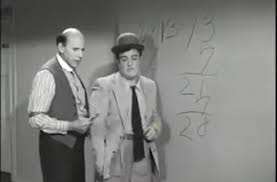
Few comedy teams have mastered the art of misunderstanding quite like Abbott and Costello. With their distinctive combination of straight-man authority, frantic energy, wordplay, and escalating confusion, Bud Abbott and Lou Costello created some of the most memorable comedy in American television history. “7 x 13 = 28” is a wonderful example of the duo’s signature style, turning a seemingly simple mathematical problem into an entertaining exercise in logic, frustration, and comic timing.
At the heart of the sketch is the familiar Abbott and Costello formula: Abbott attempts to maintain control and explain a situation in a serious, rational manner, while Costello becomes increasingly confused by the explanation. What begins with an apparently straightforward question quickly spirals into a chain of misunderstandings. The humor comes not simply from getting an answer wrong, but from the strange logic used to defend that answer.
The title itself, “7 x 13 = 28,” immediately signals that something is not quite right. Anyone familiar with basic multiplication knows that seven multiplied by thirteen equals ninety-one. Yet in the world of Abbott and Costello, mathematics is rarely allowed to remain simple. The incorrect equation becomes the starting point for a comic battle over numbers, words, and common sense.
The Classic Abbott and Costello Dynamic
One of the reasons Abbott and Costello remained so popular was the contrast between their personalities. Bud Abbott often played the confident, impatient straight man. His character generally believed he understood the situation and expected everyone else to follow his reasoning.
Lou Costello, by contrast, played the confused innocent. His character often asked perfectly reasonable questions, but his attempts to understand Abbott’s explanations created even more confusion. Costello’s expressive face, nervous reactions, physical movements, and distinctive delivery made even a simple misunderstanding hilarious.
This relationship is especially effective in a sketch built around mathematics. Numbers should be precise. There should be only one correct answer. But Abbott and Costello turn certainty into uncertainty. The more Abbott tries to explain, the more complicated the situation becomes.
Costello’s confusion is not simply stupidity. In many of their routines, he notices contradictions that Abbott ignores. He questions definitions, challenges assumptions, and interprets statements literally. His questions force the conversation into increasingly ridiculous territory.
That is where the comedy becomes particularly effective.
When Simple Mathematics Becomes Complicated
The brilliance of “7 x 13 = 28” lies in its ability to take something ordinary and transform it into something absurd. Mathematics is normally associated with rules and certainty. Two plus two should always equal four. Seven times thirteen should always equal ninety-one.
But comedy thrives when those rules are deliberately disrupted.
The incorrect equation becomes a comic object. Rather than immediately correcting the mistake and moving on, the characters become trapped inside it. The conversation develops through repetition, questioning, correction, and renewed misunderstanding.
This kind of humor was central to Abbott and Costello’s television work. Their sketches frequently took everyday subjects—jobs, money, food, sports, family, or simple conversations—and pushed them into ridiculous situations.
The audience understands the basic reality of the situation. That makes the characters’ confusion even funnier.
When Costello cannot accept the logic being presented to him, viewers can anticipate the inevitable explosion of frustration. When Abbott attempts to regain control, audiences know that another misunderstanding is probably waiting around the corner.
The Importance of Timing
Abbott and Costello’s comedy was never dependent entirely on clever dialogue. Their success also came from extraordinary timing.
A pause at the right moment could make a simple sentence funny. A quick response could completely change the direction of the conversation. Costello’s facial expressions could communicate confusion before he even said a word.
Abbott’s delivery was equally important. His increasingly frustrated tone created a strong contrast with Costello’s innocent questions. The rhythm often resembles a musical performance: question, answer, misunderstanding, correction, reaction, and escalation.
That rhythm is one of the reasons their comedy continues to work decades after the original performances.
Even when viewers already know where a joke is going, the timing can make it enjoyable again. The pleasure comes from watching the performers execute the routine with precision.
Verbal Confusion as a Comedy Tool
Abbott and Costello were masters of verbal comedy. They understood that language could become funny when two people interpreted the same words differently.
In their routines, a single phrase could have multiple meanings. One character might use a word in one sense while the other interprets it literally. This creates a conversational trap in which every attempt to clarify the situation only makes it worse.
The mathematical theme of “7 x 13 = 28” fits perfectly into this tradition. Numbers appear objective, but the characters manage to turn them into a source of disagreement.
The humor is therefore not really about mathematics. It is about communication.
The audience watches two people attempt to reach an understanding while speaking past each other. That is a situation that remains recognizable even today.
Physical Comedy and Expression
Another important part of Abbott and Costello’s appeal was physical comedy. Costello was particularly talented at using his entire body to express emotion.
A moment of confusion might involve a raised eyebrow, a nervous gesture, a sudden movement, or an exaggerated reaction. His physical performance amplified the dialogue.
Abbott, meanwhile, often remained comparatively controlled. His restraint made Costello’s reactions appear even more dramatic.
This contrast created a visual rhythm that complemented their verbal exchanges.
Even when the central joke is based on a mathematical equation, the performance does not feel like a classroom lesson. Instead, the audience experiences the comedy through personality, movement, expression, and timing.
Why Their Humor Still Works
Modern audiences have access to countless forms of entertainment, from short-form videos to streaming series and social media comedy. Yet Abbott and Costello’s routines continue to attract viewers.
One reason is simplicity.
Their comedy does not require elaborate technology, complicated special effects, or an extensive fictional universe. The humor often depends on two performers standing together and talking.
Another reason is relatability. Everyone has experienced a conversation where a simple idea somehow became complicated. Everyone has encountered someone who explains something in a way that creates even more questions.
Abbott and Costello exaggerate those experiences until they become absurd.
The result is comedy that remains accessible across generations.
A Lasting Legacy
Abbott and Costello helped establish a style of American comedy built around misunderstanding, repetition, wordplay, and escalating absurdity. Their influence can be seen in later television comedians, sketch performers, sitcoms, and even modern internet comedy.
Their routines demonstrate that a strong comic premise does not have to be complicated. A single misunderstanding can provide enough material for an entire performance when the performers understand how to develop it.
“7 x 13 = 28” captures that philosophy beautifully. The title presents an impossible equation, but the real subject is the comic journey created by trying to make sense of it.
The routine reminds viewers that logic can be wonderfully funny when it is pushed beyond its limits.
Conclusion
“Abbott & Costello: 7 x 13 = 28” is a charming example of the classic comedy style that made Bud Abbott and Lou Costello legendary. Through misunderstandings, verbal exchanges, exaggerated reactions, and impeccable timing, the duo transforms an ordinary mathematical problem into a memorable comic situation.
The enduring appeal of the sketch comes from its simplicity. There is no need for a complicated story. The humor grows naturally from the relationship between Abbott and Costello.
Abbott wants order and control. Costello wants to understand. Their opposing approaches collide, producing the kind of escalating confusion that became one of the defining features of their comedy.
Decades later, the equation may still be mathematically wrong, but that is precisely the point. In the hands of Abbott and Costello, being wrong can be the beginning of something wonderfully funny.
For fans of classic television comedy, “7 x 13 = 28” offers another reminder of why Abbott and Costello remain beloved. Their performances demonstrate the timeless power of good timing, strong character contrast, clever wordplay, and the simple joy of watching two talented comedians turn confusion into laughter.