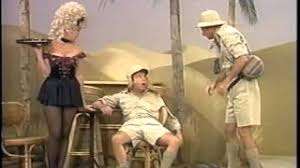
Few television comedy programs have achieved the lasting cultural impact of The Carol Burnett Show. Known for its unforgettable characters, clever sketches, musical performances, and brilliant ensemble cast, the series created countless moments that continue to entertain audiences decades later. Among its memorable adventures is the comedy sketch often remembered as “Lost in the Sahara,” a wonderfully exaggerated parody of desert exploration that transforms an ordinary survival situation into a chaotic and hilarious comedy routine.
The sketch captures one of the most recognizable qualities of The Carol Burnett Show: the ability to take a dramatic situation and completely destroy its seriousness through physical comedy, ridiculous dialogue, unexpected reactions, and perfectly timed performances.
A Dramatic Setting Becomes a Comedy Playground
The Sahara Desert is naturally associated with danger, isolation, heat, exhaustion, and survival. A person lost in such an environment would normally face a genuinely frightening situation. In the world of The Carol Burnett Show, however, being stranded in the Sahara becomes an opportunity for nonstop jokes.
The basic premise immediately creates a humorous contrast. The characters are placed in an environment where they should be focused on survival, yet their behavior repeatedly becomes irrational and absurd. Instead of presenting a serious adventure story, the sketch exaggerates the difficulties of desert travel until every small problem becomes an enormous comedic disaster.
This type of contrast was one of the show’s greatest strengths. Carol Burnett and her fellow performers could take a familiar movie or television scenario and turn it upside down. Audiences recognized the dramatic conventions being parodied, which made the exaggerated reactions even funnier.
Carol Burnett’s Comedic Performance
Carol Burnett’s extraordinary ability to communicate emotion through her face and body is central to the success of sketches like “Lost in the Sahara.” She could move effortlessly from confidence to panic, frustration, confusion, or disbelief, often within seconds.
Her performance style was never dependent solely on dialogue. A facial expression, a pause, a gesture, or a change in posture could become the punchline. When something unexpected happened in a sketch, Burnett knew how to give the audience just enough time to appreciate the absurdity before moving to the next joke.
That talent was especially effective in physical-comedy situations. Being lost in a desert gives performers countless opportunities to act exhausted, confused, thirsty, frightened, or completely overwhelmed. Burnett could turn each of those emotions into another layer of comedy.
Rather than simply telling the audience that a character was struggling, she allowed viewers to see the struggle through exaggerated movements and reactions.
The Power of Ensemble Comedy
Although Carol Burnett was the show’s central star, The Carol Burnett Show was famous for its exceptional ensemble. Performers such as Harvey Korman, Vicki Lawrence, Lyle Waggoner, and Tim Conway contributed enormously to the show’s unique comedic style.
The chemistry between performers was particularly important in sketches involving misunderstandings and escalating chaos. One character might make a ridiculous statement, another would respond with complete seriousness, and a third would react with disbelief. The situation would then spiral further out of control.
That rhythm is a major reason classic Carol Burnett sketches remain entertaining. The humor rarely depends on a single joke. Instead, jokes build on one another.
A simple problem becomes a bigger problem, then a ridiculous problem, and eventually an almost impossible situation. Each performer adds another reaction, creating a comic chain reaction.
Parodying Adventure Stories
“Lost in the Sahara” works especially well because it plays with familiar adventure-story conventions.
Classic adventure films often feature brave explorers crossing dangerous landscapes, searching for civilization, discovering mysterious locations, and overcoming incredible obstacles. Characters are usually portrayed as courageous and resourceful.
The comedy sketch takes these conventions and exaggerates them.
Instead of perfectly prepared explorers, the characters behave like ordinary people who are completely unprepared for the situation. Instead of calmly solving problems, they become increasingly confused. Instead of heroic speeches, audiences receive ridiculous conversations and reactions.
This is a classic parody technique: take something traditionally serious and exaggerate its characteristics until they become ridiculous.
The Sahara therefore becomes more than a setting. It becomes a comedic character in its own right—a huge, unforgiving environment that constantly creates new problems for the performers.
Physical Comedy and Timing
One of the defining characteristics of The Carol Burnett Show was its mastery of physical comedy. “Lost in the Sahara” provides an ideal environment for this kind of humor.
Walking through sand, dealing with extreme heat, searching for water, attempting to find direction, or reacting to an unexpected obstacle can all become visual jokes. The performers do not need elaborate special effects. Their bodies, expressions, timing, and interaction with the set are enough.
Timing is particularly important.
A joke may be funny because of what a character says, but it can become much funnier because of the pause afterward. A performer may look at another character for several seconds, allowing the audience to anticipate the reaction. Then the smallest movement or expression delivers the punchline.
Burnett and her cast understood this rhythm extremely well.
Why the Sketch Still Feels Entertaining
Modern audiences have access to sophisticated visual effects, elaborate productions, and fast-paced digital entertainment. Yet classic television comedy can still feel surprisingly fresh.
One reason is that the humor is fundamentally human.
People still get confused. People still panic when plans fail. People still misunderstand one another. People still react dramatically to situations that could be handled much more simply.
The performers’ exaggerated personalities make these everyday human experiences recognizable while pushing them into absurd territory.
Another reason is the simplicity of the premise. You do not need extensive background information to understand what is happening. The characters are lost, the environment is difficult, and everything keeps going wrong. That is enough to build an entertaining comedy routine.
The Magic of Live Television Comedy
The Carol Burnett Show was produced during an era when television variety shows depended heavily on live performance skills. Performers could not simply rely on digital editing to repair every mistake.
That environment encouraged exceptional discipline and timing.
The cast had to know their lines, movements, entrances, exits, props, and reactions. At the same time, they had to remain flexible enough to respond when something unexpected happened.
This is part of what makes classic sketches so enjoyable to watch today. Viewers can sense the energy of performers sharing the stage and playing off one another.
Sometimes a performer’s reaction to another person’s mistake becomes funnier than the planned joke itself.
Carol Burnett’s Lasting Legacy
Carol Burnett became one of the defining figures in American television comedy because she understood that comedy could be both intelligent and wonderfully silly.
Her show welcomed different forms of humor, from character comedy and parody to slapstick and musical performances. The result was a program with an enormous range.
Sketches such as “Lost in the Sahara” demonstrate how effectively the show could transform an ordinary premise into a memorable comic adventure.
The sketch also represents the larger spirit of the program: do not take the situation too seriously, embrace the absurdity, and allow talented performers to build jokes together.
A Journey Worth Revisiting
“Lost in the Sahara” is ultimately less about the desert itself and more about the comedy that emerges when people are placed in an impossible situation.
The exaggerated setting, expressive performances, escalating problems, and ensemble chemistry create the kind of classic television humor that does not require complicated technology or elaborate storytelling.
At the center of it all is Carol Burnett, whose ability to make a character’s confusion, fear, frustration, and disbelief entertaining helped define an entire generation of television comedy.
Decades after The Carol Burnett Show first entertained television audiences, sketches like “Lost in the Sahara” remain a reminder of how powerful simple comedy can be. A handful of talented performers, a clever premise, a well-designed set, and impeccable timing can create something that audiences remember long after the original broadcast.
For longtime fans, revisiting the sketch offers a nostalgic trip back to an era when variety television was a major part of American entertainment. For newer viewers, it provides an opportunity to discover why Carol Burnett and her remarkable cast became comedy legends.
The Sahara may be vast, hot, and unforgiving—but in the hands of The Carol Burnett Show, getting lost there becomes an unforgettable reason to laugh.