Tim Conway had a dangerous talent.
He knew how to make funny people laugh when they weren’t supposed to.
Harvey Korman became his most famous victim, but he wasn’t the only one.
In one unforgettable Carol Burnett Show sketch, Conway turned his attention to Lyle Waggoner.
The setting couldn’t have looked more serious.
Waggoner played an American prisoner of war.
Conway was his interrogator.
The costume, the situation and Conway’s exaggerated German accent established what looked like a conventional World War II parody.
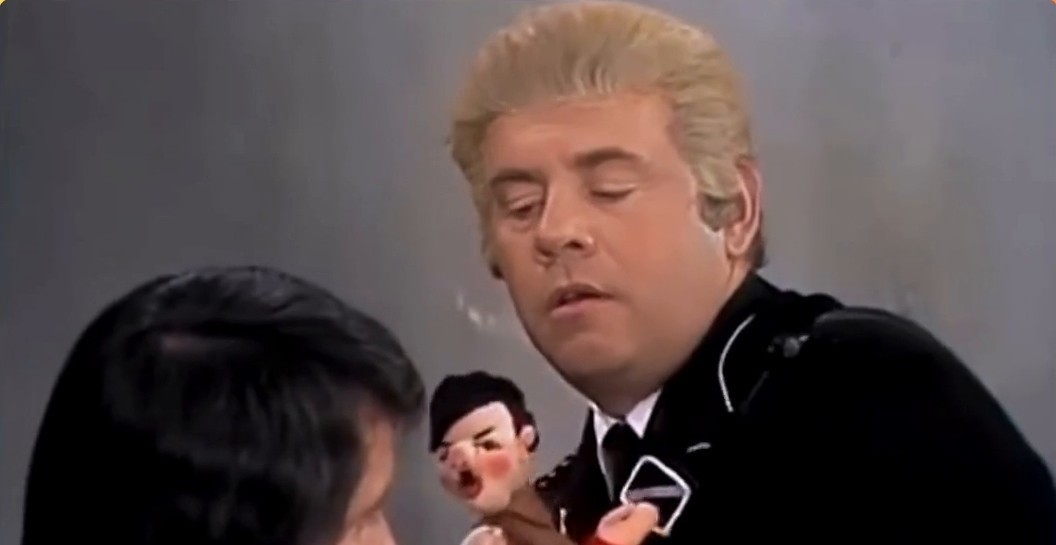
Then Tim Conway reached inside his coat.
And pulled out a tiny Hitler puppet.
From that moment forward, Lyle Waggoner was in trouble.
The Interrogation Begins
The sketch appeared in the February 23, 1974 episode of The Carol Burnett Show, featuring Tim Conway and musical guest Eydie Gormé. Episode guides specifically describe one of its highlights as Conway playing a “brutal” Nazi interrogator attempting to extract information from Waggoner’s POW.
Of course, putting the word “brutal” in quotation marks is important.
This is Tim Conway.
His idea of getting tough is somewhat different.
The premise begins with the familiar structure of countless wartime movies: an enemy officer wants information from a captured soldier.
Waggoner’s character refuses to cooperate.
So Conway decides stronger methods are necessary.
That sounds ominous.
Until you see his weapon.
Enter the Puppet
Conway produces a tiny hand puppet resembling Hitler.
It’s visually ridiculous before the puppet even does anything.
But Conway doesn’t stop there.
The puppet begins singing.
Accounts of the routine describe Conway having the puppet perform “I’ve Been Working on the Railroad” in a high-pitched, exaggerated German-accented voice while Waggoner desperately attempts to remain in character.
The contrast is perfect.
Waggoner is supposed to be a prisoner undergoing interrogation.
Conway is supposed to be intimidating him.
Instead, Waggoner is sitting inches away from a tiny puppet singing a children’s folk song.
And he isn’t allowed to laugh.
That’s the real torture.
Lyle Waggoner Tries to Survive
Once the puppet appears, watching Waggoner becomes almost as entertaining as watching Conway.
He knows what Tim is doing.
The audience knows what Tim is doing.
Tim certainly knows what he’s doing.
Conway isn’t simply trying to entertain the television audience.
He’s trying to destroy his scene partner’s composure.
Waggoner fights it.
He looks away.
He tries to maintain the expression of a serious POW.
But Conway keeps going.
And going.
The longer the puppet sings, the more impossible the situation becomes.
A later account of Conway’s career described Waggoner trying in vain to ignore the puppet while Conway stretched the gag through the song.
This became one of the great pleasures of watching Tim Conway.
There were often two jokes happening simultaneously.
The first was the sketch.
The second was watching another performer realize that Conway had set a trap for them.
Nobody Told Lyle About the Puppet
And here’s the detail that makes the footage much better.
Apparently, Waggoner didn’t know what was coming.
In an interview with Tim Conway, the interviewer specifically brought up this sketch and asked whether anyone else knew beforehand that Conway was going to produce the Hitler puppet.
Conway’s answer was wonderfully concise:
“Just me.”
That changes how you watch the scene.
Waggoner isn’t merely acting surprised.
He’s dealing with Tim Conway introducing something unexpected into the performance.
The laughter he’s fighting suddenly makes complete sense.
Conway knew exactly what he was doing.
The “Conway’s Capers”
This kind of behavior became so closely associated with Conway that the show’s staff reportedly had a name for his unscripted additions: “Conway’s Capers.”
The program generally went through rehearsals and two tapings. Accounts of the production describe Conway sometimes playing material more conventionally during the first taping, then adding bizarre surprises during another performance once the show already had a usable version.
That gave Conway freedom.
And it made life extremely difficult for whoever happened to be standing next to him.
The Hitler puppet is frequently cited as one of the notable examples.
Unlike some Conway improvisations that were removed from the original broadcast and resurfaced later, accounts indicate that the puppet material actually made it into the final program.
Harvey Korman Wasn’t His Only Victim
When people think about Tim Conway making another actor break, they naturally think of Harvey Korman.
Their chemistry became legendary.
Conway’s dentist sketch is one of the best-known examples. The Oldest Man character repeatedly put Korman through similar ordeals.
Then there’s the famous elephant story, where Conway’s increasingly absurd tale eventually destroys almost everybody around him.
But this sketch demonstrates that Conway didn’t require Harvey Korman to create that dynamic.
Lyle Waggoner could be trapped too.
In some ways, Waggoner’s relatively straight, serious appearance makes the puppet gag even better.
Conway needed someone who looked as though he belonged in a serious World War II movie.
Then he could destroy the illusion.
Why the Puppet Works
Take away the context and the object itself is absurdly simple.
It’s a hand puppet.
That’s all.
There are no complicated special effects.
No expensive stunt.
No enormous set piece.
Conway simply puts his hand inside a ridiculous puppet and gives it a voice.
But the simplicity is exactly why it works.
The sketch establishes one expectation:
This is an interrogation.
Conway then gives the audience something completely incompatible with that expectation:
A singing puppet.
Comedy loves contrast.
Serious versus ridiculous.
Dangerous versus harmless.
An intimidating interrogator versus a tiny puppet singing a children’s tune.
The greater the distance between those two ideas, the funnier the collision becomes.
Conway’s Greatest Weapon Was Patience
Another reason the routine works is Conway’s willingness to stretch a joke.
Many performers would introduce the puppet, get the first laugh and move on.
Conway understood that sometimes the funniest thing you can do is refuse to move on.
The puppet keeps performing.
Waggoner keeps suffering.
The audience keeps laughing.
Every additional second increases the pressure.
That’s the same principle Conway used with his famous Oldest Man character.
He wasn’t afraid of taking time.
Silence could be funny.
Waiting could be funny.
Watching another actor anticipate the next ridiculous thing could be extremely funny.
The Carol Burnett Show’s Special Chemistry
Moments like this also help explain why The Carol Burnett Show continues to circulate so effectively in short clips decades later.
The comedy isn’t limited to the written joke.
We’re also watching real performers interact.
We can see someone struggling not to laugh.
We can sometimes sense when a performer has been surprised.
That creates intimacy between the audience and the cast.
We’re no longer simply watching characters.
We’re watching Tim Conway trying to crack Lyle Waggoner.
And we’re rooting for him to succeed.
One Tiny Puppet, One Classic Moment
The sketch could have been a straightforward World War II parody.
Tim Conway made sure it wasn’t.
He introduced one absurd idea that apparently nobody else knew was coming.
A tiny puppet.
A ridiculous voice.
A song that had absolutely no business appearing in an interrogation scene.
And across from him sat Lyle Waggoner, desperately trying to survive without laughing.
That’s Tim Conway’s comedy in miniature.
He didn’t always need the biggest joke.
Sometimes he just needed one unexpected idea and a scene partner who wasn’t prepared for it.
Lyle Waggoner thought he was being interrogated by Tim Conway. The real challenge was surviving the puppet without breaking character. 😂