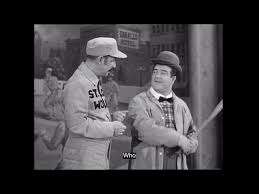
Few comedy routines in American entertainment history have achieved the legendary status of “Who’s on First?” Performed by the iconic comedy duo Abbott and Costello, the routine remains one of the most recognizable examples of verbal comedy ever created. Featured in The Naughty Nineties, the famous exchange transforms an ordinary conversation about a baseball team into a hilarious spiral of misunderstanding, repetition, frustration, and perfectly timed reactions. Even decades after its original performance, “Who’s on First?” continues to demonstrate why great comedy can remain timeless.
Abbott and Costello were masters of the comedy double act. Bud Abbott typically played the confident, fast-talking straight man, while Lou Costello portrayed the confused, excitable character who constantly found himself trapped in absurd situations. Their contrasting personalities created the foundation for countless memorable routines. In “Who’s on First?”, this dynamic reaches one of its most brilliant forms because the humor depends almost entirely on language.
The premise sounds simple. Abbott is explaining the names of the players on a baseball team to Costello, who wants to understand who plays each position. The problem is that the players’ names include words such as “Who,” “What,” and “I Don’t Know.” Costello naturally interprets these words as questions and statements rather than names. Abbott, meanwhile, answers literally, completely unaware—or seemingly unaware—of why Costello is becoming increasingly frustrated.
The first question establishes the entire pattern: “Who’s on first?” Abbott answers that “Who” is on first. Costello thinks Abbott is asking him who the player is, but Abbott is actually giving him the player’s name. From there, the conversation becomes increasingly complicated.
The brilliance of the routine comes from its structure. Each exchange builds on the previous one. Costello tries to clarify what he believes is a simple misunderstanding, but every clarification creates another misunderstanding. Abbott patiently provides information that makes perfect sense within the strange logic of the baseball roster. Costello hears ordinary conversational language and tries to interpret it normally. The two perspectives can never meet.
This creates a comedic loop that becomes more ridiculous with every question.
Costello moves on to second base and asks about the player there. Abbott explains that the player’s name is “What.” Costello again assumes that Abbott is asking him a question. When Costello asks about the third baseman, Abbott says the player is “I Don’t Know.” By this point, the audience understands the linguistic trap, while Costello remains caught inside it.
That difference in audience knowledge is an important part of the humor. Viewers quickly recognize the pattern and begin anticipating Costello’s next mistake. Every new question creates a familiar rhythm: Costello asks, Abbott answers, Costello becomes confused, and the confusion grows. The audience knows exactly why the misunderstanding is happening, but watching Costello desperately attempt to make sense of it makes the situation even funnier.
The performance also demonstrates the importance of timing. “Who’s on First?” is not simply funny because of the words. The pauses, interruptions, changes in volume, facial expressions, and reactions all contribute to the routine. Costello’s increasing frustration gives the dialogue emotional energy. Abbott’s calm and matter-of-fact delivery makes the situation even more absurd.
If both performers reacted in the same way, the routine would lose much of its impact. Abbott’s controlled confidence acts as the perfect contrast to Costello’s growing exasperation. Costello appears increasingly convinced that Abbott is deliberately refusing to answer his questions. Abbott, from his perspective, is simply providing the information Costello requested.
This contrast between logic and absurdity is one of the defining characteristics of Abbott and Costello’s comedy.
The setting of The Naughty Nineties also gives the routine a memorable cinematic context. Released during the 1940s, the film presents Abbott and Costello in a larger entertainment environment filled with musical performances, comedy, and theatrical spectacle. Within that setting, “Who’s on First?” stands out because it requires remarkably little physical action. The comedy comes primarily from conversation.
That is part of what makes the routine so impressive. There are no elaborate special effects, complicated sets, or expensive visual effects required. The performers simply stand, speak, listen, react, and manipulate language. Yet the result is energetic enough to remain entertaining for modern audiences.
Baseball itself is also an important part of the routine’s appeal. Baseball was deeply embedded in American popular culture, and audiences immediately understood the basic positions: first base, second base, and third base. Because the audience understands the normal terminology, the unusual player names become even more effective. The routine takes something familiar and turns it into something completely absurd.
At its heart, “Who’s on First?” is a comedy about communication. Two people are technically speaking the same language, but they are operating under completely different interpretations of the words. Costello assumes that “who” means an interrogative pronoun. Abbott treats “Who” as a proper name. Neither interpretation is inherently impossible, but placing them together creates chaos.
This idea remains relevant far beyond baseball. Miscommunication is one of the oldest sources of comedy because audiences recognize it from everyday life. People misunderstand instructions, interpret phrases differently, make assumptions, and sometimes become frustrated because they believe someone else is not listening. Abbott and Costello turn that ordinary human experience into an exaggerated theatrical routine.
Another reason the performance remains memorable is its rhythm. The routine has a musical quality even though there is no singing. Questions and answers repeat with slight variations. Words return again and again. The repetition creates anticipation, while small changes keep the conversation moving forward. The audience becomes familiar with the pattern and waits for the next escalation.
Costello’s physical reactions are equally important. His confusion gradually transforms into disbelief and anger, but the performance remains playful rather than genuinely hostile. His frustration becomes part of the joke. The more desperately he tries to regain control of the conversation, the more completely the conversation escapes him.
Abbott, meanwhile, maintains the appearance of someone who cannot understand why there is a problem. His calmness makes Costello look even more confused. This is classic straight-man-and-comic-partner construction, and Abbott and Costello perfected it.
“Who’s on First?” has also survived because it is easy to understand across generations. A viewer does not need extensive knowledge of 1940s entertainment to appreciate the basic joke. The situation is immediately recognizable: someone asks a question, receives an answer, and somehow becomes more confused. The language may come from another era, but the comedic mechanism remains universal.
The routine also serves as a reminder that comedy does not always need complicated storytelling. Sometimes a simple idea can become extraordinary when performed with precision. Abbott and Costello understood how to stretch a small misunderstanding into an extended comedic experience without losing the audience.
Watching “Who’s on First?” today offers more than nostalgia. It provides a glimpse into the craftsmanship behind classic American comedy. Every word matters. Every pause matters. Every reaction matters. The performers understood their characters so thoroughly that the conversation feels spontaneous even though the routine was carefully constructed and refined.
The Naughty Nineties therefore preserves more than a famous comedy sketch. It captures a moment in entertainment history when radio, stage, and film comedy were closely connected, and performers relied heavily on dialogue and personality to entertain audiences. Abbott and Costello’s chemistry shines throughout the routine, proving why they became one of the most celebrated comedy teams of their generation.
Ultimately, “Who’s on First?” remains unforgettable because it turns language itself into the source of chaos. The names “Who,” “What,” and “I Don’t Know” are transformed from ordinary words into characters in a linguistic puzzle. Costello’s attempts to understand the situation only make everything more confusing, while Abbott’s calm explanations keep the cycle going.
More than eighty years after its appearance in The Naughty Nineties, the routine continues to be referenced, imitated, studied, and enjoyed. Its longevity is a testament to the extraordinary chemistry between Bud Abbott and Lou Costello. Their performance demonstrates that great comedy does not necessarily depend on elaborate production. Sometimes all it takes is two talented performers, a clever idea, impeccable timing, and a conversation that goes completely off the rails.
That is the enduring magic of “Who’s on First?”—a simple baseball question becomes one of the greatest examples of comedic misunderstanding ever performed.