Some comedy sketches are funny because of clever dialogue. Others are memorable because of an outrageous situation. And then there are sketches that become unforgettable because the performers themselves are so committed to the joke that even their reactions become part of the comedy.
“The Dentist” from The Carol Burnett Show belongs firmly in that final category.
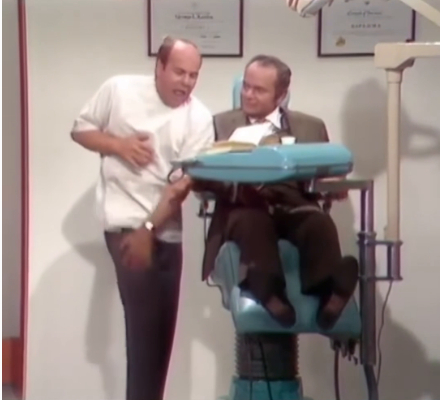
Starring Tim Conway and Harvey Korman, the sketch takes a simple situation—a patient visiting a dentist—and transforms it into one of the most memorable pieces of physical comedy in television history. Conway plays Dr. Kiefer, a recently graduated dentist facing his very first patient, while Korman plays the unlucky man who desperately needs treatment for a painful tooth. The official Carol Burnett Show description confirms the basic premise: Conway’s nervous new dentist accidentally injects himself with Novocain instead of properly treating his patient.
The setup is immediately funny because the audience knows something the patient does not.
This is not an experienced dentist confidently welcoming a routine patient.
This is a nervous rookie who has only just graduated from dental school.
And unfortunately for Harvey Korman’s character, he is the dentist’s very first patient.
The opening establishes the situation perfectly. Korman arrives with a painful tooth and wants one simple thing: relief. The assistant warns him that the new dentist may be nervous. His response is essentially that he will not be the only nervous person in the room.
That single idea establishes the entire comedic conflict.
The patient is already worried about the dentist’s lack of experience, while the dentist is clearly terrified about treating his first patient. The audience can immediately see that this appointment is unlikely to go smoothly.
Tim Conway was particularly skilled at playing characters who seemed completely overwhelmed by ordinary situations. Instead of portraying the dentist as incompetent in an exaggerated or cartoonish way from the beginning, Conway makes him genuinely nervous. His facial expressions, hesitant movements, and awkward delivery make the character feel almost painfully uncomfortable.
That makes the situation even funnier.
The dentist knows he is not ready.
The patient knows something feels wrong.
And the audience knows disaster is coming.
The comedy then begins to escalate.
When Korman’s character explains how much pain he is experiencing, the dentist starts discussing his academic performance. Rather than confidently explaining the procedure, he admits that he received only average grades in some of the most important dental procedures.
His strongest subject was cleaning.
Unfortunately, cleaning is not going to solve the patient’s immediate problem.
That exchange perfectly captures the sketch’s style. Conway’s character is technically a professional, but everything he says makes the patient less confident in him. The more he tries to explain himself, the more nervous the situation becomes.
This is classic character-based comedy.
The humor does not depend on a complicated plot. It comes from watching two people respond to an increasingly ridiculous situation.
Eventually, the dentist decides he has to perform the procedure.
And this is where the sketch becomes legendary.
The Novocain is introduced as the solution to the patient’s pain, but Conway’s nervous dentist struggles to handle the equipment. Instead of smoothly administering the anesthetic, he accidentally injects himself.
His hand becomes numb.
Then things become even worse.
As he tries to continue working, the effects spread through his body in increasingly ridiculous ways. The dentist is supposed to be treating his patient, but he is gradually becoming less capable of performing the procedure himself. The official descriptions of the sketch note that Conway’s character accidentally injects himself with Novocain and ends up numbing his hand, leg, and head.
The physical comedy is what makes these moments so effective.
Conway’s movements change as the anesthetic affects him. His body becomes increasingly difficult to control, while Korman’s character watches the disaster unfold from the dental chair.
The contrast between the two performers is brilliant.
Korman is desperately trying to get his tooth fixed.
Conway is desperately trying to remain a functioning dentist.
Neither objective is going particularly well.
One of the greatest aspects of the sketch is the chemistry between Conway and Korman. The two performers had an extraordinary ability to make each other laugh, and that chemistry became part of what made their sketches so memorable.
In “The Dentist,” that dynamic is especially obvious.
Korman attempts to maintain his character while Conway continues delivering his increasingly absurd performance. Eventually, the situation becomes so funny that staying completely serious becomes almost impossible.
The audience can see Korman struggling not to laugh.
That reaction makes the scene even funnier.
Interestingly, the element of surprise was important to the original performance. According to an interview with the Los Angeles Times, Conway said Korman had not seen the ending of the dentist sketch before the performance because Conway did not want to reveal the Novocain gag. Korman therefore experienced the escalation in much the same way the audience did.
That helps explain why some of the reactions feel so spontaneous.
The laughter becomes part of the entertainment.
It is a perfect example of why live sketch comedy can be so special. When performers genuinely struggle to stay in character, the audience gets to experience something that feels unpredictable and authentic.
The sketch originally appeared during the early years of The Carol Burnett Show. PBS identifies the dentist routine as a popular sketch featuring Conway and Korman, and the show’s archive notes that it was later brought back by popular demand.
That popularity is easy to understand.
The basic premise is universal.
Everyone understands the anxiety of visiting a dentist.
Everyone understands the fear of being treated by someone who seems inexperienced.
And everyone can appreciate the absurdity of a dentist accidentally becoming the person who needs medical attention.
The sketch simply takes those familiar fears and pushes them to an extreme.
Another reason the comedy still works is its simplicity. There are no complicated visual effects or elaborate locations. The scene takes place in a dentist’s office, and the central props are ordinary dental equipment.
The performers create the comedy.
That is an important part of classic television comedy. When the writing and performances are strong enough, the setting does not need to be spectacular. A small room can become an entire comedic world.
Tim Conway’s performance demonstrates just how powerful physical comedy can be. His movements become increasingly awkward as the sketch progresses, and every change in his physical behavior communicates another stage of the disaster.
Harvey Korman, meanwhile, provides the perfect reaction.
His character’s growing disbelief gives the audience someone to identify with. We watch the situation through his eyes and wonder how anyone could possibly continue trusting this dentist.
That combination creates a perfect comedic rhythm.
The dentist makes a mistake.
The patient reacts.
The dentist attempts to fix the mistake.
The situation becomes worse.
The patient reacts again.
And the cycle continues until the entire scene collapses into laughter.
That structure is remarkably simple, but the execution is exceptional.
“The Dentist” also represents what made The Carol Burnett Show such an influential comedy program. The series became famous for combining memorable characters, parody, physical comedy, exaggerated situations, and performers who were willing to completely commit to the material. The show ran from 1967 to 1978 and became one of the defining sketch-comedy programs of its era.
Decades later, the dentist sketch still feels fresh because the humor is based on human reactions rather than contemporary references.
The technology may look old.`
The dental office may look vintage.
The television production style may belong to another era.
But nervousness, embarrassment, frustration, and laughter are timeless.
That is why new audiences can still discover the sketch and immediately understand why it became so beloved.
At its heart, “The Dentist” is simply a story about a professional who is completely unprepared for his first day on the job.
Unfortunately, his first patient has a terrible toothache.
And the one thing that is supposed to make the patient comfortable ends up making the dentist increasingly helpless instead.
With Tim Conway’s brilliant physical performance and Harvey Korman’s unforgettable reactions, the result is a piece of classic television comedy that continues to stand out.
It is proof that you do not need a complicated story to create a legendary comedy sketch.
Sometimes all you need is a nervous dentist, an unfortunate patient, a syringe of Novocain, and two performers who are almost incapable of keeping straight faces.