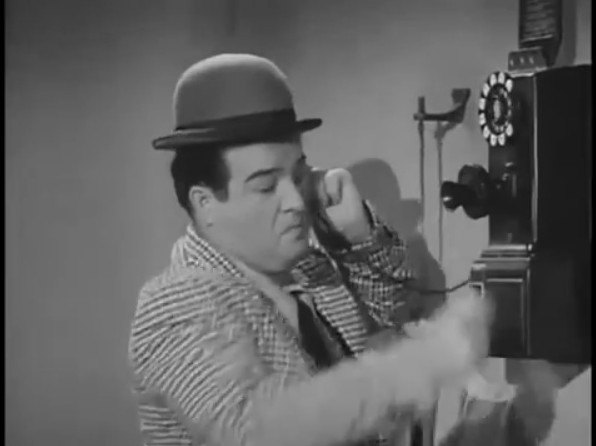
There are some comedy routines that begin with the simplest possible problem and somehow transform it into complete, unforgettable chaos. This classic Abbott & Costello-style telephone routine does exactly that.
The mission sounds easy enough: Lou needs a job.
Bud Abbott tells him to look up the Fields Employment Agency and make a phone call. It should take only a few seconds. Find the number, dial it, ask about work, and hopefully solve Lou’s employment problem.
But this is Lou Costello we are talking about.
And when Lou Costello gets anywhere near a telephone, a simple local call can somehow become an international adventure involving Australia, Brazil, Italy, kangaroo farms, coffee companies, confused operators, busy telephone lines, and enough misunderstandings to make the entire phone system collapse.
The result is a brilliant example of classic comedy built almost entirely around timing, repetition, confusion, and Costello’s incredible ability to turn the simplest task into a disaster.
A Job Search Begins With Forty Cents

The routine starts with Abbott trying to push Lou toward getting a job. Before Lou can even begin his employment search, however, money becomes part of the confusion.
Abbott gives him forty cents but immediately reminds him that Lou owes him forty cents.
Naturally, Lou is confused.
The exchange captures one of the great strengths of Abbott and Costello’s comedy partnership. Abbott speaks with confidence and impatience, while Costello reacts as though the basic rules of reality are changing right in front of him.
The audience immediately understands what kind of journey is about to begin.
Lou has one simple responsibility: call the employment agency.
Unfortunately, making that call proves to be almost impossible.
Alexander Four Four Four Four
The number Lou needs is simple:
Alexander… four… four… four… four.
At least, it sounds simple.
But throughout the routine, that number becomes Lou’s personal nightmare.
Every time he asks the operator for Alexander Four Four Four Four, something goes wrong. The line is busy. The operator misunderstands him. Lou becomes increasingly desperate. The number seems to exist everywhere and nowhere at the same time.
The funniest part is that the employment agency is only two blocks away.
Two blocks.
Lou could probably walk there faster than he can explain the number to the operator.
But that would not be nearly as funny.
Instead, the telephone becomes a gateway to the entire world.
Australia Is Apparently Easier to Reach

Unable to get through to a business just two blocks away, Lou somehow manages to place a long-distance call to Sydney, Australia.
This is where the routine becomes wonderfully absurd.
Lou asks for Mr. Smith’s kangaroo farm.
And when the call finally connects, the conversation takes an unexpected turn.
How is the kangaroo farm?
Fine.
How is everybody?
The whole place is jumping.
That simple joke is exactly the kind of humor that made these routines so memorable. A kangaroo farm is literally a place where everything jumps, but the line is delivered like a completely ordinary business update.
Lou treats the conversation as though it makes perfect sense.
Meanwhile, the audience knows that he has somehow successfully called Australia while still being unable to reach a local employment agency.
That contrast is the heart of the entire sketch.
The farther away the destination is, the easier it seems for Lou to connect.
Two blocks? Impossible.
Another country? No problem.
A Worldwide Tour of Wrong Numbers
The comedy continues as Lou makes one increasingly ridiculous international call after another.
He reaches Brazil.
He calls a coffee company.
He asks about the coffee business.
The answer is that business is “just a grind.”
Another perfectly terrible joke.
And another reminder of how much classic comedy relied on wordplay that was simple enough for anyone to understand.
Then comes Italy.
Lou speaks with someone connected to Milan and becomes involved in another strange conversation that has absolutely nothing to do with finding a job.
The pattern becomes increasingly hilarious.
Every person in the world seems available.
Every business on another continent can be reached.
Every international operator appears ready to help.
But Alexander Four Four Four Four?
Busy.

The local employment agency remains completely unreachable.
That repetition is what makes the routine work so well.
Each time Lou returns to the same request, the audience already knows something ridiculous is about to happen.
And each failure makes the next attempt even funnier.
The Operator Versus Lou Costello
Much of the humor comes from Lou’s battle with the telephone operators.
Lou knows exactly what he wants—or at least he thinks he does.
He wants Alexander Four Four Four Four.
The operator asks him to repeat the number.
Lou repeats it.
The operator asks again.
Lou becomes louder.
The operator still does not understand.
Eventually, the misunderstanding becomes even more ridiculous when the numbers are treated as though they might be added together.
But Lou insists that the fours are not something to calculate.
They are individual numbers.
Separate.
One after another.
The frustration in his voice is what makes the scene work.
Costello had a remarkable ability to sound genuinely offended by situations that were completely ridiculous. He could take nonsense seriously, and that seriousness made the nonsense even funnier.
The audience laughs because Lou is trying so hard.
He is not trying to be funny.
That is exactly why he is funny.
The Phone Is Always Busy
As the routine continues, Lou’s frustration reaches another level.
Every time he wants to use the phone, it seems to be busy.
He cannot understand why.
Eventually, the explanation becomes another wonderful piece of absurd comedy.
There are people in the apartment who are apparently making calls all over the world.
Someone is calling Europe.
Someone is calling Brazil.

Someone is calling Australia.
The telephone system is practically handling international diplomacy.
But Lou cannot call two blocks down the street.
The contrast is perfect.
Modern audiences may laugh at the old-fashioned telephone technology, but the basic joke still feels familiar today.
Everyone has experienced trying to make one quick call, send one simple message, or complete one easy task—only for everything to go wrong.
Abbott and Costello take that everyday frustration and push it to the most ridiculous possible extreme.
Niagara Falls on the Telephone
One of the funniest moments comes when Lou becomes convinced that something is seriously wrong with the telephone connection.
The noise is so overwhelming that he jokes about being connected to Niagara Falls.
It is a wonderful visual idea created almost entirely through dialogue.
That was one of the great powers of classic radio and stage comedy.
The performers did not always need elaborate special effects.
They could create entire worlds through timing, voices, reactions, and imagination.
A busy telephone line becomes a waterfall.
A local call becomes an international journey.
A job search becomes a comedy disaster.
And all of it begins with one man trying to dial a number.
Abbott’s Role in the Chaos
Bud Abbott is essential to the success of the routine.
While Costello creates confusion, Abbott acts as the anchor.
He is usually calmer, more direct, and more impatient.
He represents the ordinary person watching Lou make one mistake after another.
When Lou finally admits that he could not reach the employment agency, Abbott reacts with the kind of frustration the audience understands completely.
You mean after all of that, you still did not get the employment agent?
No.
That is the joke.

After calls across the world, after conversations about kangaroos and coffee, after arguments with operators and endless confusion about four identical numbers, Lou has accomplished absolutely nothing.
The original problem remains unsolved.
He still does not have a job.
He is still hungry.
And the employment agency is still only two blocks away.
Why This Routine Still Works
The brilliance of Abbott and Costello is that their comedy was built on ideas that never really disappear.
Miscommunication still exists.
Technology still fails.
Simple tasks still become complicated.
People still misunderstand instructions.
And everyone has experienced the frustration of trying repeatedly to accomplish something that should have been easy.
The difference is that Abbott and Costello knew how to stretch that frustration into comedy.
They understood rhythm.
They understood repetition.
They knew exactly when to repeat a joke and when to change it.
Every return to Alexander Four Four Four Four becomes funnier because the audience remembers the previous attempt.
The routine builds like a snowball rolling downhill.
At first, the problem is small.
Then it becomes annoying.
Then confusing.
Then international.
Then completely absurd.
And by the end, the audience is laughing because the original goal seems almost impossible to remember.
Was Lou looking for a job?
Was he calling an employment agency?
Or was he planning a worldwide telephone tour?
Somewhere along the way, nobody really knows anymore.
A Timeless Lesson in Comedy
This routine is a perfect reminder that great comedy does not need to be complicated.
Give two talented performers a telephone.
Give one of them a simple number.
Give the other one endless patience—or perhaps endless frustration.
Then let the misunderstandings grow.
Abbott and Costello turned simple situations into comic masterpieces because they trusted their characters and their timing.
Abbott was the straight man trying to keep the world organized.
Costello was the force of chaos who could destroy that organization with one misunderstanding.
Together, they created something much bigger than a series of jokes.
They created a world where a man can call Australia more easily than the business around the corner.
Where a kangaroo farm provides the perfect opportunity for a joke.
Where the coffee business is always “a grind.”
And where four identical numbers can become one of the most complicated problems in the history of telecommunications.
By the end of the routine, Lou still has not found a job.
He has not solved his problem.
He has not successfully completed the simple task Abbott gave him.
But the audience has received something much better.
A hilarious journey through confusion, frustration, wordplay, and perfectly timed classic comedy.
And that is why routines like this continue to survive generation after generation.
Technology changes.
Telephones disappear.
Operators become rare.
Long-distance calls become easier.
But the comedy remains.
Because somewhere, somehow, there will always be someone trying to do one simple thing—and accidentally turning it into a complete disaster.
And nobody did that quite like Abbott and Costello.