Some comedy scenes become memorable because of a clever punchline. Others stay with audiences because of the personalities involved, the timing of every line, and the sheer absurdity of what unfolds. This particular classic comedy sequence belongs firmly in the second category. What begins as a tense conversation between a superior officer and a seemingly unlucky policeman quickly transforms into a ridiculous plan involving two reluctant men, a chief’s house, a frightened cat, a garbage collector, a piano, and one of the most questionable police strategies imaginable.
The scene opens with a superior officer confronting Kennedy about the previous night. The question sounds simple enough: who was on duty in the neighborhood?
Kennedy immediately answers that he was.
The officer then asks whether Kennedy had seen the morning newspaper. Kennedy admits that he had not. The officer produces the paper and makes it clear that another robbery has occurred in the very neighborhood Kennedy was supposed to be watching.
That immediately establishes the central joke of the scene. Kennedy is supposed to protect the neighborhood, yet somehow the neighborhood keeps getting robbed while he is on duty. His explanation is not particularly convincing, and his superior quickly loses patience.
The threat is blunt: if another robbery occurs and Kennedy fails to make an arrest, he will be fired.
Kennedy can only agree.
The comedy becomes even stronger when another character delivers the brutal observation that poor Kennedy will probably never make an arrest unless he frames someone himself. It is an exaggerated insult, but it also perfectly sets up what comes next.
Kennedy encounters two men, Mr. Hard and Mr. Laurel, who are apparently involved in criminal activity. Instead of simply arresting them and taking them to the station, Kennedy sees an opportunity. He has a problem with his chief, and he wants to get back into the chief’s good graces.
His solution is unbelievable.
He proposes that the two men rob the chief’s house.
The men are understandably confused. One of them points out the obvious problem: if they rob the house, they will be arrested.
Kennedy’s response is essentially: exactly.
That is the entire plan.
Kennedy will allow them to commit the robbery, then arrest them afterward. In his mind, this will make him look good to the chief. The men, however, immediately wonder what will happen to them.
Kennedy assures them that they should not worry because he will “fix it.”
Of course, they refuse.
Kennedy responds with the ultimate threat: if they do not cooperate, they will spend time on the rock pile.
That changes their minds.
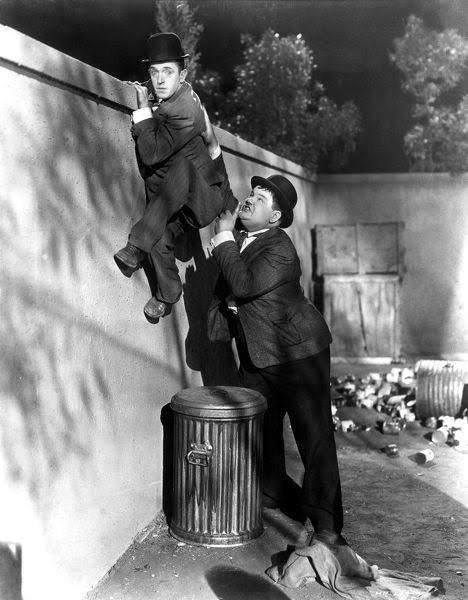
The scene then moves from questionable police procedure into full physical comedy. Kennedy takes the two men to the chief’s house and tells them to be as quiet as possible. He points out the house and leaves them to carry out their assignment.
From this moment on, the plan begins falling apart almost immediately.
The men climb over the wall, trying desperately not to make noise. Their nervousness is obvious, and every little movement becomes an opportunity for another joke.
Then they see something outside.
A cat.
Instead of simply ignoring it, the frightened men decide that perhaps the best strategy is to pretend they are cats themselves.
That decision perfectly captures the absurd logic of the entire scene.
They begin making cat noises while simultaneously trying to carry out a burglary. The humor comes not just from the idea itself but from how seriously they treat it. They are not professional criminals. They are two terrified men who have somehow been persuaded that pretending to be cats is a reasonable way to avoid detection.
The situation continues deteriorating.
They struggle with doors, objects, and tools. One character repeatedly reminds the other that there is nothing to be afraid of because “Kennedy will fix it.” The line becomes a running gag. Every time something goes wrong, Kennedy’s promise becomes less reassuring.
Eventually, they find themselves trapped in an increasingly complicated situation. They need a hammer. They need to move quietly. They need to avoid being discovered. But practically everything they touch seems to create another problem.
The physical comedy is especially effective because the characters never appear fully prepared for what they are doing. Their movements are hesitant and awkward, and their attempts to remain silent somehow make them even more noticeable.
Then comes another interruption.
Someone appears and asks whether they rang.
The response is awkward and defensive. The men are desperately trying to maintain the illusion that nothing unusual is happening.
The chief, meanwhile, is understandably annoyed by the disturbance.
He wants to sleep.
The burglars want to finish the job.
Kennedy wants an arrest.
And none of these goals appear likely to be achieved smoothly.
The sequence then takes another wonderfully absurd turn when music becomes part of the chaos. Someone is apparently playing the piano at an unreasonable hour, leading to even more confusion.
At this point, the original robbery plan has almost completely disappeared beneath layers of misunderstandings and physical comedy.
What makes the scene work so well is the contrast between the seriousness of the characters and the ridiculousness of the circumstances. The police officer is dealing with a career crisis. The two men are facing the possibility of punishment. The chief is trying to protect his home and get some sleep.
Yet everything that happens feels increasingly cartoonish.
The repeated reassurance that Kennedy will “fix it” becomes particularly funny because the audience can see that Kennedy has very little control over anything. His plan depends on several people cooperating, remaining quiet, and behaving predictably. Instead, everyone does exactly the opposite.
Eventually, the noise becomes impossible to ignore.
The police are called.
And suddenly the men discover the obvious consequence of their brilliant assignment: they have been caught.
The chief realizes what is happening, and the situation circles back to the original problem—Kennedy wanted to catch someone robbing the neighborhood.
Now he has exactly what he wanted.
Except the entire situation is so ridiculous that the arrest feels less like a successful police operation and more like the inevitable conclusion of a chain of disasters.
That is the charm of this classic comedy style. The humor does not depend on complicated technology, elaborate special effects, or modern references. It comes from timing, misunderstanding, repetition, physical reactions, and characters making increasingly terrible decisions.
The cat moment is a perfect example. On paper, two burglars pretending to be cats sounds like a simple gag. In performance, however, the awkwardness of the situation makes it far funnier. The same is true of the repeated references to Kennedy fixing everything. The audience knows he cannot possibly control what is happening, which makes every new disaster even more entertaining.
There is also something timeless about the scene. The characters are caught in a situation where everyone has a different goal, yet nobody communicates properly. The policeman wants to impress his chief. The criminals want to avoid punishment. The chief wants peace and quiet. Each character believes they are solving the problem, but their actions only make it worse.
That escalating cycle is one of the oldest and most reliable formulas in comedy.
The scene also demonstrates why physical comedy can remain effective decades after it was originally performed. A confused expression, a delayed reaction, an awkward movement, or an unexpected sound can communicate humor without requiring a lengthy explanation.
And that is exactly what makes this sequence so enjoyable.
It starts with a simple question about a neighborhood robbery.
It ends with a completely ridiculous attempt to manufacture an arrest.
In between, there are frightened burglars, questionable police tactics, a mysterious cat, a hammer, a garbage man, late-night interruptions, a piano, and a rapidly collapsing plan.
The result is classic comedy built around one simple principle: once everything starts going wrong, let it go even further.
That is why scenes like this continue to attract viewers. The story is simple, but the timing and escalating absurdity give it a life of its own. You do not need to know every detail of the original production to understand the joke. You simply watch these characters make one bad decision after another and wait to see how badly the situation can possibly end.
And, naturally, it ends with an arrest.
Just not quite in the way Kennedy imagined.