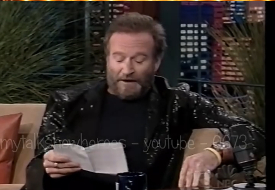
Robin Williams first gained widespread attention through stand-up comedy. His performances quickly revealed a performer with an extraordinary ability to think faster than almost anyone around him. Instead of relying on a fixed routine, he could move from one idea to another with remarkable speed. His mind seemed to create jokes continuously, allowing him to turn simple observations into energetic and unexpected moments of humor.
His stand-up style was highly distinctive because it combined physical comedy, impressions, voices, characters, and spontaneous storytelling. Robin Williams could suddenly change his voice, facial expression, posture, or personality while remaining completely connected to the audience. This unpredictable style gave his performances a sense of excitement. Viewers never knew exactly what he would say or do next, and that uncertainty became one of the most entertaining parts of his comedy.
Another important quality was his ability to observe everyday life from unusual perspectives. He could take ordinary situations and exaggerate them until they became hilarious. Small details about relationships, family life, social behavior, technology, school, or popular culture could become the starting point for an elaborate comedic idea. His imagination allowed him to expand a simple observation into an entire sequence of characters and situations.
Robin Williams also developed a powerful relationship with live audiences. He constantly reacted to the energy in the room, adjusting his delivery and direction according to the audience’s response. Laughter could encourage him to continue an idea, while a different reaction could inspire him to take the joke in another direction. This made his performances feel spontaneous rather than mechanically rehearsed.
His incredible speed of thought became one of his most recognizable trademarks. He could create connections between unrelated ideas almost instantly. One moment he might be discussing an everyday subject, and the next he could transform into a completely different character with a new voice and personality. This ability demonstrated not only his comedic talent but also his exceptional improvisational instincts.
As his reputation grew, Robin Williams became increasingly recognized as a performer who could command a stage through sheer personality. His energy was often intense, but it was supported by careful observation and a strong understanding of comedic timing. He knew how to build momentum, interrupt it with an unexpected line, and then accelerate the performance again.
Stand-up comedy also gave Williams an important foundation for his later acting career. The stage taught him how to control an audience, communicate emotions quickly, develop memorable characters, and remain comfortable with unpredictability. These skills later became valuable when he moved into television and film. His ability to improvise allowed him to bring an unusual level of spontaneity to many of his screen performances.
What made Robin Williams especially memorable was that his comedy was not limited to telling jokes. He created complete worlds through his imagination. A single subject could become a conversation between several imaginary personalities, a dramatic monologue, or a rapid sequence of impressions. His performances often felt like watching a creative mind work in real time.
His stand-up success eventually helped establish him as one of the most recognizable comedic performers of his generation. Audiences were attracted not only to his jokes but also to his extraordinary enthusiasm and emotional openness. Beneath the fast-paced humor was a performer who understood the importance of connecting with people. He could make an audience laugh loudly while also creating moments that felt surprisingly personal.
This early period in stand-up comedy became an essential chapter in Robin Williams’ career. It demonstrated the remarkable versatility that would later define him as both a comedian and an actor. His rise through live comedy showed that he possessed something rare: the ability to transform thought, movement, voice, and emotion into entertainment almost instantly. That combination of creativity and performance skill would eventually help him become a lasting figure in American comedy and popular culture.