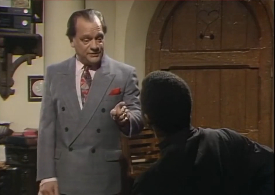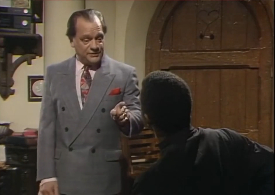
His colorful language and extravagant confidence often suggest that he believes he is much closer to success than he really is. This exaggerated self-belief is one of the central ingredients of Del Boy’s personality, allowing him to transform ordinary situations into grand opportunities. He rarely describes a simple business deal as merely a business deal. Instead, he presents it as the beginning of something enormous, using impressive phrases and confident predictions to convince himself and everyone around him that wealth is just around the corner.
What makes this behavior particularly entertaining is the contrast between Del Boy’s words and the reality surrounding him. He may talk about becoming a wealthy businessman, yet his latest scheme is often based on questionable products, unreliable contacts, or an idea that has little chance of succeeding. His confidence remains remarkably strong even when the evidence suggests otherwise. Rather than allowing failure to change his outlook, Del Boy usually treats disappointment as a temporary obstacle.
This attitude creates some of the sitcom’s most memorable comic situations. Viewers can often recognize that a scheme is going wrong long before Del Boy does. His enthusiasm continues to grow while the circumstances around him become increasingly chaotic. The more complicated the situation becomes, the harder he tries to maintain the appearance of control. His ability to remain confident in completely unsuitable circumstances gives his character a distinctive form of comedy.
Del Boy’s language is also an important part of his personality. He frequently uses ambitious expressions, business terminology, and impressive-sounding phrases to make himself appear more sophisticated than he actually is. His speech gives ordinary conversations an exaggerated sense of importance. Even when he is selling a questionable product or explaining another unrealistic plan, he speaks as though he is addressing the boardroom of a major international company.
This creates a fascinating difference between appearance and reality. Del Boy wants people to see him as successful, intelligent, and financially powerful. However, his surroundings often tell a very different story. His ambitions are much larger than his resources, and his confidence is often much stronger than his practical ability. The comedy comes from watching him attempt to bridge that enormous gap.
Rodney frequently serves as the person who recognizes this contradiction. While Del Boy becomes excited about another opportunity, Rodney is more likely to question the details. He can see the risks that his brother ignores and often understands that Del Boy’s impressive promises are not supported by reality. Their arguments therefore become more than simple sibling disagreements. They represent two very different attitudes toward life.
Del Boy sees possibilities everywhere, while Rodney sees consequences.
This difference is one reason their relationship works so effectively. Del Boy’s optimism pushes the story forward, while Rodney’s skepticism gives the audience a realistic perspective. If both brothers were equally enthusiastic about every scheme, the comedy would lose an important source of tension. Rodney’s reactions allow viewers to appreciate just how unrealistic Del Boy’s expectations have become.
At the same time, Del Boy’s confidence is not presented simply as stupidity. There is a genuine intelligence behind his ability to persuade, improvise, and adapt. He understands people extremely well and knows how to make an opportunity sound attractive. He can read a situation quickly and often finds creative ways to keep a failing plan alive. His problem is that his imagination frequently moves faster than his judgment.
This makes him a more interesting character than a conventional failed businessman. Del Boy is not simply incapable of success. Instead, he repeatedly gets close enough to believe that success is possible, only to discover that his latest shortcut has created another problem. His greatest strength and greatest weakness are therefore connected. His optimism gives him energy, but it also prevents him from recognizing when he should stop.
His determination also reflects a broader theme within Only Fools and Horses: the desire to improve one’s circumstances. Del Boy dreams about wealth because he wants a better life. His schemes may be ridiculous, but the desire behind them is understandable. He wants financial security, social recognition, and the feeling that he has finally moved beyond the limitations of his surroundings.
This makes audiences more willing to sympathize with him. Although his methods are often questionable, his ambition comes from a recognizable human desire. Many people understand what it feels like to imagine a better future while struggling with present difficulties. Del Boy simply expresses that feeling in an unusually loud, dramatic, and entertaining way.
His relationship with success is also closely connected to his need to maintain appearances. He does not merely want money; he wants people to believe that he is already successful. His confidence becomes a kind of performance. When he tells others that everything is going according to plan, he sometimes seems to be convincing himself as much as anyone else.
This performance becomes particularly funny when reality begins to expose the truth. A confident statement can quickly become an embarrassing explanation. A promising business opportunity can become a complete disaster. A moment in which Del Boy appears to be the smartest person in the room can suddenly turn into a situation where everyone realizes that he has misunderstood everything.
Yet even after these failures, he rarely loses his ability to dream. That quality gives the character a remarkable resilience. Failure does not permanently defeat him because he is always looking toward the next opportunity. Tomorrow might bring another idea, another customer, another deal, or another chance to become the successful businessman he imagines himself to be.
This endless optimism is one of the reasons Del Boy remains such an enduring comedy character. His confidence may be extravagant, his plans may be unreliable, and his predictions may regularly prove wrong, but his belief in the possibility of success never completely disappears. He continues to move forward, turning disappointment into another story and failure into another excuse to try again.
Ultimately, Del Boy’s exaggerated confidence is more than a source of jokes. It reveals the character’s hopes, insecurities, ambitions, and determination. Behind the colorful language and grand promises is a man who desperately wants to believe that his circumstances can change. That mixture of confidence and vulnerability gives his comedy emotional depth. He may constantly convince himself that he is only one deal away from becoming wealthy, but his real achievement is something different: he turns every failure into another opportunity to dream.