There are impressions.
And then there are impressions so famous that eventually the comedian gets to perform them next to the person being impersonated.
That is exactly what happened to John Belushi on October 2, 1976.
Joe Cocker walked onto the Saturday Night Live stage to perform “Feelin’ Alright.”
Then another Joe Cocker appeared.
Except this one was John Belushi.
What followed became one of the most memorable musical-comedy moments from SNL’s original era.
Belushi Had Been Doing Cocker Long Before This Night
John Belushi’s Joe Cocker impression wasn’t created specifically for this performance.
In fact, it went back years.
According to Belushi’s official site, he was already performing his Cocker impression while working at Chicago’s Second City in the early 1970s. The act reproduced Cocker’s distinctive voice as well as his highly recognizable physical movements.
It became one of Belushi’s signature pieces.
When Belushi joined the original cast of Saturday Night Live in 1975, television gave him an opportunity to bring the impression to a national audience.
The First SNL Joe Cocker
Belushi performed the character during SNL’s first season.
On October 25, 1975, host Rob Reiner introduced what appeared to be Joe Cocker.
It wasn’t.
It was Belushi.
The SNL transcript records Belushi performing “With a Little Help from My Friends” while throwing himself completely into the impersonation.
And “completely” is the right word.
Belushi didn’t simply imitate Cocker’s voice.
He transformed his entire body.
His arms moved.
His face contorted.
His posture changed.
He stumbled and twisted around the stage.
The performance became physical comedy almost as much as musical parody.
Then SNL Booked the Real Joe Cocker
One year later, the opportunity became irresistible.
For the October 2, 1976 episode, British comedian Eric Idle hosted while Joe Cocker was booked as musical guest.
Cocker performed “You Are So Beautiful.”
But the other major musical number was “Feelin’ Alright.”
And this time SNL had an additional performer waiting.
John Belushi.
Peacock’s official episode listing confirms exactly what happened: Joe Cocker performed with Belushi joining him onstage for “Feelin’ Alright.”
Two Joe Cockers
The visual joke works almost immediately.
There’s Joe Cocker.
Then there’s Belushi behaving like Joe Cocker.
Instead of doing the impression somewhere else in the show, Belushi is standing beside the actual man.
That completely changes the joke.
Now viewers can compare them in real time.
Cocker moves.
Belushi moves.
Cocker sings.
Belushi responds.
The parody and its inspiration exist simultaneously.
Belushi Wasn’t Making Fun of the Music
This is an important part of why the performance remains so enjoyable.
Belushi could actually perform.
His impression was exaggerated, but there was genuine musical ability underneath it.
Joe Cocker himself later acknowledged this.
Speaking years later about Belushi’s impression, Cocker said he found it amusing and specifically complimented Belushi’s vocal imitation.
That changes the nature of the parody.
It wasn’t simply:
“Look how strangely this singer moves.”
Belushi had studied Cocker closely enough to reproduce the whole package — the voice, intensity, gestures and physical commitment.
Joe Cocker Was In on the Joke
That may be the most important element.
Imagine this performance if Cocker appeared irritated.
It would be uncomfortable.
Instead, the real singer allows the situation to happen around him.
He keeps performing.
Belushi keeps exaggerating.
And the audience gets the extraordinary experience of watching a celebrity share the stage with his own parody.
There’s something generous about that.
Cocker didn’t need to pretend Belushi’s impression didn’t exist.
He embraced the moment.
Why Belushi’s Impression Worked
Joe Cocker had an extraordinarily distinctive performance style.
His singing could appear almost physically overwhelming.
That gave Belushi plenty to work with.
But exaggeration alone isn’t enough to make an impression memorable.
The audience still has to recognize the person.
Belushi found the essential details and pushed them just far enough.
That’s what great impressions often do.
They don’t reproduce every detail equally.
They identify the traits an audience already associates with someone and amplify them.
Belushi’s Cocker did exactly that.
John Belushi Was an Extremely Physical Performer
The routine also demonstrates one of Belushi’s greatest strengths.
He used his entire body.
Think about his other famous characters.
Bluto in Animal House.
Samurai Futaba.
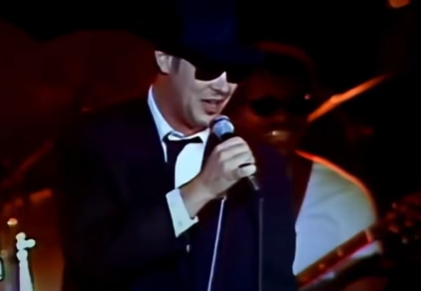
Jake Blues.
His explosive Weekend Update appearances.
Belushi rarely seemed content to deliver comedy only from the neck up.
He jumped.
He fell.
He danced.
He threw himself into scenes.
The Cocker impression gave that physicality a perfect target.
Before Jake Blues Became a Movie Icon
There’s another fascinating aspect to watching this footage today.
This performance happened in 1976.
Animal House wouldn’t arrive until 1978.
The Blues Brothers movie wouldn’t arrive until 1980.
So audiences were watching Belushi before two of the roles most associated with him had reached movie theaters.
Yet many of the ingredients were already visible.
His love of music.
His ability to combine music and comedy.
His physical fearlessness.
His commitment to character.
The Joe Cocker performance contains all of them.
Comedy and Music Were Never Completely Separate for Belushi
That’s something that becomes increasingly obvious when looking across Belushi’s career.
For some comedians, music is simply another thing to parody.
For Belushi, music became part of his comedy identity.
His Cocker impression required musical performance.
Later, Jake Blues would push that connection much further.
Belushi wasn’t merely pretending to be a musician.
With the Blues Brothers, he became the frontman of a real touring act surrounded by accomplished musicians.
That makes this Cocker duet feel almost like an early chapter in a larger story.
SNL Was the Perfect Place for It
Early Saturday Night Live could combine sketch comedy and live music in ways conventional sitcoms couldn’t.
Musicians weren’t separated from the comedians by an invisible wall.
The show could let those worlds collide.
The October 2 episode is a perfect example.
The SNL transcript lists the segment simply as Joe Cocker & Joe Cocker (John Belushi) performing “Feelin’ Alright.”
That description alone explains why the idea is funny.
Joe Cocker.
And Joe Cocker.
A Moment That Became Part of SNL History
The duet continues to appear in retrospectives about the show’s early years.
It captures something difficult to recreate:
a performer who had become famous for impersonating someone finally meeting that person onstage through the impression itself.
And because Cocker participated willingly, the scene never becomes hostile.
It feels celebratory.
Belushi is exaggerating him.
But he’s also clearly fascinated by him.
Why This Clip Is Excellent for Short-Form Video
For your Facebook audience, this particular clip has an unusually strong hook.
Even before viewers know the history, the visual raises a question:
Why are these two men performing almost the same way?
Then the context makes it even better.
One is Joe Cocker.
The other is John Belushi pretending to be Joe Cocker while standing beside Joe Cocker.
That’s a story that can be explained in one sentence.
And that’s ideal for social media.
Almost Fifty Years Later
The performance took place on October 2, 1976.
Nearly half a century later, the premise still feels wonderfully audacious.
Most impressionists perform their parody for the celebrity.
John Belushi did something better.
He performed it with him.
Joe Cocker kept singing.
Belushi kept becoming increasingly Belushi.
And television captured a moment where parody and reality stood side by side at the same microphone.
One Joe Cocker was already unforgettable.
SNL decided the world needed two.