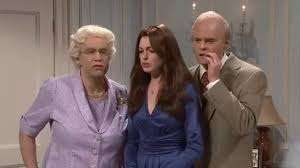
Anne Hathaway delivered one of the funniest royal comedy performances on Saturday Night Live when she portrayed Kate Middleton meeting Prince William’s grandparents, only to discover that Queen Elizabeth II and Prince Philip were nothing like their elegant public images.
The unforgettable sketch aired on November 20, 2010, just days after Prince William and Kate Middleton announced their engagement.
With Hathaway portraying the future royal bride, Andy Samberg playing Prince William, Fred Armisen transforming into Queen Elizabeth II, and Bill Hader appearing as Prince Philip, Saturday Night Live turned one of the world’s biggest celebrity news stories into an outrageous comedy.
What begins as a formal royal introduction quickly becomes a chaotic encounter filled with exaggerated accents, unexpected threats, and a completely ridiculous version of Britain’s most famous family.
The sketch arrived at the perfect moment because the world was fascinated by Prince William and Kate Middleton’s engagement.
On November 16, 2010, the couple officially announced their plans to marry.
The news immediately generated enormous international attention.
Television networks, newspapers, and entertainment programs began discussing the future royal wedding.
Only four days later, Saturday Night Live transformed that excitement into a comedy sketch.
Anne Hathaway was an especially entertaining choice to portray the future royal bride.
The actress had already established herself as a major Hollywood star through movies such as The Princess Diaries, The Devil Wears Prada, and Rachel Getting Married.
Her experience playing a fictional princess made her appearance as Kate Middleton particularly amusing.
Audiences were familiar with Hathaway’s ability to combine elegance, humor, and expressive reactions.
Those qualities became essential to the sketch.
The performance begins inside Buckingham Palace, where Prince William prepares to introduce Kate to his grandparents.
Andy Samberg portrays William as polite, formal, and eager to make a good impression.
Hathaway’s Kate appears equally respectful.
She understands the importance of meeting Queen Elizabeth and Prince Philip.
Everything initially suggests a traditional royal family conversation.
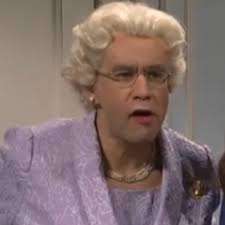
Fred Armisen’s Queen Elizabeth appears to embody the formality associated with the British monarchy.
She sits with the composure expected of a reigning monarch.
Her speech is measured.
Her manner is reserved.
Her carefully controlled expressions reinforce the impression of royal dignity.
At first, there is little indication that this version of the Queen has a completely different personality waiting to emerge.
Bill Hader’s Prince Philip appears equally committed to maintaining the royal family’s formal image.
He speaks politely and follows the expected social conventions.
His behavior suggests that he and the Queen are pleased to welcome their grandson’s fiancée.
Together, Armisen and Hader create an exaggerated version of the traditional royal couple.
Their restrained performances establish the perfect setup for the surprise that follows.
Anne Hathaway’s Kate Middleton approaches the meeting with genuine enthusiasm and respect.
She speaks warmly about her relationship with William.
She expresses appreciation for the opportunity to join the family.
Her carefully chosen words reflect the pressure of meeting two of the world’s most recognizable public figures.
Hathaway portrays Kate as someone determined to make the right impression.
Prince William’s presence initially keeps the conversation calm and respectable.
Samberg’s character appears completely unaware of any unusual family behavior.
He treats his grandparents as affectionate and dignified members of the monarchy.
His confidence reassures Kate.
But the audience is about to discover that William’s understanding of his grandparents is hilariously incomplete.
The entire sketch changes when Prince William leaves the room.
William briefly excuses himself, leaving Kate alone with Queen Elizabeth and Prince Philip.
The moment creates a dramatic shift.
The royal couple no longer needs to maintain its polished public appearance.
Their behavior changes almost immediately.
Queen Elizabeth suddenly drops her refined accent and begins speaking in an exaggerated Cockney voice.
Fred Armisen transforms the character in seconds.
The quiet, dignified monarch becomes loud, confrontational, and unexpectedly aggressive.
Her body language changes.
Her facial expressions become sharper.
Her entire personality seems to belong to someone completely different.
Bill Hader’s Prince Philip undergoes an equally ridiculous transformation.
He abandons his formal speech and joins the Queen in an exaggerated working-class London accent.
The two characters begin behaving like intimidating neighborhood troublemakers rather than members of the royal family.
Their sudden transformation creates the sketch’s biggest comedic surprise.
The contrast between their public and private personalities is deliberately absurd.
Kate Middleton is completely unprepared for the personalities that emerge.
Hathaway reacts with visible confusion.
She had expected a polite conversation about marriage and royal traditions.
Instead, she finds herself being questioned by two unexpectedly aggressive characters.
Her bewilderment becomes one of the funniest elements of the scene.
The Queen immediately makes it clear that Kate is entering a family with very unusual expectations.
Armisen’s character begins challenging Kate’s intentions.
She questions whether the future bride understands what joining the monarchy really means.
Her comments become increasingly confrontational.
The joke is that the Queen behaves less like a grandmother welcoming a new family member and more like a territorial gang leader protecting her position.
Prince Philip enthusiastically supports the Queen’s aggressive questioning.
Hader’s character echoes her concerns and adds his own intimidating remarks.
The two performers work together as a comedic team.
Their shared accent and exaggerated attitudes make them seem like characters from an entirely different television program.
The effect is intentionally ridiculous.
The sketch turns the traditional idea of royal etiquette completely upside down.
Instead of teaching Kate how to behave at formal events, the Queen focuses on maintaining her authority.
Instead of offering gentle advice, Prince Philip helps intimidate the future bride.
Their behavior has almost nothing in common with the public image of the monarchy.
That contrast provides the foundation for the comedy.
Fred Armisen makes the Queen especially funny by combining regal appearance with unexpectedly rough behavior.
He remains dressed as Queen Elizabeth.
The character still occupies an elegant palace setting.
But her language, gestures, and attitude are dramatically different from what audiences expect.
The visual contrast makes every exaggerated reaction more entertaining.
Bill Hader matches Armisen’s energy with an equally committed performance.
Hader was already known for his ability to portray unusual characters and deliver convincing comic impressions.
As Prince Philip, he embraces the absurd premise completely.
His exaggerated accent and expressive reactions complement Armisen’s performance.
Together, they create a believable comedy partnership within an intentionally unbelievable situation.
The royal couple’s hostility becomes even funnier because Kate continues trying to remain polite.
Hathaway does not immediately abandon her formal manners.
Her character attempts to understand what is happening.
She responds cautiously while the Queen and Prince Philip become increasingly aggressive.
The contrast between Kate’s restraint and their chaotic behavior creates a steady rhythm of laughs.
One of the sketch’s central jokes is the Queen’s determination to protect her royal status.
Armisen’s character behaves as though Kate might arrive at Buckingham Palace and attempt to take over.
She treats the future marriage as a challenge to her personal authority.
The idea is absurd, particularly because Kate is simply trying to make a good impression.
That exaggerated suspicion gives the Queen a distinctive comic personality.
The Queen also makes a memorable joke about Kate’s connection to The Princess Diaries.
The reference is especially funny because Anne Hathaway starred in the 2001 Disney film and its 2004 sequel.
In those movies, Hathaway portrayed Mia Thermopolis, an ordinary teenager who discovers that she is a princess.
The SNL sketch deliberately contrasts that fictional royal fantasy with its own outrageous version of palace life.
The joke connects Hathaway’s movie career directly to the character she is playing.
The Princess Diaries reference becomes one of the sketch’s cleverest celebrity jokes.
Audiences familiar with Hathaway’s films immediately understand the connection.
Her fictional princess had to learn royal etiquette and adapt to an unfamiliar lifestyle.
Now her portrayal of Kate Middleton faces an entirely different kind of royal education.
The unexpected comparison makes the scene especially entertaining.
The Queen’s attitude becomes increasingly territorial as she explains the rules of the family.
She makes it clear that Kate will not simply arrive and begin exercising authority.
Armisen’s delivery gives the warning a ridiculous intensity.
The character appears deeply suspicious of anyone who might challenge her position.
The exaggerated behavior turns royal succession and palace etiquette into a comedy about personal rivalry.
Prince Philip behaves like the Queen’s enthusiastic partner in intimidation.
He reinforces her statements and reacts dramatically to Kate’s answers.
Their interactions suggest that they have been behaving this way privately for years.
The sketch never attempts to explain why they have such unusual personalities.
Instead, it treats their behavior as a secret that only emerges when William leaves the room.
The comedy becomes even more effective because Prince William appears completely unaware of the situation.
Samberg portrays him as a polite grandson who believes his grandparents are perfectly respectable.
His character has no reason to suspect what happens in his absence.
That dramatic irony allows the audience to enjoy a secret that William does not understand.
The sketch builds anticipation around whether he will discover the truth.
The Queen and Prince Philip continue challenging Kate while she struggles to maintain her composure.
Hathaway’s expressions communicate a mixture of disbelief and concern.
She appears uncertain whether she should answer their questions seriously.
Her reactions make the exaggerated royal characters seem even more ridiculous.
The scene depends on her ability to play the situation straight while the others behave outrageously.
The contrast between the palace setting and the characters’ behavior creates an important visual joke.
Buckingham Palace represents tradition, ceremony, and established social rules.
The room is designed to suggest royal elegance.
Yet the Queen and Prince Philip behave like aggressive characters from a street comedy.
The mismatch between environment and personality makes the sketch instantly recognizable.
Fred Armisen’s exaggerated Cockney accent becomes one of the performance’s defining features.
The character’s sudden change in speech signals that the polite royal persona has disappeared.
His delivery becomes faster and more forceful.
The accent is deliberately theatrical rather than a serious attempt at portraying Queen Elizabeth.
It reinforces the sketch’s absurd alternative version of the monarchy.
Bill Hader’s matching accent helps establish the royal couple as a united comedic force.
His Prince Philip does not simply react to the Queen.
He participates enthusiastically in the intimidation.
The two characters share a rhythm that makes their exchanges feel coordinated.
Their performances give the impression of a long-established partnership.
The sketch also uses the difference between public appearances and private behavior as a central comedic idea.
Public figures are often expected to maintain carefully controlled images.
Royal family members face particularly intense expectations regarding etiquette and tradition.
SNL imagines the most extreme possible contrast.
Behind the palace doors, the characters abandon everything associated with their public identities.
The humor does not depend on viewers believing that the real Queen Elizabeth behaved this way.
The premise is obviously fictional.
The comedy comes from imagining a completely impossible private personality.
The more extreme the behavior becomes, the funnier the contrast with royal tradition.
That exaggerated approach allows the sketch to parody celebrity culture without presenting itself as reality.
Anne Hathaway’s performance provides the essential balance that keeps the scene entertaining.
If Kate reacted with the same exaggerated energy as the Queen and Prince Philip, the sketch would lose much of its contrast.
Instead, Hathaway remains comparatively restrained.
Her confusion gives the audience someone to identify with.
She becomes the ordinary person trying to survive an extraordinary social encounter.
The performance also demonstrates Andy Samberg’s ability to support a comedy sketch without dominating it.
His portrayal of Prince William establishes the formal atmosphere.
He plays the character as polite and unaware.
His absence allows the Queen and Prince Philip to reveal their secret personalities.
His eventual return becomes important because it forces another change in their behavior.
When William returns, the Queen and Prince Philip immediately resume their formal royal personalities.
The transformation happens just as suddenly as the earlier change.
Their rough accents disappear.
Their expressions become composed.
They once again behave like dignified members of the monarchy.
The rapid reversal provides another major laugh.
Kate is left trying to understand how the two royals can change personalities so quickly.
Hathaway’s character has witnessed an astonishing private confrontation.
But William sees only his grandparents behaving normally.
Kate must now decide how to respond without creating an awkward situation.
Her bewilderment becomes the final element of the joke.
The sudden return to royal politeness gives the sketch a perfect comedic structure.
It begins with formality.
It introduces an unexpected secret.
The situation escalates through increasingly absurd behavior.
Then the characters return to their original public identities.
The contrast makes the ending satisfying.
The sketch became one of the memorable moments from Anne Hathaway’s November 2010 hosting appearance.
Hathaway was hosting Saturday Night Live during the show’s thirty-sixth season.
The episode also featured musical guest Florence and the Machine.
Throughout the evening, Hathaway participated in several different comedy sketches.
Her Kate Middleton performance stood out because it connected directly to a major international news story.
The timing was particularly important because the royal engagement had been announced only days earlier.
SNL has a long tradition of transforming current events into comedy.
The engagement provided an immediately recognizable subject.
Viewers were already familiar with photographs of William and Kate and discussions of the upcoming wedding.
The sketch used that public awareness to establish its premise quickly.
The royal parody also became the beginning of a recurring SNL comedy concept.
Fred Armisen and Bill Hader later returned to portray their exaggerated versions of Queen Elizabeth and Prince Philip.
The characters appeared in additional sketches involving other celebrities and royal events.
Their recurring appearances demonstrated that the original idea had enough comic potential to be revisited.
The creative team behind the royal sketches included Fred Armisen, Bill Hader, and John Mulaney.
The performers and writer helped develop the exaggerated personalities of the royal couple.
Their approach combined absurd characterization with topical celebrity comedy.
The result was a distinctive interpretation of the monarchy that became recognizable to SNL audiences.
The characters’ exaggerated private behavior remained the defining joke.
The original 2010 sketch established the personalities that made the later appearances possible.
Armisen’s Queen was intimidating, unpredictable, and fiercely protective of her authority.
Hader’s Prince Philip was equally confrontational.
Together, they behaved like a comedy duo hiding behind royal titles.
The characters could be placed into different situations while maintaining the same basic joke.
In a later sketch, the fictional royal couple confronted Elton John before William and Kate’s wedding.
The appearance continued the idea that the Queen and Prince Philip secretly behaved like aggressive troublemakers.
The characters’ established personalities made the new situation immediately recognizable.
Viewers familiar with the original Kate Middleton sketch understood the joke.
The recurring format allowed SNL to expand its royal parody.
Another later appearance featured Katy Perry in a royal family sketch.
The show again used the fictional Queen and Prince Philip to create an exaggerated family confrontation.
The recurring characters had become an established comedy concept.
Their continued popularity demonstrated the appeal of the original premise.
The royal family setting offered opportunities for new jokes while preserving the same unusual personalities.
The Kate Middleton sketch also remains an interesting example of Anne Hathaway’s versatility as a performer.
She was already known for dramatic roles, romantic comedies, and musical performances.
SNL allowed her to demonstrate a different set of skills.
She had to respond naturally to unpredictable comedic characters.
Her controlled reactions helped make the exaggerated performances around her more effective.
Hathaway’s connection to The Princess Diaries gave the parody an additional layer of entertainment.
Many viewers associated her with the story of an ordinary young woman becoming royalty.
Kate Middleton’s engagement offered a real-world version of someone preparing to enter a royal family.
SNL exaggerated that similarity for comedy.
The resulting joke became one of the most memorable references in the sketch.
Fred Armisen’s performance remains particularly distinctive because of his commitment to the absurd transformation.
He does not simply change his accent.
He changes the Queen’s entire personality.
His gestures, expressions, and delivery become dramatically different.
The contrast makes the character feel like two separate people sharing the same costume.
That complete transformation is central to the humor.
Bill Hader provides an equally important performance by making Prince Philip just as outrageous.
His character reinforces the Queen’s aggressive personality.
He responds enthusiastically to her comments.
The two actors maintain their shared comedic energy throughout the scene.
Their partnership is one of the sketch’s strongest elements.
The performance works because the three central characters occupy completely different emotional positions.
The Queen is confrontational.
Prince Philip supports her behavior.
Kate is confused and intimidated.
Those contrasting personalities create a clear comedic dynamic.
Every exchange reinforces the difference between what Kate expected and what she actually experiences.
The sketch also offers a playful commentary on the pressures surrounding royal marriage.
Joining a famous family involves expectations, traditions, and public scrutiny.
SNL takes those concerns and exaggerates them into an absurd confrontation.
Kate is not simply meeting her future husband’s relatives.
She is facing a ridiculous version of palace politics.
The exaggeration turns an intimidating social situation into comedy.
The setting makes the premise accessible even to viewers who do not follow British royal news closely.
Most audiences understand the idea of meeting a partner’s family for the first time.
The situation can be awkward even under ordinary circumstances.
SNL imagines that experience taking place inside Buckingham Palace.
Then it makes the grandparents impossibly intimidating.
The familiar social situation helps make the absurdity relatable.
The sketch’s continued popularity reflects the timeless appeal of unexpected character transformations.
Audiences enjoy watching a character reveal a personality completely different from the one initially presented.
Armisen and Hader execute that transformation with remarkable confidence.
Hathaway’s reactions make the surprise more entertaining.
The result remains funny even when viewers already know what is coming.
The official SNL video has introduced the performance to audiences who may not remember the original 2010 broadcast.
The clip was uploaded to YouTube in October 2013.
Online viewers could discover the royal parody independently of the full television episode.
Its recognizable characters and simple premise made it easy to enjoy as a standalone sketch.
The performance continued reaching new audiences long after the engagement news had passed.
The sketch also captures a distinctive moment in celebrity culture before William and Kate’s 2011 wedding.
At the time, the couple’s engagement was a major international event.
The public was fascinated by the future bride and her introduction to royal life.
SNL used that excitement as the foundation for a fictional comedy.
The result became a humorous record of the media atmosphere surrounding the engagement.
The performance is especially memorable because it avoids complicated storytelling.
The setup is straightforward.
Kate meets William’s grandparents.
William leaves.
The grandparents reveal their outrageous secret personalities.
William returns, and everything appears normal again.
That simple structure allows the actors’ performances to carry the comedy.
The most successful moments come from the contrast between elegance and chaos.
The royal costumes and palace setting suggest tradition.
The Queen and Prince Philip behave like unruly troublemakers.
Kate struggles to respond.
William remains unaware.
Every element contributes to the same central joke.
More than fifteen years after its original broadcast, the sketch remains a memorable example of Saturday Night Live’s ability to parody major cultural moments.
It transformed an internationally celebrated engagement into a ridiculous fictional encounter.
It gave Anne Hathaway an opportunity to demonstrate her comedic timing.
It allowed Fred Armisen and Bill Hader to introduce a memorable pair of recurring characters.
And it turned the familiar idea of meeting future in-laws into an unforgettable royal nightmare.
Ultimately, Kate Middleton Meets the Real Royal Family succeeds because it combines a perfectly timed celebrity parody with outstanding comic performances.
Anne Hathaway brings charm and believable confusion to her portrayal of Kate Middleton.
Andy Samberg establishes the polite, unsuspecting Prince William.
Fred Armisen transforms Queen Elizabeth into an outrageous fictional character.
Bill Hader matches him as an equally unpredictable Prince Philip.
Together, they create a sketch built around one brilliantly absurd idea: what if the world’s most formal royal couple became completely different people whenever their grandson left the room?
From the shocking accent changes to the exaggerated palace confrontation and the sudden return to royal politeness, the performance remains a hilarious reminder of why Saturday Night Live has been such an enduring force in American television comedy.