THE MOST UNCOMFORTABLE JOKE CAN SOMETIMES REVEAL THE BIGGEST TRUTH.
A Sketch That Dares to Go Too Far
Some comedy sketches make you smile, some make you laugh until you can barely breathe, and others leave you sitting in silence, trying to process what you have just witnessed.
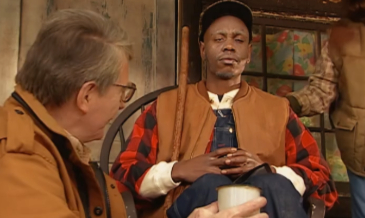
Clayton Bigsby, the unforgettable character from Chappelle’s Show, belongs to that final category.
Built around an outrageous premise, the sketch introduces viewers to a blind white supremacist who does not know that he is Black.
It is the kind of concept that immediately makes people question where the story could possibly go.
Yet Dave Chappelle takes this provocative idea and transforms it into a biting satire about racism, prejudice, identity, and the absurdity of judging people through deeply ingrained beliefs.
For longtime fans of classic sketch comedy, this remains one of the most daring and conversation-provoking moments associated with Chappelle’s Show.
The Premise That Changes Everything
At first glance, the setup sounds almost impossible to believe.
Clayton Bigsby is presented as a man whose worldview is built around racial hatred, despite his inability to see the very physical characteristic that forms the foundation of his prejudice.
That contradiction becomes the engine driving the sketch.
Rather than relying entirely on random jokes or exaggerated physical comedy, the writing builds its humor around a disturbing irony.
The audience understands something that the character himself cannot recognize, creating an uncomfortable gap between what is happening and what Clayton believes to be true.
Every new detail makes that gap more difficult to ignore.
The result is comedy that works on multiple levels, inviting laughter while exposing the irrational foundations of racism.
Dave Chappelle’s Fearless Performance
One of the most memorable elements of the sketch is Dave Chappelle’s commitment to the character.
His performance depends on maintaining Clayton’s conviction, allowing the audience to experience the full absurdity of a person whose beliefs remain unquestioned even when the situation itself exposes their contradictions.
Chappelle does not simply ask viewers to laugh at an eccentric character.
He constructs a situation in which the character’s own certainty becomes part of the joke.
That distinction is important.
The sketch’s satirical target is not merely an individual with outrageous opinions, but the broader logic of prejudice and the ways people can cling to beliefs without examining the evidence in front of them.
This approach gives the performance a lasting impact beyond its immediate shock value.
When the Shock Turns Into Laughter
The comedy develops through anticipation.
Viewers begin with the central contradiction, then wait for the next revelation that could make the situation even more unbelievable.
The tension comes from knowing how absurd the premise is while watching Clayton behave as though his worldview makes perfect sense.
An imagined audience reaction captures the feeling: “How can he believe this?”
That question is at the heart of the sketch’s humor.
The more confidently Clayton expresses his beliefs, the more obvious the contradiction becomes to everyone watching.
The laughter comes from surprise, disbelief, and the uncomfortable recognition that the situation is exposing something much larger than one fictional character.
Rather than depending on a single punchline, the sketch builds its impact through the relationship between the character’s certainty and the audience’s understanding.
Why the Sketch Is More Than Shock Comedy
Provocative comedy can easily become empty when its only purpose is to offend or surprise.
Clayton Bigsby stands out because its central premise serves a recognizable satirical purpose.
The sketch asks viewers to consider how racial prejudice can survive even when it contradicts reality.
It also highlights the role of identity, social conditioning, and unquestioned assumptions in shaping the way people understand the world.
By taking those issues to an extreme, Chappelle makes the contradiction impossible to overlook.
The humor is deliberately uncomfortable, and that discomfort is part of its design.
Viewers may laugh at the absurdity of the character while simultaneously confronting the ugliness of the beliefs he represents.
That combination is what gives the sketch its distinctive edge.
The Art of Building Tension Through Satire
Strong sketch comedy often depends on timing, escalation, and the careful release of tension.
In this case, the central joke is established early, but the audience remains curious about how far the writers will push it.
Each development invites another question.
Will the contradiction become even more obvious?
Will Clayton recognize what the audience already understands?
How will the situation resolve itself without losing the satirical force of the premise?
These questions help sustain attention throughout the performance.
The sketch demonstrates how a simple conceptual twist can support a much larger comedic structure when the writing and performance remain focused on the same central idea.
It also illustrates why timing matters so much in comedy.
A revelation delivered too early might weaken the buildup, while one that arrives at precisely the right moment can make the entire premise feel even more outrageous.
Why Fans Still Remember Chappelle’s Show
For many viewers, Chappelle’s Show represents a distinctive period in American television comedy.
The series became known for sketches that approached race, celebrity culture, politics, and everyday social behavior with an irreverent and often confrontational perspective.
Clayton Bigsby is frequently remembered as one of its boldest examples because it combines an instantly recognizable premise with a subject that demands more than superficial treatment.
The sketch also demonstrates the appeal of comedy that encourages discussion after the laughter fades.
Some viewers may remember the shocking setup first.
Others may focus on the writing, the character’s unwavering conviction, or the uncomfortable social commentary beneath the jokes.
That range of reactions helps explain why the sketch continues to attract attention among fans exploring classic television comedy.
Why This Kind of Comedy Still Sparks Debate
Comedy changes as audiences, cultural expectations, and public conversations evolve.
A sketch created for one era may be interpreted differently by viewers watching it years later.
That does not mean every joke works the same way for everyone, or that controversial comedy should be beyond criticism.
Instead, revisiting a sketch like Clayton Bigsby offers an opportunity to examine how satire uses exaggeration to challenge assumptions and provoke uncomfortable questions.
The key distinction is understanding what the joke is targeting.
Here, the character’s racism and the contradictions underlying his beliefs form the center of the satire.
For some viewers, that approach makes the sketch particularly effective.
For others, its subject matter may remain difficult to watch.
Both reactions demonstrate how comedy can function as entertainment while also becoming part of a larger cultural conversation.
A Lasting Example of Bold Sketch Comedy
The most memorable sketches are not always the ones that offer the easiest laughs.
Sometimes, they are the ones that take a single outrageous idea and develop it into something viewers continue discussing long after the final scene.
Clayton Bigsby achieves its impact through a combination of provocative writing, committed performance, escalating irony, and a subject that remains socially significant.
It is a reminder that satire can entertain audiences while exposing the contradictions hidden inside deeply held beliefs.
For fans of Dave Chappelle, classic television, and controversial comedy, this sketch remains a notable example of the creative risks that helped define Chappelle’s Show.
Watch the Full Clayton Bigsby Sketch
Reading about the premise only tells part of the story.
The real experience comes from watching the performance unfold, observing how the character’s certainty drives the satire, and seeing how the sketch develops its central contradiction.
If you enjoy comedy that combines unexpected twists with sharp social commentary, this is a clip worth revisiting.
Watch it for the outrageous premise, stay for the escalating irony, and consider the message behind the laughter.
WATCH THE FULL VIDEO BELOW AND EXPERIENCE THE SKETCH FOR YOURSELF!