SOME COMEDY MAKES YOU LAUGH — THIS SKETCH MAKES YOU QUESTION EVERYTHING.
The Setup That Changes Everything
Imagine a comedy sketch that begins with an already outrageous premise and somehow becomes even more unbelievable with every passing moment.
That is the unforgettable experience of Clayton Bigsby, the fictional character at the center of one of the most provocative sketches from Chappelle’s Show.
Dave Chappelle created a character whose contradictory identity becomes the foundation of a daring satire about racism, prejudice, and the absurdity of judging people by racial stereotypes.
The result is not simply a sequence of shocking jokes.
It is a carefully constructed comedy performance that uses surprise, discomfort, and escalating absurdity to challenge the audience’s expectations.
Who Is Clayton Bigsby?
Clayton Bigsby is introduced as a blind white supremacist who believes he is white, despite actually being a Black man.
The contradiction is the central engine of the sketch.
Because Clayton cannot see his own appearance, he has developed an identity based on the beliefs and prejudices surrounding him rather than on the reality that others can observe.
This extraordinary premise creates a situation that is simultaneously absurd and deeply uncomfortable.
The audience understands the contradiction, while Clayton remains convinced that his worldview is correct.
That dramatic irony makes every statement and interaction more unpredictable.
Instead of relying on a single punchline, the sketch builds an entire satirical scenario around the distance between what Clayton believes and what everyone else can see.
Dave Chappelle’s Fearless Approach to Satire
One reason the Clayton Bigsby sketch remains memorable is Dave Chappelle’s willingness to explore difficult subjects through uncomfortable comedy.
The performance does not treat racism as a harmless misunderstanding.
Instead, it exposes the absurdity of racial hatred by creating a character whose beliefs collapse under the weight of the central contradiction.
Chappelle’s performance depends on commitment.
Clayton speaks and behaves as though his convictions are entirely reasonable, which makes the situation increasingly ridiculous to anyone who recognizes the truth.
The character is not funny because racism itself is harmless.
The satire comes from exposing the irrationality of racist ideology and the contradictions that sustain it.
That distinction is essential to understanding why the sketch provokes such strong reactions.
How the Comedy Builds Toward the Unbelievable Reveal
The sketch works because it carefully controls what the audience knows.
From the beginning, viewers understand something that Clayton does not.
That knowledge creates anticipation.
Every new detail invites the audience to imagine what might happen if the contradiction becomes impossible to ignore.
The humor grows through dramatic irony, increasingly uncomfortable situations, and the confidence with which Clayton expresses his beliefs.
Rather than immediately exhausting its premise, the sketch lets the absurdity develop.
The longer Clayton maintains his worldview, the more ridiculous the situation becomes.
This gradual escalation is one of the reasons the sketch can still surprise people who already know its basic premise.
The central joke is familiar, but watching the character navigate the consequences of his beliefs gives the scenario its momentum.
The Moment That Makes Audiences Do a Double Take
The most striking element of Clayton Bigsby is the gap between the character’s certainty and the r
eality surrounding him.
That gap transforms ordinary exchanges into moments of tension.
Viewers are not simply waiting for another joke.
They are waiting to discover how far the situation can go before the contradiction overwhelms everything else.
The sketch uses that anticipation to create a distinctive rhythm.
A statement that might seem ordinary in another context becomes outrageous because of what the audience already knows.
A new revelation adds another layer of disbelief.
The resulting comedy can produce laughter, shock, and discomfort almost simultaneously.
It is an example of how a strong comedic premise can generate an entire chain of reactions without depending exclusively on rapid-fire punchlines.
Why the Sketch Is More Than Shock Comedy
At first glance, the premise may seem designed purely to provoke.
However, the sketch has a more specific satirical target.
It challenges the assumptions, stereotypes, and ideological contradictions that allow racism to persist.
Clayton’s blindness functions as a central device in the satire, but the deeper joke concerns the beliefs that shape his identity.
His certainty makes the character ridiculous, while the surrounding situation encourages viewers to examine the logic behind racial prejudice.
The sketch does not ask the audience to accept Clayton’s worldview.
It invites viewers to recognize how absurd that worldview becomes when its contradictions are made impossible to ignore.
That is what separates pointed satire from shock comedy that exists only to offend.
The uncomfortable premise serves a larger comedic argument.
The Power of Dave Chappelle’s Performance
A concept this unusual requires a performer who can maintain the character’s conviction without undermining the joke.
Chappelle approaches Clayton with a level of seriousness that strengthens the absurdity.
The character behaves as though his beliefs are perfectly normal, allowing the contradiction to do much of the comedic work.
That commitment is crucial.
If the performance constantly signaled that Clayton understood the joke, the central dramatic irony would lose its force.
Instead, the audience is left to process the situation while the character continues moving forward with complete confidence.
This contrast gives the sketch its unusual energy.
It also demonstrates Chappelle’s ability to build comedy around character, timing, and an audience’s awareness of information that the character lacks.
Why Viewers Still Talk About This Chappelle’s Show Classic
Comedy changes with time, and sketches involving race can generate very different reactions depending on the audience and the cultural context.
Yet Clayton Bigsby remains a frequently discussed example of provocative television satire because its central contradiction is so immediately recognizable.
The sketch creates a strong reaction before viewers have time to settle into a comfortable interpretation.
Some people respond to its audacity.
Others focus on its criticism of racial ideology.
Many find themselves moving between laughter and discomfort as the consequences of the premise become clearer.
That combination is part of what makes the sketch memorable.
It does not offer the easy comfort of a joke with no larger implications.
Instead, it uses an outrageous fictional character to expose the absurdity of deeply held prejudice.
A Reminder of What Character-Driven Comedy Can Accomplish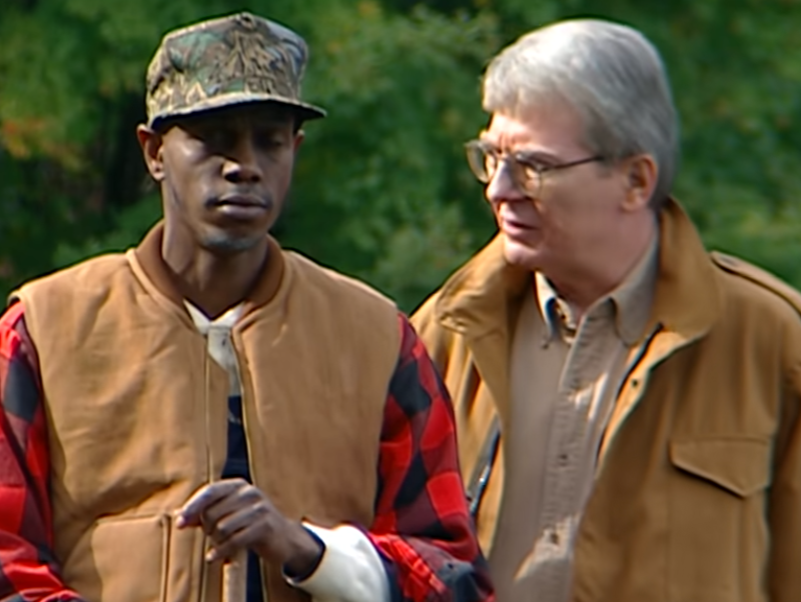
One reason classic sketches remain worth revisiting is that a strong character can make a familiar subject feel unexpectedly new.
Clayton Bigsby is built around a contradiction, but the sketch continues to develop that contradiction through performance and dramatic irony.
The result is more than a collection of isolated punchlines.
It is a complete comedic scenario with a clear premise, escalating tension, and a reveal that changes how viewers understand everything that came before it.
Modern comedy continues to explore controversial subjects, and bold satire has not disappeared.
Still, sketches that commit so completely to a single uncomfortable premise can feel distinctive in an era when audiences encounter countless short clips and jokes every day.
The Clayton Bigsby sketch demonstrates how a carefully developed idea can remain in the conversation long after its original broadcast.
Watch the Clayton Bigsby Sketch Below
If you enjoy Dave Chappelle’s sharpest character work, controversial comedy, and sketches that challenge audiences to think while they laugh, this performance deserves your attention.
Watch how the premise develops, notice the contrast between Clayton’s certainty and the audience’s knowledge, and see how the escalating absurdity creates the sketch’s unforgettable impact.
Whether you are revisiting Chappelle’s Show or discovering this classic for the first time, the experience is best enjoyed by watching the complete performance rather than relying on a summary.
The setup is outrageous, the satire is fearless, and the central contradiction is impossible to forget.
Press play below and experience one of the most talked-about sketches in Chappelle’s Show history.
WATCH THE FULL VIDEO HERE 👇